
Hello everyone, I have the following concern:
I want to install a steel wall bracket for a 70 kg (154 lbs) heavy punching bag. According to the building specifications of our terraced house (built 1989, NRW), the following applies to the wall (1st floor; facing the neighbor):
,,All load-bearing walls are constructed from masonry, and where necessary, concrete." ,,The exterior walls are insulated with a 6 cm (2.4 inches) thick core insulation mat and faced with an 11.5 cm (4.5 inches) thick sand-lime brick veneer."
Slightly offset from each other, I made 4 test drillings (3 mm, about 10 cm (4 inches) deep) through the textured wallpaper using a masonry drill bit and could not detect any cavities. In my opinion, the "masonry" consists of solid sand-lime bricks.
Is there a risk that it might actually be hollow or perforated brick? If so, how can I ensure this (more test drillings)?
The punching bag bracket has 6 M10 holes for wall mounting (4 on top, 2 on the bottom). Included in the delivery were 6 screws M8x60 and 6 matching metal expansion anchors (probably only for concrete fixing?). However, these do not seem very secure to me because of their short length. Considering the punching bag will cause significant vibrations... I recently came across anchor rods and injection mortar (e.g. FIS A+V by Fischer) online. Is this the right solution for my problem or overkill? How long should/can the threaded rods be, would M8x110 be okay? About 1.5 cm (0.6 inches) should protrude from the wall. And would I also need anchor sleeves made of plastic or metal?
If relevant, the punching bag is 1.80 m (5 ft 11 in) tall, the wall bracket extends 60 cm (24 inches) from the wall (meaning the distance from punching bag center to wall), and the suspension (chains, spring...) takes up about 50 cm (20 inches).
Additionally, I’m interested in how to avoid drilling into a joint when drilling through wallpaper, or does this not affect stability?
After days of research, I am completely confused. I hope one of the experts here can at least offer some guidance. I am very grateful for any tip. Thank you in advance!
Best regards
V4L3NTIN
I want to install a steel wall bracket for a 70 kg (154 lbs) heavy punching bag. According to the building specifications of our terraced house (built 1989, NRW), the following applies to the wall (1st floor; facing the neighbor):
,,All load-bearing walls are constructed from masonry, and where necessary, concrete." ,,The exterior walls are insulated with a 6 cm (2.4 inches) thick core insulation mat and faced with an 11.5 cm (4.5 inches) thick sand-lime brick veneer."
Slightly offset from each other, I made 4 test drillings (3 mm, about 10 cm (4 inches) deep) through the textured wallpaper using a masonry drill bit and could not detect any cavities. In my opinion, the "masonry" consists of solid sand-lime bricks.
Is there a risk that it might actually be hollow or perforated brick? If so, how can I ensure this (more test drillings)?
The punching bag bracket has 6 M10 holes for wall mounting (4 on top, 2 on the bottom). Included in the delivery were 6 screws M8x60 and 6 matching metal expansion anchors (probably only for concrete fixing?). However, these do not seem very secure to me because of their short length. Considering the punching bag will cause significant vibrations... I recently came across anchor rods and injection mortar (e.g. FIS A+V by Fischer) online. Is this the right solution for my problem or overkill? How long should/can the threaded rods be, would M8x110 be okay? About 1.5 cm (0.6 inches) should protrude from the wall. And would I also need anchor sleeves made of plastic or metal?
If relevant, the punching bag is 1.80 m (5 ft 11 in) tall, the wall bracket extends 60 cm (24 inches) from the wall (meaning the distance from punching bag center to wall), and the suspension (chains, spring...) takes up about 50 cm (20 inches).
Additionally, I’m interested in how to avoid drilling into a joint when drilling through wallpaper, or does this not affect stability?
After days of research, I am completely confused. I hope one of the experts here can at least offer some guidance. I am very grateful for any tip. Thank you in advance!
Best regards
V4L3NTIN
Good evening everyone,
I have tried to fasten the bracket using the supplied sleeve anchors. Unfortunately, 2 out of the 6 anchors would not tighten at all because first the masonry, and then the threads, gave way.
Now I plan to install the bracket using M8 threaded rods and injection mortar. This also brings up my next question (?):
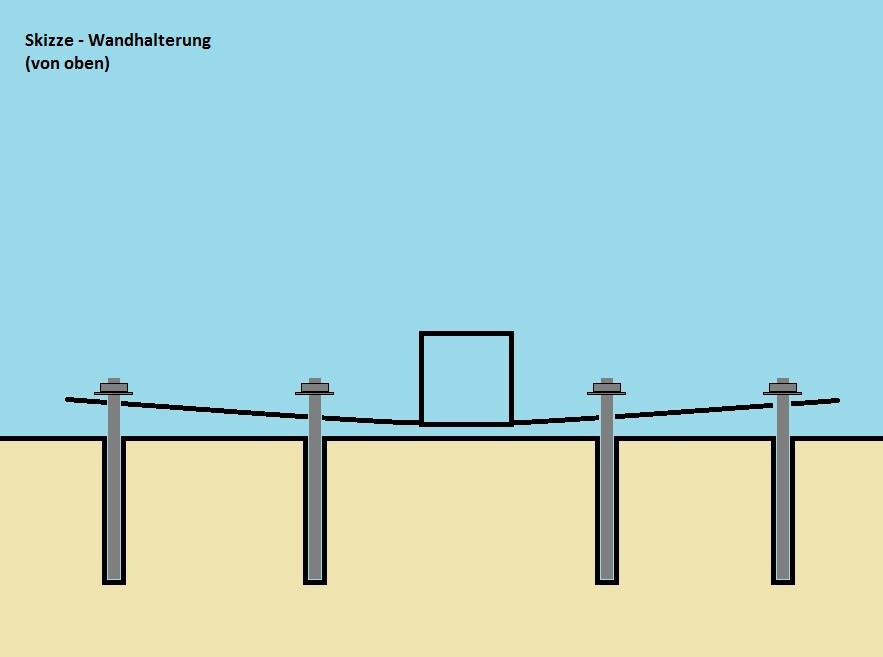
As shown in the sketch below (/ at the top of the first picture), the bracket has a slight bend. Do the flanges of the bracket (with the holes for wall mounting) need to sit flush against the wall after installation, or is it sufficient to tighten them firmly / keep them under tension? According to the mortar’s technical datasheet, the maximum torque when fastening is only 4 Nm (M8 threaded rod). The tensile load range is specified as 6.8 kN (C 20/25) up to 42.0 kN (C 50/60).
Does anyone perhaps know an alternative heavy-duty fixing method for sand-lime brick?
I would appreciate any help. Thank you very much!
I have tried to fasten the bracket using the supplied sleeve anchors. Unfortunately, 2 out of the 6 anchors would not tighten at all because first the masonry, and then the threads, gave way.
Now I plan to install the bracket using M8 threaded rods and injection mortar. This also brings up my next question (?):
As shown in the sketch below (/ at the top of the first picture), the bracket has a slight bend. Do the flanges of the bracket (with the holes for wall mounting) need to sit flush against the wall after installation, or is it sufficient to tighten them firmly / keep them under tension? According to the mortar’s technical datasheet, the maximum torque when fastening is only 4 Nm (M8 threaded rod). The tensile load range is specified as 6.8 kN (C 20/25) up to 42.0 kN (C 50/60).
Does anyone perhaps know an alternative heavy-duty fixing method for sand-lime brick?
I would appreciate any help. Thank you very much!
Great, thank you! I think I’ve finally found someone with the right expertise.
A few details are still unclear to me:
How would it look as an alternative to use injection mortar and anchor rods for fastening?
By removing the original anchor bolts, the drill holes have unfortunately become slightly enlarged (about 13mm (0.5 inches) in diameter and 50mm (2 inches) deep). Would injection mortar possibly be suitable here as well? How else can I repair the holes to, for example, install M8 wall anchors?
And how tight do I actually need to tighten them? Is “hand tight” sufficient, or does the bracket need to sit flush against the wall? I’m unfortunately unable to assess the vibrations that may occur.
I would appreciate any further feedback.
Thank you very much!
A few details are still unclear to me:
How would it look as an alternative to use injection mortar and anchor rods for fastening?
By removing the original anchor bolts, the drill holes have unfortunately become slightly enlarged (about 13mm (0.5 inches) in diameter and 50mm (2 inches) deep). Would injection mortar possibly be suitable here as well? How else can I repair the holes to, for example, install M8 wall anchors?
And how tight do I actually need to tighten them? Is “hand tight” sufficient, or does the bracket need to sit flush against the wall? I’m unfortunately unable to assess the vibrations that may occur.
I would appreciate any further feedback.
Thank you very much!
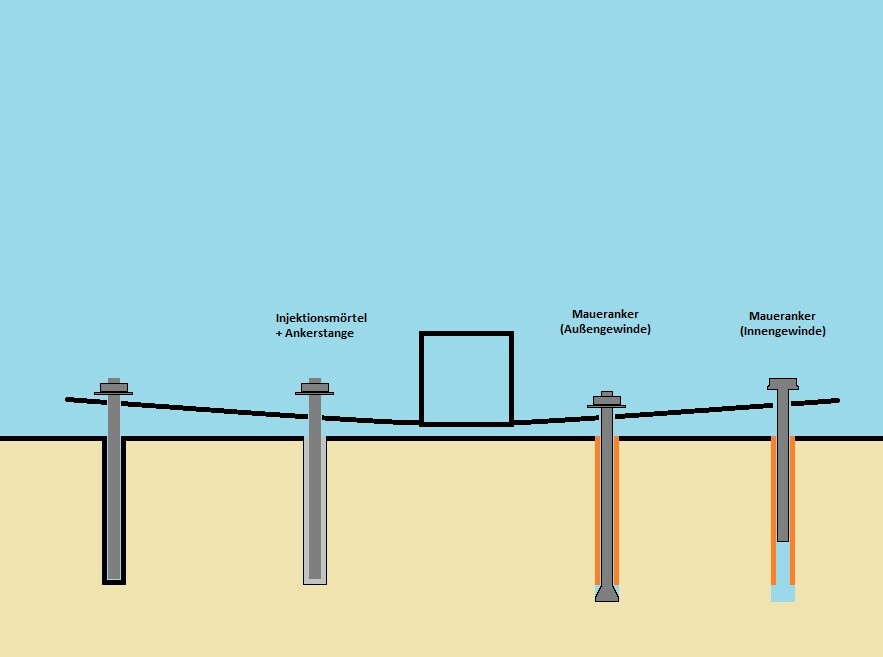
Thank you again! This is really helpful. I’m now just considering which would be the best solution. I’ve illustrated the three options again in the sketch and the image below. According to the datasheet, the method with injection mortar only allows a maximum installation torque of 4 Nm.
For the two versions of the “Rawl wall anchors,” the maximum torque is 15 Nm. Here, I would have the advantage that I could reuse the existing drill holes (--> 14mm outer diameter).
With the version that has an internal thread, however, I’m concerned that I might reach the 15 Nm torque before the screw is fully screwed into the anchor, meaning the screw head might stand off from the wall. The bracket should ideally sit flush against the surface... Does bending and the resulting stress affect the torque or the tensile load? Or possibly both? Am I missing something? I hope this makes sense :-P
Thanks again! It’s really great that there are so many knowledgeable people here
For the two versions of the “Rawl wall anchors,” the maximum torque is 15 Nm. Here, I would have the advantage that I could reuse the existing drill holes (--> 14mm outer diameter).
With the version that has an internal thread, however, I’m concerned that I might reach the 15 Nm torque before the screw is fully screwed into the anchor, meaning the screw head might stand off from the wall. The bracket should ideally sit flush against the surface... Does bending and the resulting stress affect the torque or the tensile load? Or possibly both? Am I missing something? I hope this makes sense :-P
Thanks again! It’s really great that there are so many knowledgeable people here
Similar topics