
Hello everyone, I have the following concern:
I want to install a steel wall bracket for a 70 kg (154 lbs) heavy punching bag. According to the building specifications of our terraced house (built 1989, NRW), the following applies to the wall (1st floor; facing the neighbor):
,,All load-bearing walls are constructed from masonry, and where necessary, concrete." ,,The exterior walls are insulated with a 6 cm (2.4 inches) thick core insulation mat and faced with an 11.5 cm (4.5 inches) thick sand-lime brick veneer."
Slightly offset from each other, I made 4 test drillings (3 mm, about 10 cm (4 inches) deep) through the textured wallpaper using a masonry drill bit and could not detect any cavities. In my opinion, the "masonry" consists of solid sand-lime bricks.
Is there a risk that it might actually be hollow or perforated brick? If so, how can I ensure this (more test drillings)?
The punching bag bracket has 6 M10 holes for wall mounting (4 on top, 2 on the bottom). Included in the delivery were 6 screws M8x60 and 6 matching metal expansion anchors (probably only for concrete fixing?). However, these do not seem very secure to me because of their short length. Considering the punching bag will cause significant vibrations... I recently came across anchor rods and injection mortar (e.g. FIS A+V by Fischer) online. Is this the right solution for my problem or overkill? How long should/can the threaded rods be, would M8x110 be okay? About 1.5 cm (0.6 inches) should protrude from the wall. And would I also need anchor sleeves made of plastic or metal?
If relevant, the punching bag is 1.80 m (5 ft 11 in) tall, the wall bracket extends 60 cm (24 inches) from the wall (meaning the distance from punching bag center to wall), and the suspension (chains, spring...) takes up about 50 cm (20 inches).
Additionally, I’m interested in how to avoid drilling into a joint when drilling through wallpaper, or does this not affect stability?
After days of research, I am completely confused. I hope one of the experts here can at least offer some guidance. I am very grateful for any tip. Thank you in advance!
Best regards
V4L3NTIN
I want to install a steel wall bracket for a 70 kg (154 lbs) heavy punching bag. According to the building specifications of our terraced house (built 1989, NRW), the following applies to the wall (1st floor; facing the neighbor):
,,All load-bearing walls are constructed from masonry, and where necessary, concrete." ,,The exterior walls are insulated with a 6 cm (2.4 inches) thick core insulation mat and faced with an 11.5 cm (4.5 inches) thick sand-lime brick veneer."
Slightly offset from each other, I made 4 test drillings (3 mm, about 10 cm (4 inches) deep) through the textured wallpaper using a masonry drill bit and could not detect any cavities. In my opinion, the "masonry" consists of solid sand-lime bricks.
Is there a risk that it might actually be hollow or perforated brick? If so, how can I ensure this (more test drillings)?
The punching bag bracket has 6 M10 holes for wall mounting (4 on top, 2 on the bottom). Included in the delivery were 6 screws M8x60 and 6 matching metal expansion anchors (probably only for concrete fixing?). However, these do not seem very secure to me because of their short length. Considering the punching bag will cause significant vibrations... I recently came across anchor rods and injection mortar (e.g. FIS A+V by Fischer) online. Is this the right solution for my problem or overkill? How long should/can the threaded rods be, would M8x110 be okay? About 1.5 cm (0.6 inches) should protrude from the wall. And would I also need anchor sleeves made of plastic or metal?
If relevant, the punching bag is 1.80 m (5 ft 11 in) tall, the wall bracket extends 60 cm (24 inches) from the wall (meaning the distance from punching bag center to wall), and the suspension (chains, spring...) takes up about 50 cm (20 inches).
Additionally, I’m interested in how to avoid drilling into a joint when drilling through wallpaper, or does this not affect stability?
After days of research, I am completely confused. I hope one of the experts here can at least offer some guidance. I am very grateful for any tip. Thank you in advance!
Best regards
V4L3NTIN
To clarify, I have created a more detailed sketch.
Does it make sense to calculate the bending moment or to compare it with the torque of the anchors? I want to avoid another failure if possible... :-P
The bending moment seems to be "small" enough that I can almost press the flat steel completely flush against the wall using full muscle power. However, I cannot estimate how many Nm of bending moment this corresponds to.
If the only downside is the more complicated removal, and there are no objections to the Rawl wall anchors with external thread and nut, I would like to try these now. With the other option, I still worry that I might not be able to fully countersink the screws due to the bending moment, and therefore the anchor might not set properly. Please provide your feedback again.
Thanks as always!
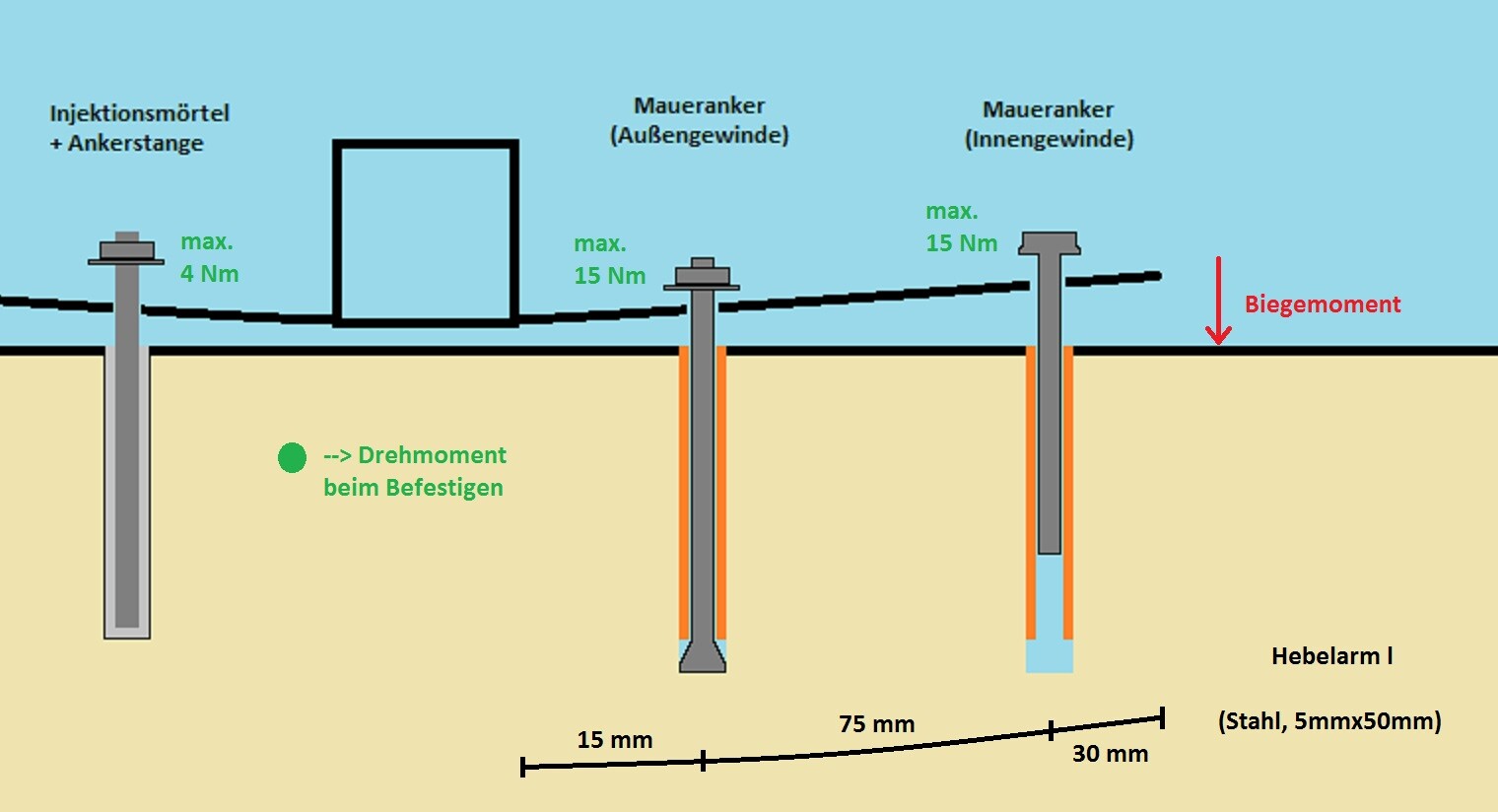
Does it make sense to calculate the bending moment or to compare it with the torque of the anchors? I want to avoid another failure if possible... :-P
The bending moment seems to be "small" enough that I can almost press the flat steel completely flush against the wall using full muscle power. However, I cannot estimate how many Nm of bending moment this corresponds to.
If the only downside is the more complicated removal, and there are no objections to the Rawl wall anchors with external thread and nut, I would like to try these now. With the other option, I still worry that I might not be able to fully countersink the screws due to the bending moment, and therefore the anchor might not set properly. Please provide your feedback again.
Thanks as always!
B
Bauexperte26 May 2016 10:08V4L3NTIN schrieb:
I apologize for disregarding the forum rules; it will not happen again! Thank you!
As far as I know, a hyphen is not a professional title, so please fill in that field in your profile.
Regards, Bauexperte
V4L3NTIN schrieb:
The image links didn’t work above, so here are the two types of wall anchors:
External thread:

Internal thread:

Thanks!!! Both are equally good. The one with the external thread can be secured from the back with a nut, allowing the bracket to rest flush against the lock nut.
Why is the bracket bent like that in the first place?