
Hello, during the last freezing period I noticed that I probably need to insulate or heat our new wooden shed a bit more to keep it frost-free. When the outside temperature was between -3 and -5°C (27 to 23°F), the temperature inside quickly dropped to around -0.5°C (31°F).
It serves as a workshop and accordingly stores paint, silicone, tools, and of course a supply of beer.
At first, I thought about installing 20-40 mm (1 to 1.5 inch) rigid foam boards (Styrodur) inside the studs, but the only Styrodur I know comes as either green or pink boards, which in my opinion would completely ruin the appearance. I was also planning to cover the foam boards with some kind of thin plywood panel.
Therefore, I am now more inclined to use wood fiber insulation boards because their color would fit better.
The stud cavity has a depth of about 12 cm (5 inches). Installing 40 mm (1.5 inch) wood fiber boards would leave about 80 mm (3 inches) for, for example, installing shelves and still allow some storage space in the cavity.
If I were to insulate walls and ceiling, that would be just under 60 m² (645 sq ft), costing roughly 5 €/m² (about 0.50 $/sq ft), so nearly 300 € (about $320) for materials.
Or maybe it’s all nonsense and I should just install a small electric heater and let it run for those saved 300 €. Or since 300 € isn’t far from the price of a split air conditioning unit from a home improvement store, I wonder if that would be more worthwhile—though that’s another question altogether.
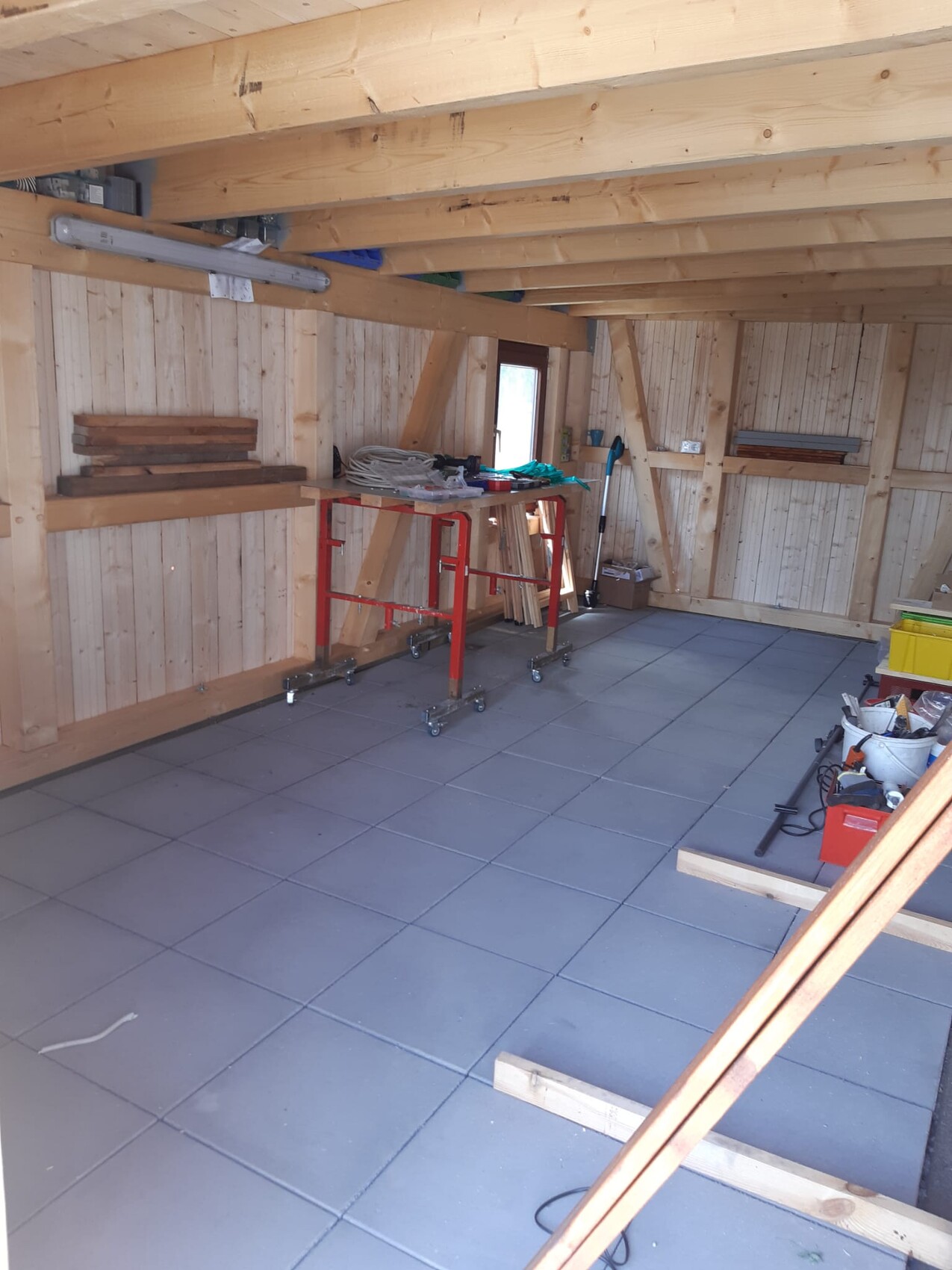
It serves as a workshop and accordingly stores paint, silicone, tools, and of course a supply of beer.
At first, I thought about installing 20-40 mm (1 to 1.5 inch) rigid foam boards (Styrodur) inside the studs, but the only Styrodur I know comes as either green or pink boards, which in my opinion would completely ruin the appearance. I was also planning to cover the foam boards with some kind of thin plywood panel.
Therefore, I am now more inclined to use wood fiber insulation boards because their color would fit better.
The stud cavity has a depth of about 12 cm (5 inches). Installing 40 mm (1.5 inch) wood fiber boards would leave about 80 mm (3 inches) for, for example, installing shelves and still allow some storage space in the cavity.
If I were to insulate walls and ceiling, that would be just under 60 m² (645 sq ft), costing roughly 5 €/m² (about 0.50 $/sq ft), so nearly 300 € (about $320) for materials.
Or maybe it’s all nonsense and I should just install a small electric heater and let it run for those saved 300 €. Or since 300 € isn’t far from the price of a split air conditioning unit from a home improvement store, I wonder if that would be more worthwhile—though that’s another question altogether.

For a shed designed as a workshop, I wonder how you originally planned to implement the concept?
From my perspective, it is questionable whether insulation alone is sufficient if there are also leaks. If these occur around the floor and wall connections—that is, if drafts easily pass through cracks and walls—then even a lot of insulation won’t help.
Otherwise, your shed seems to be reasonably well constructed, just not as a warm space. Wood fiber insulation boards must not get wet, neither from direct moisture (rain, rising damp) nor from dew/condensation. They are therefore more sensitive regarding wall construction. Why not use polystyrene insulation in the cavity, seal everything as tightly as possible, and install tongue-and-groove boards on the inside? You can then attach various things securely to that, unlike with purely decorative plywood sheathing.
From my perspective, it is questionable whether insulation alone is sufficient if there are also leaks. If these occur around the floor and wall connections—that is, if drafts easily pass through cracks and walls—then even a lot of insulation won’t help.
Otherwise, your shed seems to be reasonably well constructed, just not as a warm space. Wood fiber insulation boards must not get wet, neither from direct moisture (rain, rising damp) nor from dew/condensation. They are therefore more sensitive regarding wall construction. Why not use polystyrene insulation in the cavity, seal everything as tightly as possible, and install tongue-and-groove boards on the inside? You can then attach various things securely to that, unlike with purely decorative plywood sheathing.
 SumsumBiene30 Dec 2022 07:52
I would place an insulated cabinet inside for the sensitive items.
I would only insulate if I plan to use the cabin myself for extended periods during winter.
I would only insulate if I plan to use the cabin myself for extended periods during winter.

H
Hausbau55EE30 Dec 2022 16:18Tolentino schrieb:
Insulation alone doesn’t help much; it only delays heat loss. You also need a frost protection device, whether it’s a shed or a cabinet... Exactly right! A few days ago, when the temperature in Austria dropped to -12°C (10°F), it was still -10°C (14°F) inside our unheated camper.
Similar topics