
Hello, during the last freezing period I noticed that I probably need to insulate or heat our new wooden shed a bit more to keep it frost-free. When the outside temperature was between -3 and -5°C (27 to 23°F), the temperature inside quickly dropped to around -0.5°C (31°F).
It serves as a workshop and accordingly stores paint, silicone, tools, and of course a supply of beer.
At first, I thought about installing 20-40 mm (1 to 1.5 inch) rigid foam boards (Styrodur) inside the studs, but the only Styrodur I know comes as either green or pink boards, which in my opinion would completely ruin the appearance. I was also planning to cover the foam boards with some kind of thin plywood panel.
Therefore, I am now more inclined to use wood fiber insulation boards because their color would fit better.
The stud cavity has a depth of about 12 cm (5 inches). Installing 40 mm (1.5 inch) wood fiber boards would leave about 80 mm (3 inches) for, for example, installing shelves and still allow some storage space in the cavity.
If I were to insulate walls and ceiling, that would be just under 60 m² (645 sq ft), costing roughly 5 €/m² (about 0.50 $/sq ft), so nearly 300 € (about $320) for materials.
Or maybe it’s all nonsense and I should just install a small electric heater and let it run for those saved 300 €. Or since 300 € isn’t far from the price of a split air conditioning unit from a home improvement store, I wonder if that would be more worthwhile—though that’s another question altogether.
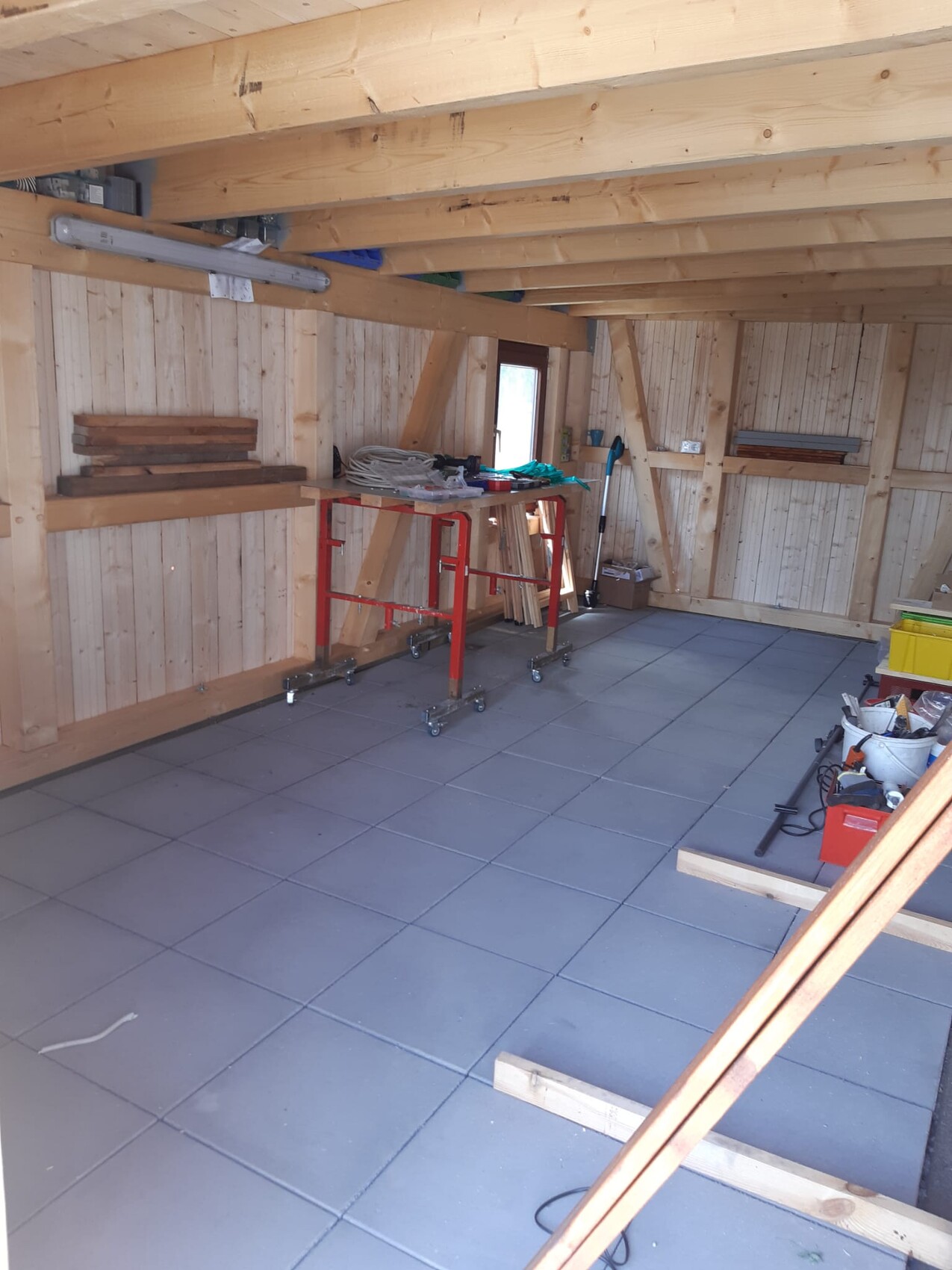
It serves as a workshop and accordingly stores paint, silicone, tools, and of course a supply of beer.
At first, I thought about installing 20-40 mm (1 to 1.5 inch) rigid foam boards (Styrodur) inside the studs, but the only Styrodur I know comes as either green or pink boards, which in my opinion would completely ruin the appearance. I was also planning to cover the foam boards with some kind of thin plywood panel.
Therefore, I am now more inclined to use wood fiber insulation boards because their color would fit better.
The stud cavity has a depth of about 12 cm (5 inches). Installing 40 mm (1.5 inch) wood fiber boards would leave about 80 mm (3 inches) for, for example, installing shelves and still allow some storage space in the cavity.
If I were to insulate walls and ceiling, that would be just under 60 m² (645 sq ft), costing roughly 5 €/m² (about 0.50 $/sq ft), so nearly 300 € (about $320) for materials.
Or maybe it’s all nonsense and I should just install a small electric heater and let it run for those saved 300 €. Or since 300 € isn’t far from the price of a split air conditioning unit from a home improvement store, I wonder if that would be more worthwhile—though that’s another question altogether.
 SumsumBiene31 Dec 2022 09:55
Hausbau55EE schrieb:
Exactly right! A few days ago, when the outdoor temperature dropped to -12°C (10°F), the inside of our unheated motorhome was also at -10°C (14°F).How is a motorhome insulated? Or were you referring to the interior furnishings?

SumsumBiene schrieb:
How is a motorhome insulated? Or was that referring to the interior fittings?A motorhome is relatively well insulated and, with the heating on, also suitable for winter and comfortable. Without heating, it will freeze inside. The shed itself is not frost-proof or suitable for winter use.
It would need to be heated, and the better it is insulated, the lower the heating costs will be.
W
WilderSueden1 Jan 2023 21:10Basically, a frost guard heater should be sufficient. I also have one running in my garden shed, as it contains the kitchen and lots of moving boxes. Even during very cold periods, it was enough to keep the shed above freezing, although the frost guard heater is actually undersized. It’s a 500W frost guard heater, and the shed measures 3.5 x 4 meters (11.5 x 13 feet) with a gable roof made of 45 mm (1.8 inch) wall logs.
However, I find it a bit odd to build an energy-efficient house and then heat the shed continuously with electricity. For paint and similar items, I would use an insulated cabinet with a frost guard heater. Tools without batteries usually don’t suffer from the cold; batteries go into the insulated cabinet. Beer can handle typical 3–5°C (37–41°F) below zero, but during extreme cold spells, I’d move it to safety in time 😉
However, I find it a bit odd to build an energy-efficient house and then heat the shed continuously with electricity. For paint and similar items, I would use an insulated cabinet with a frost guard heater. Tools without batteries usually don’t suffer from the cold; batteries go into the insulated cabinet. Beer can handle typical 3–5°C (37–41°F) below zero, but during extreme cold spells, I’d move it to safety in time 😉
Similar topics