
Good morning,
Yesterday, we received a quote for a photovoltaic system. Our construction of the single-family house will start in October 2023 and is expected to be ready for occupancy in September 2024.
We have an annual electricity consumption of about 3000 kWh for our household, plus an unknown amount for the air-to-water heat pump (Weishaupt Biblock).
Our roof is oriented exactly south with a 25° pitch (gable roof). According to the calculation in the quote, the entire south roof is fully covered with modules (20 units), and the north roof is also equipped with 5 modules.
Attached you will find the details of the quote. The price is €20,900 net with battery storage and €15,900 net without storage.
What do you think of the offer? From what I understand in the discussions here on the forum, it is advisable to skip the battery storage. That would bring the cost to just under €16,000, which is a bit over €1,600 per kWp. That seems relatively expensive, doesn’t it?
Thank you very much in advance for your help.
Best regards,
Elias

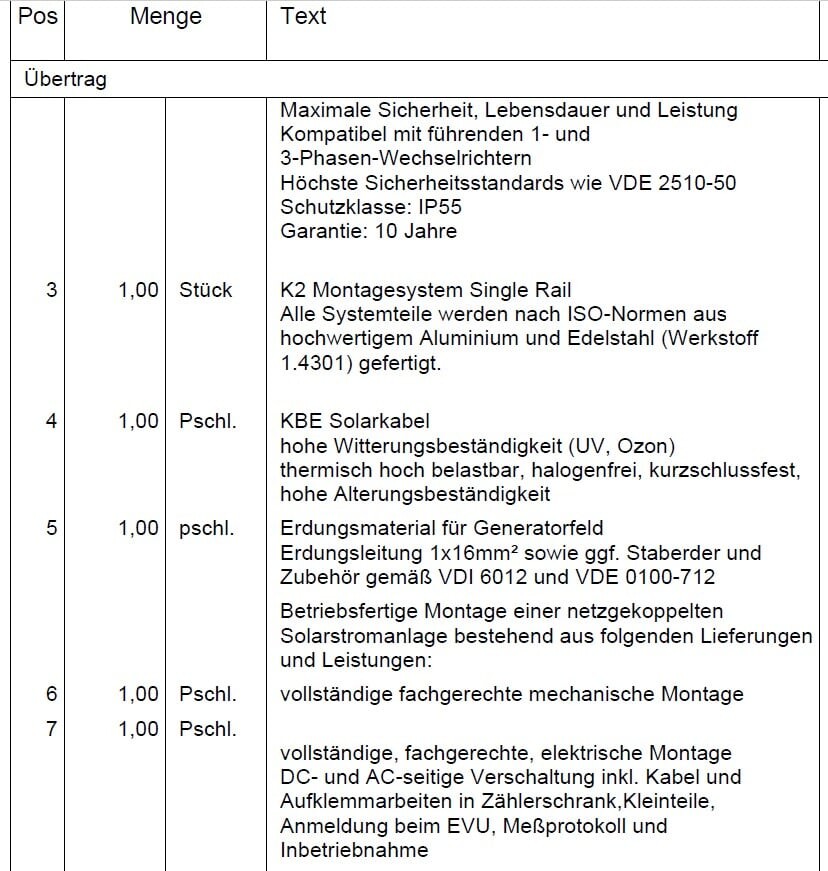
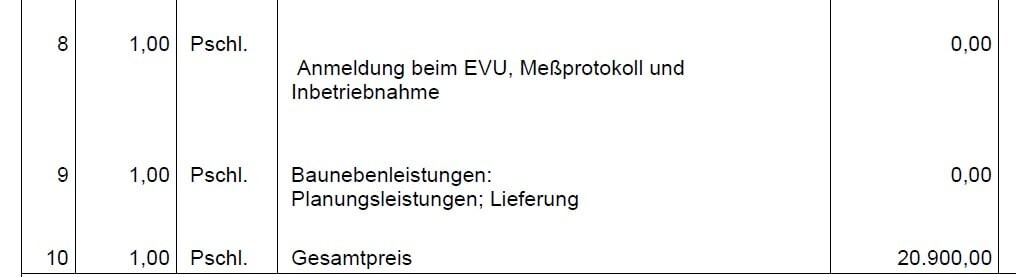
Yesterday, we received a quote for a photovoltaic system. Our construction of the single-family house will start in October 2023 and is expected to be ready for occupancy in September 2024.
We have an annual electricity consumption of about 3000 kWh for our household, plus an unknown amount for the air-to-water heat pump (Weishaupt Biblock).
Our roof is oriented exactly south with a 25° pitch (gable roof). According to the calculation in the quote, the entire south roof is fully covered with modules (20 units), and the north roof is also equipped with 5 modules.
Attached you will find the details of the quote. The price is €20,900 net with battery storage and €15,900 net without storage.
What do you think of the offer? From what I understand in the discussions here on the forum, it is advisable to skip the battery storage. That would bring the cost to just under €16,000, which is a bit over €1,600 per kWp. That seems relatively expensive, doesn’t it?
Thank you very much in advance for your help.
Best regards,
Elias
D
Deliverer25 Apr 2022 18:29Yes, I have also once dug up years-old threads and searched for signs of violations in order to issue warnings...
That’s just part of it here.
That’s just part of it here.
T
TomTom197925 Apr 2022 19:15That's why he can't get rid of me either, I'm not here because of the admin 😀 😀 😀 😀:p 😀:p 😀:p
H
Hausmax12326 Apr 2022 08:23Hello, I’d like to join the discussion here... We have received a quote from a local electrician for our new build for a 9.5 kWp system at 15.2k net. Since prices between 1100 and 1300 per kWp are being mentioned here, this seems quite expensive. Are these prices usually found with the large companies operating nationwide in Germany, or would you recommend requesting quotes from more local companies as well?
The above offer also includes an optional battery storage (BYD HWS 10.2) for 5900. If a battery storage makes sense at all, isn’t this oversized for a 9.5 kWp system?
The above offer also includes an optional battery storage (BYD HWS 10.2) for 5900. If a battery storage makes sense at all, isn’t this oversized for a 9.5 kWp system?
D
Deliverer26 Apr 2022 20:54This is open to debate. From both an ecological and economic perspective, every storage system is oversized. Rules of thumb are just that—rules of thumb...
However, they indicate that the battery storage capacity should be about half or better yet just a third of the kWp in kWh. This ensures the battery can be sufficiently charged multiple times per year. (This can be calculated, so it’s not just a guess.)
The second rule of thumb is: The battery should not be larger than your consumption during a summer night. Only then will the battery be discharged often enough throughout the year. For most people, this is roughly 200 watts multiplied by 10 hours.
If you follow both guidelines, with a bit of luck and currently reasonably priced BYD systems, you can even break even economically. So both rules are purely economic considerations.
If you want more self-sufficiency (whatever the purpose may be, as long as it’s below 100%), you obviously need a larger battery. But then economics no longer matter; it becomes “for peace of mind.” A hobby.
However, they indicate that the battery storage capacity should be about half or better yet just a third of the kWp in kWh. This ensures the battery can be sufficiently charged multiple times per year. (This can be calculated, so it’s not just a guess.)
The second rule of thumb is: The battery should not be larger than your consumption during a summer night. Only then will the battery be discharged often enough throughout the year. For most people, this is roughly 200 watts multiplied by 10 hours.
If you follow both guidelines, with a bit of luck and currently reasonably priced BYD systems, you can even break even economically. So both rules are purely economic considerations.
If you want more self-sufficiency (whatever the purpose may be, as long as it’s below 100%), you obviously need a larger battery. But then economics no longer matter; it becomes “for peace of mind.” A hobby.
H
Hausmax12327 Apr 2022 11:37Thank you for the reply! We are also leaning towards installing even more photovoltaic panels on the roof and skipping the battery storage, but so far we haven’t received any offers below 1500 per kWp, which would likely make the whole thing unprofitable...
P
Pitiglianio27 Apr 2022 15:54Hausmax123 schrieb:
But so far we unfortunately have not received any offers below 1500 per kWp, which would more or less turn the whole thing into a loss...Did you use the gross or net price per kWp?Similar topics