
Good morning,
Yesterday, we received a quote for a photovoltaic system. Our construction of the single-family house will start in October 2023 and is expected to be ready for occupancy in September 2024.
We have an annual electricity consumption of about 3000 kWh for our household, plus an unknown amount for the air-to-water heat pump (Weishaupt Biblock).
Our roof is oriented exactly south with a 25° pitch (gable roof). According to the calculation in the quote, the entire south roof is fully covered with modules (20 units), and the north roof is also equipped with 5 modules.
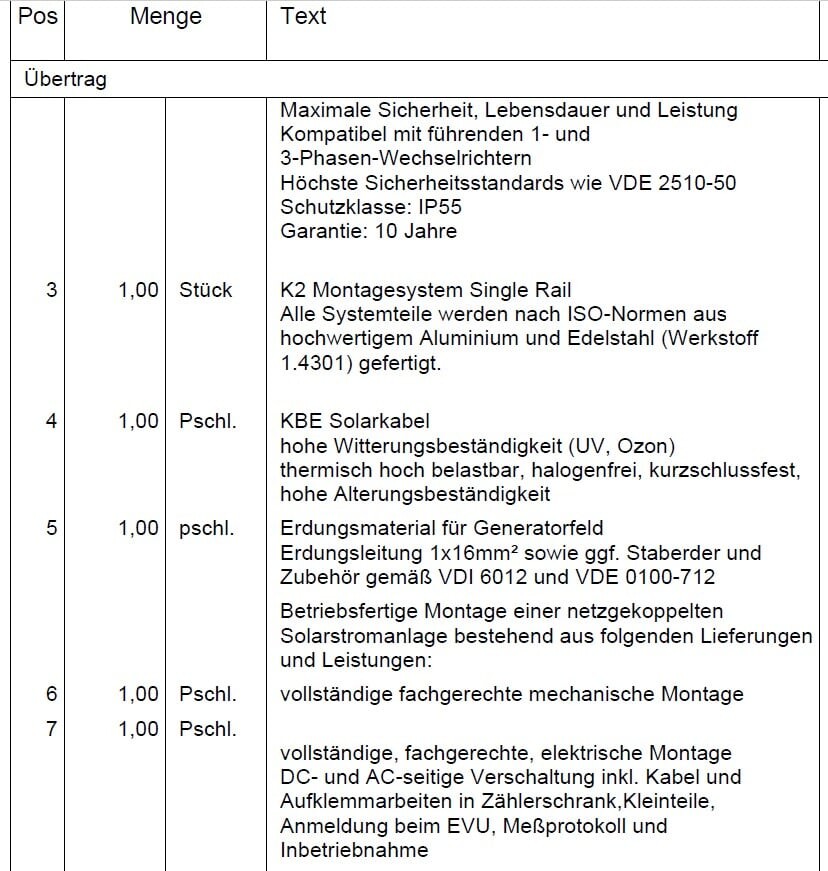
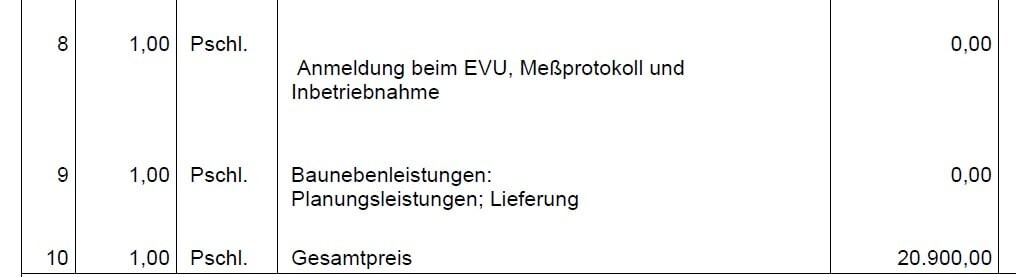
Attached you will find the details of the quote. The price is €20,900 net with battery storage and €15,900 net without storage.
What do you think of the offer? From what I understand in the discussions here on the forum, it is advisable to skip the battery storage. That would bring the cost to just under €16,000, which is a bit over €1,600 per kWp. That seems relatively expensive, doesn’t it?
Thank you very much in advance for your help.
Best regards,
Elias

Yesterday, we received a quote for a photovoltaic system. Our construction of the single-family house will start in October 2023 and is expected to be ready for occupancy in September 2024.
We have an annual electricity consumption of about 3000 kWh for our household, plus an unknown amount for the air-to-water heat pump (Weishaupt Biblock).
Our roof is oriented exactly south with a 25° pitch (gable roof). According to the calculation in the quote, the entire south roof is fully covered with modules (20 units), and the north roof is also equipped with 5 modules.
Attached you will find the details of the quote. The price is €20,900 net with battery storage and €15,900 net without storage.
What do you think of the offer? From what I understand in the discussions here on the forum, it is advisable to skip the battery storage. That would bring the cost to just under €16,000, which is a bit over €1,600 per kWp. That seems relatively expensive, doesn’t it?
Thank you very much in advance for your help.
Best regards,
Elias
R
RotorMotor23 Jun 2022 12:36Neubau2022 schrieb:
I still don’t understand. With a battery, less is fed into the grid because more is consumed.The battery doesn’t really affect that, except maybe during midday charging when the battery can slightly reduce the power curtailment. This legal curtailment concerns power output, not energy.Please ask your question again with more specific details.
Neubau2022 schrieb:
I still don’t understand. With a battery, less is fed into the grid because more is used. This concerns the current output at any given time. For a 14.4 kWp system, a maximum of 70% of that power, i.e., 10.08 kW (10.08 kW), may be fed into the grid.
There are two approaches to this:
1. You install an inverter that only delivers 70% of the capacity. That’s your offer. No matter what your modules produce, a maximum of 10 kW (10 kW) will be generated. You consume part of it, and the rest is fed into the grid. This corresponds to the “strict 70% rule.”
2. You use a larger inverter, for example 12 kW (12 kW), and regulate the feed-in amount via a control system, such as the HomeManager. This allows up to 12 kW (12 kW) to be produced. You could consume 2 kW (2 kW) simultaneously and still feed 10 kW (10 kW) into the grid. If you consume only 1 kW (1 kW), the HomeManager throttles the inverter down to 11 kW, so only 10 kW (10 kW) continues to be fed into the grid. This is called the “flexible 70% rule.” A battery can be used here as a buffer during peak times. The HomeManager charges the battery only up to 50% if the weather forecast predicts overproduction. Then, when the full 12 kW (12 kW) is available but you consume only 500 W (500 W) around midday, the battery is charged with 1.5 kW (1.5 kW) at that time. This way, self-consumption is kept at a minimum of 2 kW (2 kW), maximizing the use of the full possible 12 kW (12 kW) output and 10 kW (10 kW) feed-in. In the evening, the battery is still fully charged, and solar energy is utilized as efficiently as possible.
N
Neubau202223 Jun 2022 20:09Fuchur schrieb:
This concerns the current output. For a 14.4 kWp system, a maximum of 70% of that, i.e., 10.08 kW, can be fed into the grid.
There are now two approaches for this:
1. You install an inverter that only outputs 70%. This is your offer. Regardless of what your modules produce, only up to 10 kW will be generated. You consume part of it yourself, and the rest is fed into the grid. This corresponds to the "hard 70%" regulation.
2. You use a larger inverter, for example 12 kW, and regulate the feed-in amount via a measurement control system, such as the HomeManager in this case. This allows production of up to 12 kW. So you could use 2 kW yourself while still feeding 10 kW into the grid. If you only consume 1 kW, the HomeManager throttles the inverter down to 11 kW, so that only 10 kW is fed in continuously. This is called "soft 70%." A battery can be used as a buffer for peak times. That means the HomeManager charges the battery only to 50% when the weather forecast predicts overproduction. If then 12 kW is generated but you only consume 500 W at midday, the battery will be charged at 1.5 kW. This keeps self-consumption at a minimum of 2 kW, allowing full use of the possible 12 kW generation and 10 kW feed-in. The battery will still be full in the evening, while solar energy is optimally used.Now I even understand it. Thank you for the detailed explanation.
My offer includes the following
Is this also some kind of control device?
The term "dynamic active power limitation" refers exactly to that, limiting to 70% softly. However, for this, you need a larger inverter. Whether your system can actually deliver more than 70% simultaneously on a north-facing side needs to be calculated. There are simulation programs available for this.
N
Neubau202224 Jun 2022 07:55Fuchur schrieb:
The term "dynamic active power limiting" means exactly that: 70% soft limit. However, for this you need a larger inverter. Whether your system can actually deliver more than 70% simultaneously on a north-facing side must be calculated. There are simulation programs available for that.The inverter is larger than the system. The system has a capacity of 13.26 kWp.