
Hello,
for years I have been thinking about how to design the problem area of my house.
I have a long narrow strip along the public pathway that I would like to plant. The strip is about 75 cm (30 inches) wide and 10.5 meters (34.5 feet) long. It faces south and gets full sun. Two gardens away, the neighbor has cut down all the tall and old trees, which means that since this year, our house is fully exposed to the sun. Therefore, we really want some sort of protection to prevent the ground from heating up excessively and possibly something that will protect at least the lower part of our facade from the direct sun in the future.
Trees probably won’t work due to the limited space available.
I like plants that are useful to wildlife throughout the year.
The fence must stay because otherwise the area would become a dog toilet, even now with just the stones. The privacy screen on the fence is more of a splash guard since the whole area is on an unpaved path, which is officially a dead end but apparently many people have a key to lower the bollards, and the footpath is frequently used by vehicles, often at high speed. It’s a disaster when it rains.
So, I’m looking forward to your suggestions.
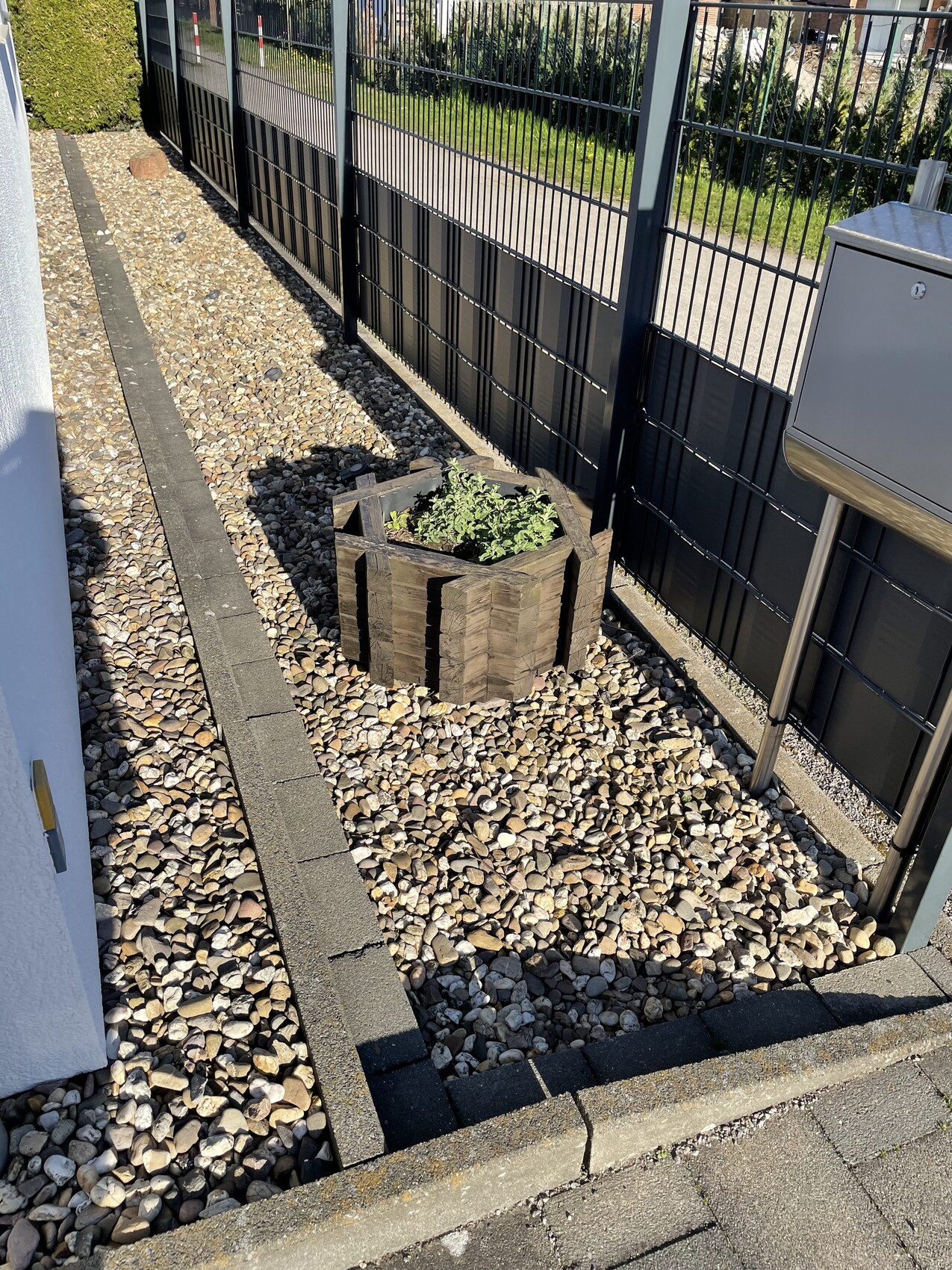

for years I have been thinking about how to design the problem area of my house.
I have a long narrow strip along the public pathway that I would like to plant. The strip is about 75 cm (30 inches) wide and 10.5 meters (34.5 feet) long. It faces south and gets full sun. Two gardens away, the neighbor has cut down all the tall and old trees, which means that since this year, our house is fully exposed to the sun. Therefore, we really want some sort of protection to prevent the ground from heating up excessively and possibly something that will protect at least the lower part of our facade from the direct sun in the future.
Trees probably won’t work due to the limited space available.
I like plants that are useful to wildlife throughout the year.
The fence must stay because otherwise the area would become a dog toilet, even now with just the stones. The privacy screen on the fence is more of a splash guard since the whole area is on an unpaved path, which is officially a dead end but apparently many people have a key to lower the bollards, and the footpath is frequently used by vehicles, often at high speed. It’s a disaster when it rains.
So, I’m looking forward to your suggestions.
P
Pinkiponk17 Apr 2022 11:11shenja schrieb:
No, the sea buckthorn had already bravely spread itself into the bed. You have to remove all the roots; otherwise, it will come back.
Which ground cover plants are worth planting? At the moment, there is rosemary growing in a pot. I still need to think about and research that. I just mean that ground cover plants are often overlooked. Personally, I really like chickweed (evergreen, with (almost) year-round attractive flowers, but it requires moisture), dandelions, and daisies. In my opinion, there should only be one type of ground cover plant to avoid it looking untidy... unless you want it to look wild and natural. My personal favorite is chickweed. (Off topic: If it didn’t need moisture, I would always prefer a chickweed carpet over a regular lawn.) Or—something I once tried, though unfortunately most of my plants were stolen—you set up your own little “botanical garden” there and experiment with all kinds of (desert?) plants from around the world. You could also attach small labels with the plant names to them.
M
motorradsilke17 Apr 2022 14:34Pinkiponk schrieb:
I was really happy about your question (also for somewhat selfish reasons ;-) ) and would like to offer two suggestions, although knowledgeable forum members might dismiss them. So far, I lack almost completely the expertise and practical experience regarding home gardens.
- Honeysuckle (Lonicera)
- Holly (Ilex)
Both are (supposedly) evergreen, popular with birds, insects, etc., and come in many sizes and varieties. I plan to plant these in my garden, preferably in yellow and pink (if my husband allows it and doesn't notice too early ;-) ).
There is probably an important reason why these two plants have not yet been mentioned by the experienced forum members.You can plant Ilex without any problems. It is evergreen but grows very slowly. That’s why larger plants tend to be quite expensive.
I am not familiar with Honeysuckle.
Similar topics