
ᐅ Concrete slab and house protected against moisture with dimpled membrane? Any experiences?
Created on: 21 Jun 2025 23:04
B
Bauherrin123
Hello dear homeowners,
Who has experience and can help me? I have been living in the house for 2 years, and now it’s time to work on the exterior landscaping. We have now installed dimpled membrane (drainage membrane) for the terraces, but it already seemed wrong to me. I have since read up on it and am still unsure. Did my construction company deliver a house without properly waterproofing the exterior or what?
The house has no basement. A neighbor said the company applied bitumen and then a slurry coat, and that would be sufficient. Additionally, we are installing the dimpled membrane, which should be more than enough.
Now I don’t know if the dimpled membrane was installed correctly, if the company really applied bitumen, and if everything we're doing is enough — or if we should call a specialist? Attached is a photo; I am totally confused. What do I need to do to protect my house from moisture and damage for the next 10 years? I don’t want to forget anything, as everyone says something different: One road construction worker offers to do it for 150 euros, saying he will remove the gravel, apply the slurry coat, and install the dimpled membrane with the dimples facing the wall. Another person says it would cost 5,000 euros and that there needs to be insulation, then a layer – I don’t know what exactly – then styrofoam, and then the dimpled membrane with drainage.
I am confused.
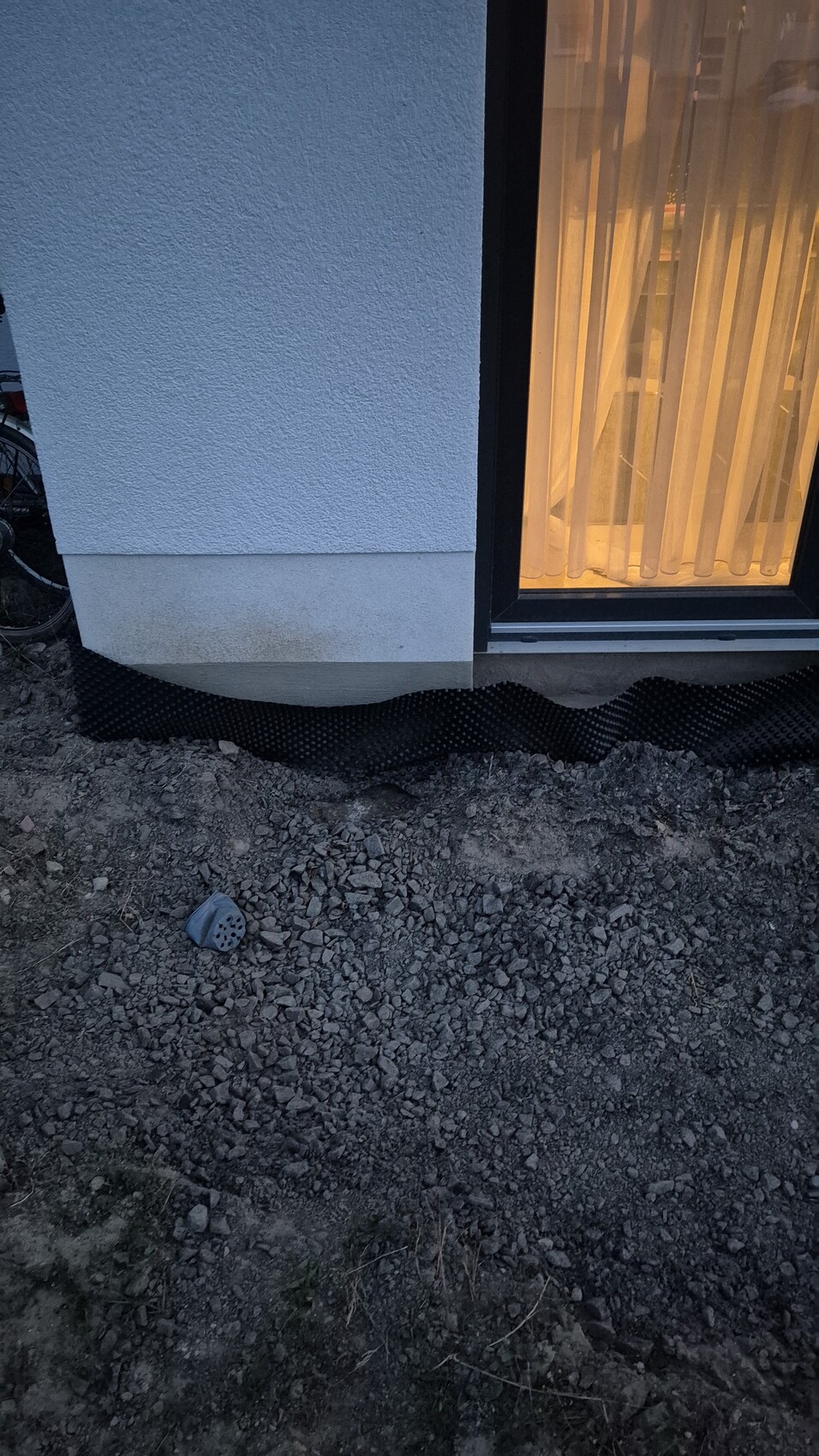
Who has experience and can help me? I have been living in the house for 2 years, and now it’s time to work on the exterior landscaping. We have now installed dimpled membrane (drainage membrane) for the terraces, but it already seemed wrong to me. I have since read up on it and am still unsure. Did my construction company deliver a house without properly waterproofing the exterior or what?
The house has no basement. A neighbor said the company applied bitumen and then a slurry coat, and that would be sufficient. Additionally, we are installing the dimpled membrane, which should be more than enough.
Now I don’t know if the dimpled membrane was installed correctly, if the company really applied bitumen, and if everything we're doing is enough — or if we should call a specialist? Attached is a photo; I am totally confused. What do I need to do to protect my house from moisture and damage for the next 10 years? I don’t want to forget anything, as everyone says something different: One road construction worker offers to do it for 150 euros, saying he will remove the gravel, apply the slurry coat, and install the dimpled membrane with the dimples facing the wall. Another person says it would cost 5,000 euros and that there needs to be insulation, then a layer – I don’t know what exactly – then styrofoam, and then the dimpled membrane with drainage.
I am confused.
B
Bauherrin12322 Jun 2025 23:50ypg schrieb:
The dimpled membrane is only a protection against abrasion caused by gravel or crushed stone against the house wall. Ideally, you can see it between the terrace and the house wall.No, not at all. It also protects directly and indirectly against moisture, for example, by protecting the slurry or membrane underneath, which should not be damaged and is intended to prevent moisture.
B
Bauherrin12322 Jun 2025 23:53nordanney schrieb:
Yes, you do.
Dimple membrane is for mechanical protection. Nothing is glued there. Whether and how drainage is installed is decided by the person who knows and planned the site.
And if you had read the answers: dimples facing the wall.
No, it is not sealed at the top either. Why should it be, if the wall itself is waterproofed?
Now take a deep breath. You live in a functioning house, right? So everything happening now is not a big deal. Just minor issues, as people used to say long ago.nordanney schrieb:
Yes, you do.
Dimple membrane is for mechanical protection. Nothing is glued there. Whether and how drainage is installed is decided by the person who knows and planned the site.
And if you had read the answers: dimples facing the wall.
No, it is not sealed at the top either. Why should it be, if the wall itself is waterproofed?
Now take a deep breath. You live in a functioning house, right? So everything happening now is not a big deal. Just minor issues, as people used to say long ago.Thanks, I really feel panicked. I need to calm down. I’m worried I might have water damage and cracks in the concrete slab after 10 years. I’ve attached a picture, showing dimples facing the wall and sealing at the top to prevent water from entering.
N
nordanney23 Jun 2025 08:49Bauherrin123 schrieb:
I don’t understand the text right now, is it not good? Sorry, I’m really confused today. Because you’re not reading and are just panicking. And you’re getting information from someone else.
Bauherrin123 schrieb:
Yes, thanks, I am really panicking. I need to calm down. I’m afraid that I might have water damage and cracks in the concrete slab in 10 years. I attached a picture, sealing the studs against the wall at the top so no water flows in. Again. Why do you want to install such a membrane if you DO NOT have a basement? You don’t read, don’t think, and don’t want to listen.
Bauherrin123 schrieb:
I attached a picture, with the non-existent basement that the membrane is supposed to seal. This is a product for basement waterproofing. As I said, you simply don’t read.
The dimpled membrane protects the waterproofing layer from mechanical damage (and yes, it also provides some protection against moisture, since by being pressed with the dimples against the wall, moisture is directed downward). It is NOT sealed, and water is allowed and even expected to run behind it.
Again. You have a standard waterproofed house (as it looks in the pictures). Unless the inspector gives different information, you have already received multiple instructions on what to do. In any case, you do not need to waterproof a basement.
B
Bauherrin12323 Jun 2025 09:03nordanney schrieb:
Because you don’t read and are just panicking. And you get random information from someone.
Once again. Why do you want to install such a membrane if you don’t have a basement? You don’t read, don’t think, and don’t want to listen.
With the non-existent basement that the membrane is supposed to seal. This is a product for basement waterproofing. As I said, you simply don’t read.
The dimpled membrane protects the waterproofing layer from mechanical damage (and yes, it also provides some protection against moisture, because the dimples create a gap against the wall and channel moisture downward). It is NOT waterproofed itself, and water can and should be able to flow behind it.
Again. You have a standard waterproofed house (just as it looks in the pictures). Unless the expert provides different information, you’ve already been told multiple times what needs to be done. In any case, you do not need to waterproof a basement. Watch out, I may be panicking, but I can still read. I just don’t understand immediately because I’m not very experienced. I had craftsmen and companies on site at the same time, and everyone says something different. In the end, the inspector also made mistakes and didn’t say anything. Even if I don’t have a basement, I have a slab-on-grade foundation that needs to be waterproofed. Even if the picture might be for a basement, the principle is the same. The slab also needs to be protected. I’m shocked that a developer could do such a thing. And everything you write isn’t correct—water must not be allowed to pass behind. A dimpled membrane isn’t the best choice; it would be okay if I had been given a bitumen sheet membrane. I only have a single layer, so a membrane is necessary.
N
nordanney23 Jun 2025 09:36Bauherrin123 schrieb:
Watch out, I may be panicking, but I can still read. No. Otherwise, you wouldn’t be asking the same question over and over.
Bauherrin123 schrieb:
Even if the picture might be for a basement, the principle is the same. No, it’s not.
Bauherrin123 schrieb:
In the end, the inspector also made a mistake and said nothing. Why do you think he made a mistake? What was he supposed to say? Maybe there is simply nothing wrong because everything looks fine.
Bauherrin123 schrieb:
I was shocked that a developer could do something like that. What exactly did the developer do? What is wrong? Please specify clearly. I don’t see anything wrong in the pictures.
Bauherrin123 schrieb:
And everything you say is wrong, water is not allowed to pass behind there. Well, if you come from the construction industry and I don’t, then obviously you know better. But if you already know everything, then there’s no need to ask.
Bauherrin123 schrieb:
Dimpled membrane is not the best choice; it would be good if I had been given a bitumen membrane. But you didn’t get that. Also, the membrane is not mandatory or explicitly required. Dimpled membrane is the correct choice here.
Bauherrin123 schrieb:
I only have a line, so I definitely need a membrane. Who exactly says that again?
I’m out. When someone is this dismissive, panics, and still thinks they know better, there’s nothing more to do. It’s a waste of time.
D
derdietmar23 Jun 2025 10:34Hello,
without going into the details of the discussion:
The dimpled membrane does not have a waterproofing function, but protects the facade from mechanical impacts. There is often controversy about the correct installation of the dimpled membrane, which in my opinion is due to a lack of knowledge about the correct type of membrane for the specific purposes:
If the black membrane is mistakenly used for structural protection on waterproofed facades, the dimples can press into the (soft) waterproofing or insulation system. Ground settlement movements then pull the waterproofing or insulation downward and cause it to tear off. Moisture can penetrate through the resulting cracks.
There are also membranes with three layers. These additionally have a slip film on the smooth side to ensure even better sliding properties against the facade.
Best regards
without going into the details of the discussion:
- A building always requires a structural waterproofing layer, in this example the black bitumen waterproofing at the base area.
- In addition to the structural waterproofing, there is moisture protection for the facade or plaster, in this example achieved by slurry waterproofing – this waterproofing protects only the plaster, not the building structure.
- In addition to the above waterproofing layers, openings such as windows and doors near ground level also need separate sealing using sealing membranes, liquid applied membranes, etc.
The dimpled membrane does not have a waterproofing function, but protects the facade from mechanical impacts. There is often controversy about the correct installation of the dimpled membrane, which in my opinion is due to a lack of knowledge about the correct type of membrane for the specific purposes:
- Structural protection (waterproofed facades and external wall insulation systems): The right membrane for this purpose is the mentioned Delta Terraxx with fleece, with the fleece facing outward. The flat and even contact of the smooth side against the facade prevents damage caused by point loads (pressure from dimples).
- Garden area: The black dimpled membrane can be used for retaining walls or similar applications without waterproofing layers. Then, depending on preference, dimples can face inward for ventilation or outward for better mechanical protection.
If the black membrane is mistakenly used for structural protection on waterproofed facades, the dimples can press into the (soft) waterproofing or insulation system. Ground settlement movements then pull the waterproofing or insulation downward and cause it to tear off. Moisture can penetrate through the resulting cracks.
There are also membranes with three layers. These additionally have a slip film on the smooth side to ensure even better sliding properties against the facade.
Best regards
Similar topics