
Hello
we are planning a new semi-detached house.
We want to install a photovoltaic system later on.
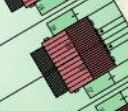
We will get the right half shown in the photo. Orientation is southwest.
The photovoltaic system will of course be installed on the southwest side facing the garden.
The black area is the 3x5 m (10x16 ft) terrace, which will later be covered with a fixed terrace roof measuring 4 m (13 ft) deep and 5.5 m (18 ft) wide.
My question is whether it will still be possible to install a photovoltaic system on the roof once the fixed terrace roof is there?
If the terrace roof is on the southwest side in the garden, it will no longer be possible to set up scaffolding.
For maintenance or in case of problems, access to the photovoltaic system will be necessary later on (is access without scaffolding not possible?)
Or can the photovoltaic system be installed without scaffolding?
The house will have a gable roof and 2.5 full stories.
we are planning a new semi-detached house.
We want to install a photovoltaic system later on.
We will get the right half shown in the photo. Orientation is southwest.
The photovoltaic system will of course be installed on the southwest side facing the garden.
The black area is the 3x5 m (10x16 ft) terrace, which will later be covered with a fixed terrace roof measuring 4 m (13 ft) deep and 5.5 m (18 ft) wide.
My question is whether it will still be possible to install a photovoltaic system on the roof once the fixed terrace roof is there?
If the terrace roof is on the southwest side in the garden, it will no longer be possible to set up scaffolding.
For maintenance or in case of problems, access to the photovoltaic system will be necessary later on (is access without scaffolding not possible?)
Or can the photovoltaic system be installed without scaffolding?
The house will have a gable roof and 2.5 full stories.

Here is my current energy balance for 2021. This represents the total household consumption measured by a single electricity meter. It includes a ground-source heat pump for heating and hot water, a mechanical ventilation system with heat recovery, as well as other household electricity use. The system features a 14.4 kWp (kilowatt-peak) photovoltaic installation with a 10 kWh (kilowatt-hour) battery, no electric car, and no fireplace:
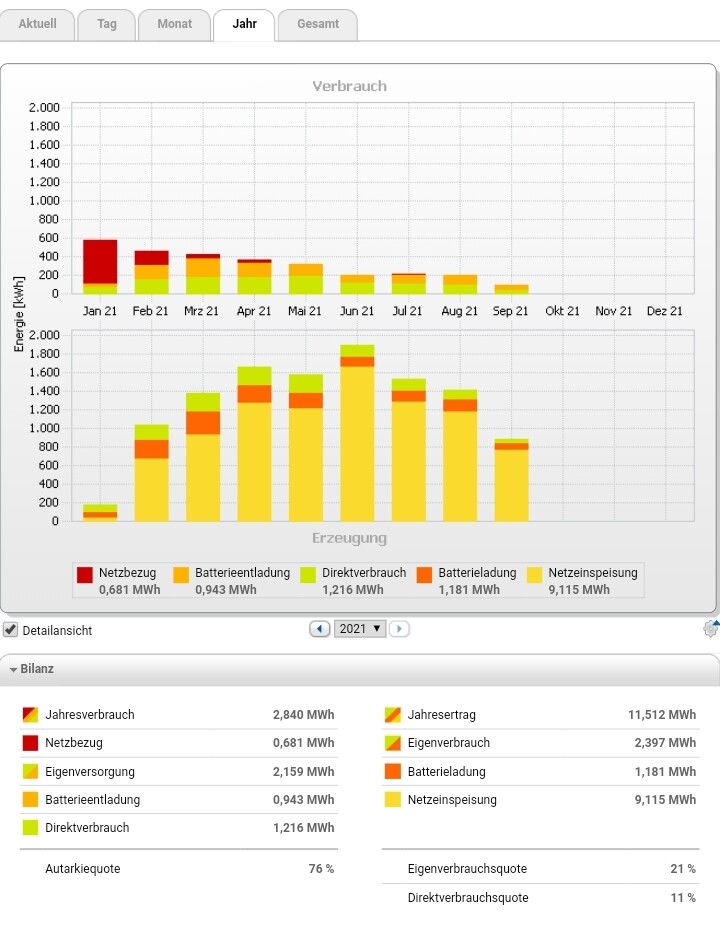
The orange portion of the consumption bars (at the top) represents battery discharge. The annual totals are listed in the table below. You can see that the battery significantly increases the self-sufficiency rate. We only chose the battery to qualify for the KfW 40+ subsidy (6,000 euros) and because the state of NRW provided an additional 2,000 euros direct grant. Whether it would be cost-effective without these subsidies, I cannot say, but probably not.
The orange portion of the consumption bars (at the top) represents battery discharge. The annual totals are listed in the table below. You can see that the battery significantly increases the self-sufficiency rate. We only chose the battery to qualify for the KfW 40+ subsidy (6,000 euros) and because the state of NRW provided an additional 2,000 euros direct grant. Whether it would be cost-effective without these subsidies, I cannot say, but probably not.
halmi schrieb:
It’s simply impossible to achieve the number of cycles needed to become even somewhat profitable. And during the darker months, you can’t fully charge the storage system to benefit from it.
If you calculate based on 200–220 cycles, the unit pays off, but the problem is that in reality, you can only reach a maximum of 100–120 cycles. Exactly, and this applies in both directions:
A “too large” battery doesn’t pay off because you purchase capacity that largely remains unused.
A “too small” battery goes through too many charge and discharge cycles in a short time and fails after just 2 to 3 years.
Li-ion cells typically last around 500 full cycles (defined as retention of 70% capacity), depending on internal design and product range, provided they are never deeply discharged or overcharged.
Considering the respective lifetime, solar thermal systems become comparatively more cost-effective than they are often claimed to be.
nordanney schrieb:
The problem can easily be solved with an electric car 😉But only if you charge it directly from the photovoltaic system. Using the home battery involves double storage losses of 10-20%. That’s no fun either.
konibar schrieb:
Li-ion cells have a lifespan of about 500 full charge cycles (defined at 70% remaining capacity), depending on internal design and product series, You unfortunately missed a zero in the number of full charge cycles. It is calculated up to 7,000 full cycles (which means many smaller charges and discharges) until reaching a remaining capacity of 80%. So there is no need to worry.
H
hampshire15 Sep 2021 13:46nordanney2 schrieb:
Unfortunately, you forgot to include zero for the number of full cycles. The calculation goes up to 7,000 full cycles (which means many more smaller charges and discharges) until a remaining capacity of 80%. There is no need to worry about that. At 7,000 full cycles, you can simply calculate based on 1 kWh of battery capacity:
7,000 * 0.9 kWh (average 90% of battery capacity) * 0.3 €/kWh (assumed average electricity price over the lifetime) = €1,890
This “back-of-the-envelope” calculation leaves out several parameters that are important for an economic analysis, such as how long it takes to reach those 7,000 cycles (certainly not within 10 years for a private household) and whether the electricity price assumption will hold true (probably it will be higher), not to mention interest rates and the opportunity cost of feeding energy back into the grid.
Let’s calculate with 200 cycles per year and an average price of 35 cents/kWh for 10 years:
2,000 * 0.9 * 0.35 = €777
A net kilowatt-hour battery costs between €400 and €500 in the residential sector today.
From this, it follows that a battery can be made to look either profitable or unprofitable—depending on which parameters you choose.
From the publicly available master data register, it can be seen that in the past 12 months, over 75% of photovoltaic systems between 5 and 15 kWp with storage have been applied for. People seem to want storage somehow.
My conclusion: there are some much more worthwhile investments and simultaneously a lot of significantly worse purchases.
Similar topics