
Hello everyone,
Now that our house construction is complete, I could really use some input, as we’re a bit uncertain and out of ideas.
This weekend, we will have an excavator again for a few weeks, and we plan to build a carport and a dry stone wall.
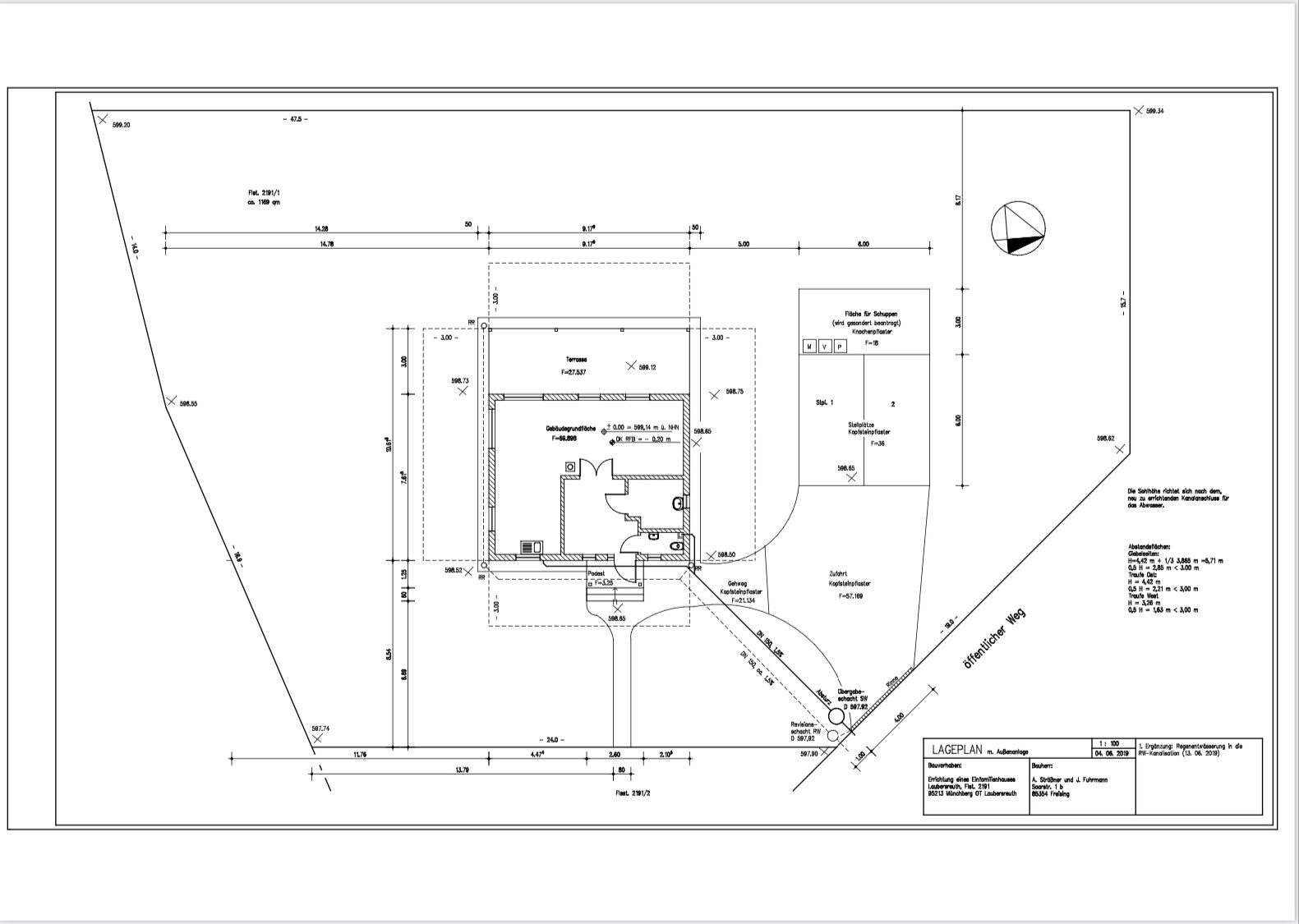
At the time, we thought we would implement it as shown on the site plan. But now, in practice, we don’t find it so appealing anymore :-(
The carport area on the north side is also supposed to serve as protection against wind and noise from the north, and a construction site container (3 x 6 m (10 x 20 ft)) is to be integrated.
On the site plan, it is shown positioned crosswise (marked as a shed), with two parking spaces in front... however, 5 m (16 ft) between the house and the carport now seem too much to us. We are now considering placing the container lengthwise, with one parking space next to it and an uncovered parking space between the house and carport... but I’m not quite sure.
The entire access to the property does not match the reality on the site plan... at the moment, we drive across the neighboring property below on a direct route to the house (and would possibly like to continue doing so—as there is a registered right of way). This would also eliminate the small path from the front door to the east...
Do you have any ideas? We cannot move closer to the northern boundary (which is also unnecessary), but we cannot shift further down (east) either. (Turning radius for agricultural “heavy-duty” traffic...)
Now that our house construction is complete, I could really use some input, as we’re a bit uncertain and out of ideas.
This weekend, we will have an excavator again for a few weeks, and we plan to build a carport and a dry stone wall.
At the time, we thought we would implement it as shown on the site plan. But now, in practice, we don’t find it so appealing anymore :-(
The carport area on the north side is also supposed to serve as protection against wind and noise from the north, and a construction site container (3 x 6 m (10 x 20 ft)) is to be integrated.
On the site plan, it is shown positioned crosswise (marked as a shed), with two parking spaces in front... however, 5 m (16 ft) between the house and the carport now seem too much to us. We are now considering placing the container lengthwise, with one parking space next to it and an uncovered parking space between the house and carport... but I’m not quite sure.
The entire access to the property does not match the reality on the site plan... at the moment, we drive across the neighboring property below on a direct route to the house (and would possibly like to continue doing so—as there is a registered right of way). This would also eliminate the small path from the front door to the east...
Do you have any ideas? We cannot move closer to the northern boundary (which is also unnecessary), but we cannot shift further down (east) either. (Turning radius for agricultural “heavy-duty” traffic...)

Grillhendl schrieb:
You’re right about that, @cschiko
In real life, it’s not really that intense…. I have no idea why….Because of natural stone, the brain doesn’t expect a uniform color like it does with dyed concrete. Try getting really close to the stone and observe the different colors in a natural stone; that’s why it blends in.
 Wolkensieben5 Jan 2021 16:30
That really suits my taste, very well done, especially since it was done as DIY work. Great job.
Please avoid using a pressure washer, as it washes away the surface and encourages even more green algae to accumulate.
In my opinion, natural stone should be left as it is. If you want to do something, then scrub it in spring with Lithofin green algae remover so you don’t slip on the wet, slippery surface.
If that’s not a problem for you and might be interesting:
cemeteries here often have curbstones made of gneiss, a black, white, and gray mottled stone. Municipalities are happy not to pay disposal costs.
Similarly, landscape gardeners on construction sites that work with natural stone collect leftovers and gradually find new uses for them.
We bought all our materials cheaply from exhibitors after a garden trade fair and installed them ourselves.
Since the fair has been canceled for the second time, you could visit building material suppliers and ask for leftover materials from exhibitions. If you’re lucky, you might also get an installation plan.
The companies that participated should be listed on the organizer’s website. They may still have palletized stock available, along with installation plans and photos.
Please avoid using a pressure washer, as it washes away the surface and encourages even more green algae to accumulate.
In my opinion, natural stone should be left as it is. If you want to do something, then scrub it in spring with Lithofin green algae remover so you don’t slip on the wet, slippery surface.
If that’s not a problem for you and might be interesting:
cemeteries here often have curbstones made of gneiss, a black, white, and gray mottled stone. Municipalities are happy not to pay disposal costs.
Similarly, landscape gardeners on construction sites that work with natural stone collect leftovers and gradually find new uses for them.
We bought all our materials cheaply from exhibitors after a garden trade fair and installed them ourselves.
Since the fair has been canceled for the second time, you could visit building material suppliers and ask for leftover materials from exhibitions. If you’re lucky, you might also get an installation plan.
The companies that participated should be listed on the organizer’s website. They may still have palletized stock available, along with installation plans and photos.
G
Grillhendl6 Jan 2021 11:34@Wolkensieben many thanks for this input. We will definitely keep an eye out for that as well.
At the moment, we get the bricks through a guy. He is a site supervisor in civil engineering and (especially in old towns) there are often interesting materials available that would otherwise end up at the landfill. It just takes a bit longer and costs almost nothing.
Well, as the saying goes: good things come to those who wait.
At the moment, we get the bricks through a guy. He is a site supervisor in civil engineering and (especially in old towns) there are often interesting materials available that would otherwise end up at the landfill. It just takes a bit longer and costs almost nothing.
Well, as the saying goes: good things come to those who wait.
G
Grillhendl14 Jan 2021 14:24Construction halt: The snow has defeated us and the excavator is broken.
P
pagoni202014 Jan 2021 14:31What a pity..... but it looks nice.....