
ᐅ Heating Load Calculation & Installation Plan According to DIN: Is a New Calculation Required?
Created on: 2 Nov 2020 11:15
T
Tolentino
Hello dear forum members,
Today I emailed my heating technician with my desired temperatures for each room. Unfortunately, he replied very quickly with a calculation and pipe layout plans that were simply done according to DIN standards. Since the structural engineer has not calculated anything yet, I am quite sure that no solar gains were included in the calculation. In any case, the total calculated heating load seems relatively high to me. What do you think?
I also mentioned that I want a flow temperature of 30°C (86°F) and a maximum pipe spacing of 10 cm (4 inches). He replied as follows:
“Since you have individual room control here, the warmest room always counts as the design peak for the flow temperature. 30 degrees is possible. Also, a fixed spacing for the piping is not practical here, because this would unnecessarily increase the pump power due to flow rate throttling.”
We had actually agreed to deactivate the individual room control and only install it to comply with the energy saving regulations. I don’t know why he forgot this again. I also don’t quite understand the rest. Does anyone have experience with this and can comment? @Daniel-Sp, @T_im_Norden, for example? You are the experts...
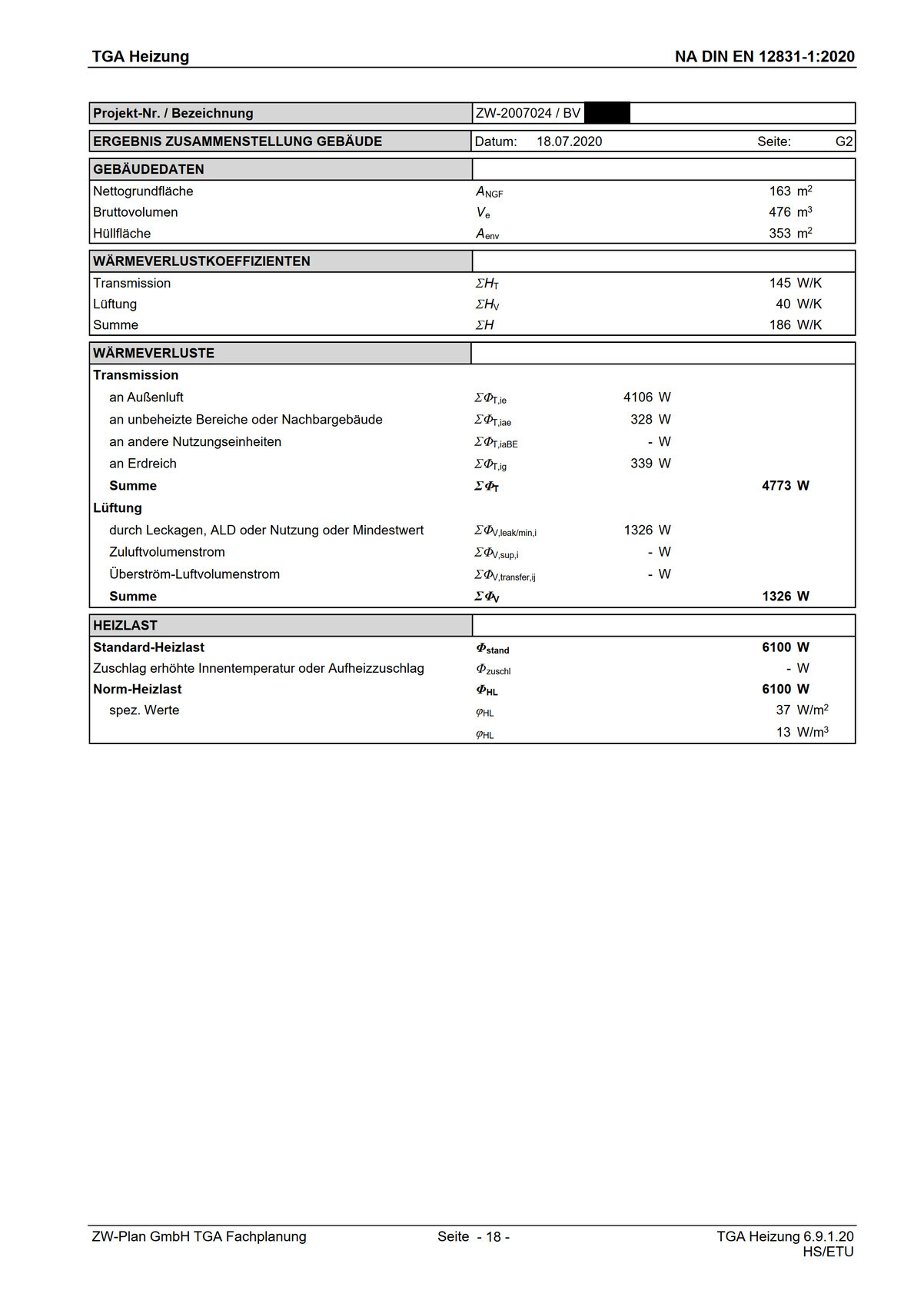
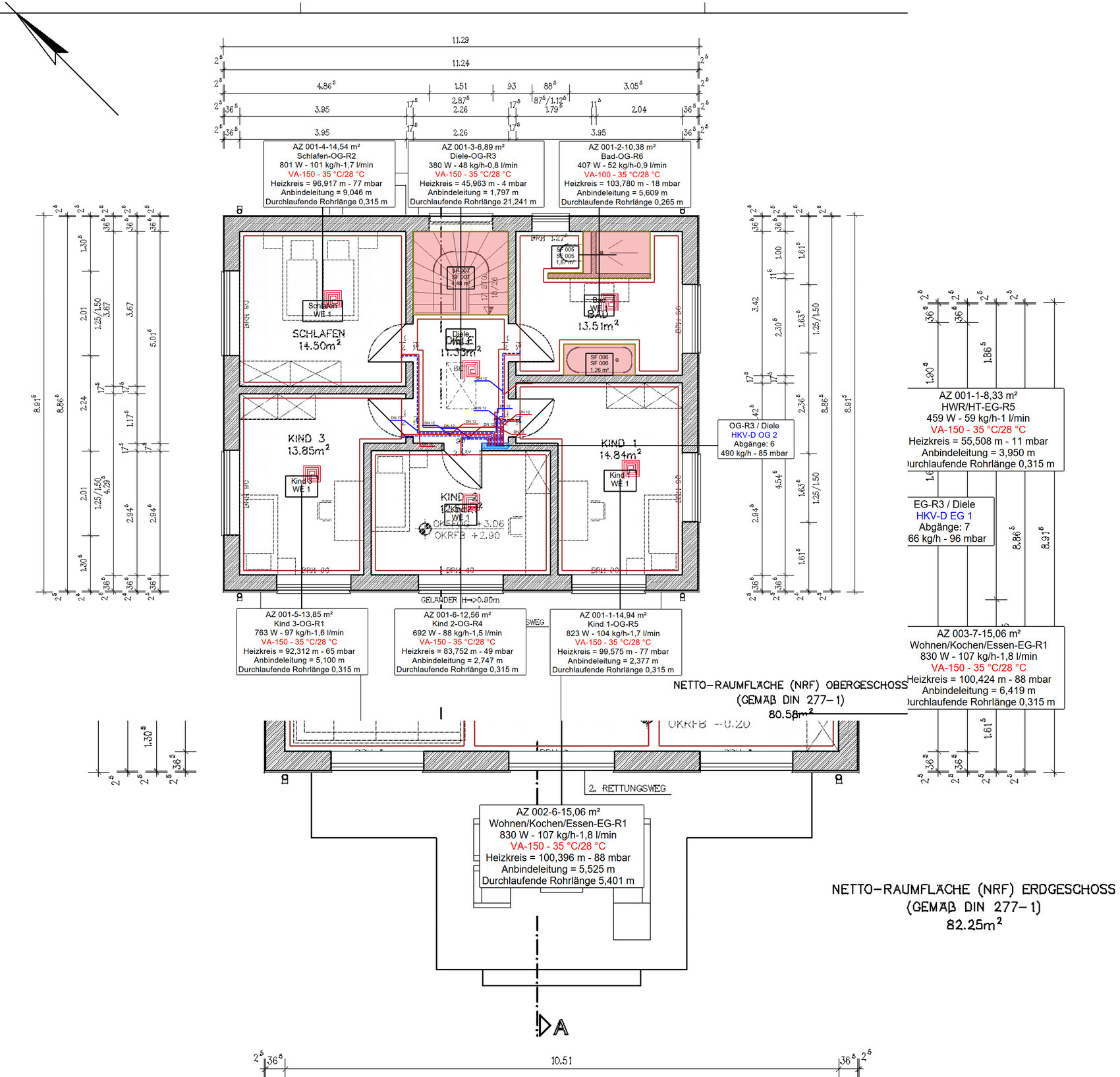
Attached are the last page of the heating load calculation and the pipe layout plan. If you also need the detailed calculations for the individual rooms, I can send screenshots of those as well.
Do I need a new calculation? Is there any way to adjust the existing calculation to fit my requested parameters?
Thanks and regards
Tolentino

Today I emailed my heating technician with my desired temperatures for each room. Unfortunately, he replied very quickly with a calculation and pipe layout plans that were simply done according to DIN standards. Since the structural engineer has not calculated anything yet, I am quite sure that no solar gains were included in the calculation. In any case, the total calculated heating load seems relatively high to me. What do you think?
I also mentioned that I want a flow temperature of 30°C (86°F) and a maximum pipe spacing of 10 cm (4 inches). He replied as follows:
“Since you have individual room control here, the warmest room always counts as the design peak for the flow temperature. 30 degrees is possible. Also, a fixed spacing for the piping is not practical here, because this would unnecessarily increase the pump power due to flow rate throttling.”
We had actually agreed to deactivate the individual room control and only install it to comply with the energy saving regulations. I don’t know why he forgot this again. I also don’t quite understand the rest. Does anyone have experience with this and can comment? @Daniel-Sp, @T_im_Norden, for example? You are the experts...
Attached are the last page of the heating load calculation and the pipe layout plan. If you also need the detailed calculations for the individual rooms, I can send screenshots of those as well.
Do I need a new calculation? Is there any way to adjust the existing calculation to fit my requested parameters?
Thanks and regards
Tolentino
T
T_im_Norden5 Nov 2020 17:17At OWL, 3m² (32ft²) of wall heating ensured that the temperature in the bathroom was comfortable.
This was calculated, yet most builders will tell you that such a small area won’t make much of a difference.
However, people who have wall heating can see that it does have an effect.
This was calculated, yet most builders will tell you that such a small area won’t make much of a difference.
However, people who have wall heating can see that it does have an effect.


Have you had the calculation done yet? I only designed for a 33°C (91°F) supply temperature, but almost everywhere I have hardwood flooring.
The temperatures are 21°C (70°F) in all living areas and 24°C (75°F) in the bathrooms.
With my two adjustments to the calculation and the fact that the window was removed, the pipe spacing in large parts of the house is 15cm (6 inches) and sometimes 20cm (8 inches). That is completely normal and nothing special. It only becomes intensive in the bathrooms, where there is 5cm (2 inches) spacing and wall heating.
He should first calculate several thousand euros. How much more pipe is needed, how many additional hours will it take, what does the larger manifold cost? The benchmark for material prices is then selfio.
The temperatures are 21°C (70°F) in all living areas and 24°C (75°F) in the bathrooms.
With my two adjustments to the calculation and the fact that the window was removed, the pipe spacing in large parts of the house is 15cm (6 inches) and sometimes 20cm (8 inches). That is completely normal and nothing special. It only becomes intensive in the bathrooms, where there is 5cm (2 inches) spacing and wall heating.
He should first calculate several thousand euros. How much more pipe is needed, how many additional hours will it take, what does the larger manifold cost? The benchmark for material prices is then selfio.
He says that the calculation will cost several thousand euros, as detailed as I want it. No, I won’t proceed until I have written confirmation from him that he will follow the installation plan from my office. Otherwise, I spend the money, and he still does it the way he thinks is right.
Seriously, 300€ is peanuts in house construction! Just do it and tell the engineer to aim for 30°C (86°F). Then you’ll see the results. Maybe you can work it out with the heating installer once they see the installation plan—that it’s not rocket science. It might also turn out that your energy-saving regulation / building regulations house actually doesn’t allow such low flow temperatures and higher temperatures must be used anyway.
The most expensive part of the entire design process is the heating load calculation. Once the formula is established, it’s just a matter of changing variables.
The most expensive part of the entire design process is the heating load calculation. Once the formula is established, it’s just a matter of changing variables.
Wow, U-values in the HLB:
Exterior wall: 0.25 instead of 0.10
Windows: 1.09 instead of approx. 0.85
They didn’t even check what is actually being built... Maybe I have a much lower heating load than the first calculation showed.
@OWL:
Yes, that’s one approach. But now I’ve already asked.
Edit: I looked through your thread again. Despite the bay window and basement, you only have 5.9 kW.
According to the first calculation, I have 6.1 kW without a basement, just a simple rectangle.
Even if you have a higher standard, there should actually be room for improvement on my end.
Maybe the heat pump is even oversized. Although I probably can’t change that anymore. It’s already registered with BAFA...
Exterior wall: 0.25 instead of 0.10
Windows: 1.09 instead of approx. 0.85
They didn’t even check what is actually being built... Maybe I have a much lower heating load than the first calculation showed.
@OWL:
Yes, that’s one approach. But now I’ve already asked.
Edit: I looked through your thread again. Despite the bay window and basement, you only have 5.9 kW.
According to the first calculation, I have 6.1 kW without a basement, just a simple rectangle.
Even if you have a higher standard, there should actually be room for improvement on my end.
Maybe the heat pump is even oversized. Although I probably can’t change that anymore. It’s already registered with BAFA...
Similar topics