
ᐅ Utility Connection: Telecom Company Refuses to Penetrate Watertight Concrete Structure
Created on: 6 Nov 2018 08:34
T
trapjaw
Hello,
we are currently in the middle of building our house (basement: waterproof concrete) and have already requested the application documents from the telecom provider for the house connection.
Summary: The telecom provider does not want to carry out a gas- and water-tight house entry seal, including sealing the cables they install where they enter the house — this responsibility is expected to be handled by the homeowner.
When we asked our site manager, he explicitly advised against us doing this ourselves (or having it done), as we would otherwise be liable for the connection. Based on experience in our building region, the telecom provider usually makes this difficult, but in this case, they want to "be firm."
The problem now is that despite multiple phone inquiries, the telecom company continues to refuse, and we are going in circles.
We are now considering submitting the application anyway and then trying to "resolve" the situation on site with the contractor or through our site manager. The application itself does not mention this issue, but it is addressed in the cover letter and in the "important notes regarding the house connection."
Does anyone have experience with this matter?
we are currently in the middle of building our house (basement: waterproof concrete) and have already requested the application documents from the telecom provider for the house connection.
Summary: The telecom provider does not want to carry out a gas- and water-tight house entry seal, including sealing the cables they install where they enter the house — this responsibility is expected to be handled by the homeowner.
When we asked our site manager, he explicitly advised against us doing this ourselves (or having it done), as we would otherwise be liable for the connection. Based on experience in our building region, the telecom provider usually makes this difficult, but in this case, they want to "be firm."
The problem now is that despite multiple phone inquiries, the telecom company continues to refuse, and we are going in circles.
We are now considering submitting the application anyway and then trying to "resolve" the situation on site with the contractor or through our site manager. The application itself does not mention this issue, but it is addressed in the cover letter and in the "important notes regarding the house connection."
Does anyone have experience with this matter?
Zaba12 schrieb:
Your general contractor and architect really messed up. The house entry point must be prepared before pouring the basement slab using a sealed drainage pipe. Check it out!
The holes from left to right: multi-utility, exhaust air for controlled mechanical ventilation, wastewater, air-to-water heat pump, controlled mechanical ventilation supply air geothermal heat exchanger (green)
Who are you letting build your house?
A core drill like that is really expensive!
It’s not Telekom’s fault.
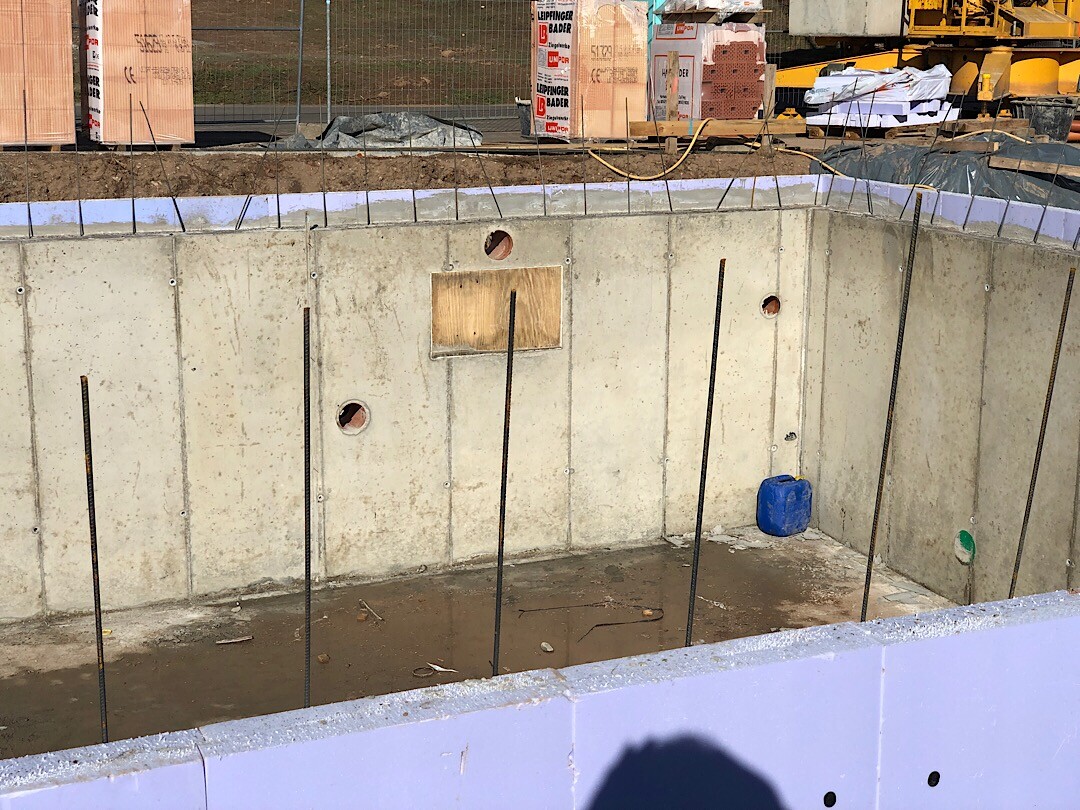
That’s not correct. In our case, it wasn’t done at the basement slab stage but differently. Only one homeowner in our development had it done exactly as you suggest.
In our case, the multi-utility connection is done by the utility company responsible for the electricity supply. They hired the civil engineer who excavated outside and then installed the multi-utility connection, including an empty conduit for Telekom, into the waterproof concrete basement shell.
So this time, it’s not Telekom’s fault.
Snowy36 schrieb:
That's not quite right. In our case, it wasn’t done at the foundation slab either, but differently. Only one builder in our development had it done immediately as you suggest.
Here, the multi-utility connection is handled by the utility company responsible for installing the electrical supply. They commissioned the civil engineer who excavated outside and then installed the multi-utility connection, including a conduit for the telecom provider, into the waterproof concrete shell.
This time, it’s not the telecom provider’s fault. Interesting. Maybe we are talking past each other. For us, either the structural contractor or the utility company could install the multi-utility connection.
But without an excavation, the multi-utility connection can’t be installed.
Now you can decide for yourself which option is more cost-effective for the builder.
Before the trenches for utility lines are dug, there is a detailed execution drawing. This drawing specifies and dimensionally indicates exactly where the empty conduits for the utility connections should be installed in the foundation. In the cellar, this means either inside the wall or depending on the design.
You don’t plan where the gas, water, and electricity lines will go during construction; this is done beforehand. I completed a 4-year apprenticeship in gas and water installation with the municipal utilities. During those four years, we only performed a core drill once in new construction. Usually, the hole or conduit was already there. Since the conduit is poured into the foundation from the outside, it only needs to be sealed properly on the inside. Because the interior is quite smooth and free of holes, you basically just need to press enough sealing material into the conduit, and it becomes reliably watertight. In those four years, there was only one issue with sealing. We had switched to a new two-component sealing material shortly before, which didn’t work well. It was then redone properly with the old sealing compound (Hilti HIT), and there were no more problems afterwards.
The suggestion to route the lines “from above” sounds good. There is no other option that would work anymore.
Whether it is the municipality or a higher authority, some requirements for the utility line penetrations have actually changed. While we used to install simple PVC pipes (often called “KG pipes”) in the footing, a former colleague had to install a rather expensive mounting bracket for the conduits. This was related to fire resistance or similar regulations because of the gas supply (we also have gas). I have never heard that this is mandatory and it seems to be a relatively new requirement. It sounds like complete nonsense, but it’s probably because the inventor of that bracket is related to someone responsible at the authority.
You don’t plan where the gas, water, and electricity lines will go during construction; this is done beforehand. I completed a 4-year apprenticeship in gas and water installation with the municipal utilities. During those four years, we only performed a core drill once in new construction. Usually, the hole or conduit was already there. Since the conduit is poured into the foundation from the outside, it only needs to be sealed properly on the inside. Because the interior is quite smooth and free of holes, you basically just need to press enough sealing material into the conduit, and it becomes reliably watertight. In those four years, there was only one issue with sealing. We had switched to a new two-component sealing material shortly before, which didn’t work well. It was then redone properly with the old sealing compound (Hilti HIT), and there were no more problems afterwards.
The suggestion to route the lines “from above” sounds good. There is no other option that would work anymore.
What does the municipality have to do with this?
Whether it is the municipality or a higher authority, some requirements for the utility line penetrations have actually changed. While we used to install simple PVC pipes (often called “KG pipes”) in the footing, a former colleague had to install a rather expensive mounting bracket for the conduits. This was related to fire resistance or similar regulations because of the gas supply (we also have gas). I have never heard that this is mandatory and it seems to be a relatively new requirement. It sounds like complete nonsense, but it’s probably because the inventor of that bracket is related to someone responsible at the authority.


How do electricity and similar utilities enter the house?
Our network operator required a multi-utility house entry.
These are available for walls, for the floor, and are also suitable for waterproof concrete basements.
The telecommunications company is not to blame. It is more likely the construction manager.
Our network operator required a multi-utility house entry.
These are available for walls, for the floor, and are also suitable for waterproof concrete basements.
The telecommunications company is not to blame. It is more likely the construction manager.
Similar topics