
Hello expert team,
we are planning to partially decorate our house with wooden cladding, either between the windows on the upper floor or alternatively the entire upper floor (see draft).
Based on your experience, does installing wooden cladding have a significant negative impact on thermal insulation? The brick is likely to be an unfilled Poroton 36.5, but this is not yet finalized. The cladding does not need to be flush with the plaster. I am now also aware of the importance of sharp drill bits and that hammer drilling should be avoided, so that makes sense to me 🙂
Please excuse any generalizations or incorrect use of terms—I am certainly not a professional 🙂
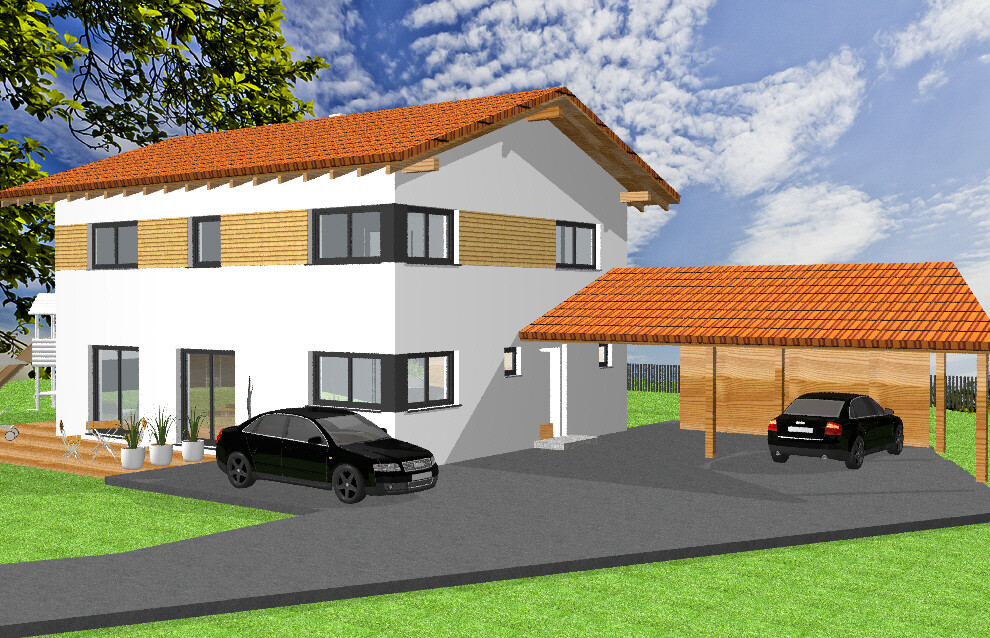
we are planning to partially decorate our house with wooden cladding, either between the windows on the upper floor or alternatively the entire upper floor (see draft).
Based on your experience, does installing wooden cladding have a significant negative impact on thermal insulation? The brick is likely to be an unfilled Poroton 36.5, but this is not yet finalized. The cladding does not need to be flush with the plaster. I am now also aware of the importance of sharp drill bits and that hammer drilling should be avoided, so that makes sense to me 🙂
Please excuse any generalizations or incorrect use of terms—I am certainly not a professional 🙂
Thank you for your reply, Behaelja,
I do not plan to remove anything or use other than 36.5 cm (14 inches) bricks on the upper floor. It would look unattractive if the cladding is removed later. This way, any holes from screws or anchors can be plastered over and repainted.
My main concern is the thermal insulation of the bricks, as drilling into them for fixing the cladding could be significant. I hadn't even thought about mold.
Is this an important issue when the installation is done professionally?
I do not plan to remove anything or use other than 36.5 cm (14 inches) bricks on the upper floor. It would look unattractive if the cladding is removed later. This way, any holes from screws or anchors can be plastered over and repainted.
My main concern is the thermal insulation of the bricks, as drilling into them for fixing the cladding could be significant. I hadn't even thought about mold.
Is this an important issue when the installation is done professionally?
K
Knallkörper30 Sep 2016 16:59You will also be installing larger anchors from the inside at some point. That has the same minimal effect. I wouldn’t see any problem with that.
There are anchor systems that do not create thermal bridges. My father-in-law, who works as a metalworker, had to attach balconies to insulated buildings. The requirement was that there must be no thermal bridging. After a meeting with the local Würth representative, the appropriate anchor was found. It is apparently either from Würth itself or from Fischer. The system is also certified and tested according to certain standards. Unfortunately, these anchors are, of course, more expensive.
Similar topics