
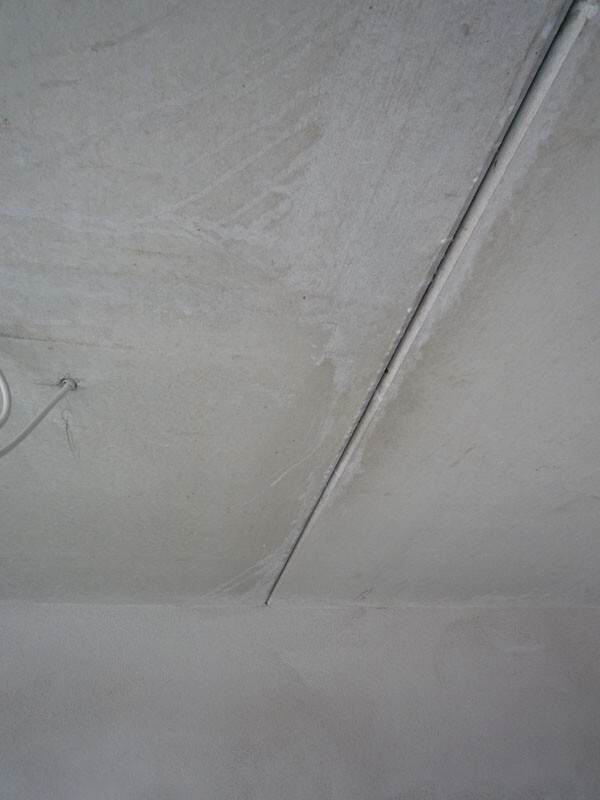
Hello dear experts. In our new build, I need to conceal the joints in the concrete ceiling. I have attached a picture for you. Could you please give me advice on which material I should use to fill the joints so that it doesn’t crack? I would also appreciate some tips on the general procedure. Thank you very much! Best regards, Stephan!
S
schwarzmeier25 Sep 2011 10:08What did you do wrong?
Basic principles:
Before any coating process, the substrate must be checked for load-bearing capacity and freedom from release agents.
If the substrate is insufficient, the unstable substrate must be removed, consolidated if possible, and primed in any case.
If the substrate is contaminated with release agents, these must be removed (surfactant washing, etc., search online). If the substrate is too smooth, it should be roughened or a bonding agent (plaster and bonding primer) applied. That’s it!
Basic principles:
Before any coating process, the substrate must be checked for load-bearing capacity and freedom from release agents.
If the substrate is insufficient, the unstable substrate must be removed, consolidated if possible, and primed in any case.
If the substrate is contaminated with release agents, these must be removed (surfactant washing, etc., search online). If the substrate is too smooth, it should be roughened or a bonding agent (plaster and bonding primer) applied. That’s it!
Hi, Wegga!
That looks bad – without a professional on site, this could become a never-ending issue.
I don’t quite understand your approach yet. Did you fill the entire ceiling? If so, no gray should be visible after the paint flakes off!?
Did you prime before painting?
The problem is: now you don’t have a sound ceiling anymore. To avoid extra work, you could try to repair the damaged spots. If that doesn’t work, the only option would be to scrape off all the filler again.
One thing I’ve learned recently: never save on materials (hardware store, DIY) – it ends up being too expensive!
Now a professional has to take a look – theoretical explanations about sinter layers, etc., don’t help from a distance.
Regards,
TomTom1
That looks bad – without a professional on site, this could become a never-ending issue.
I don’t quite understand your approach yet. Did you fill the entire ceiling? If so, no gray should be visible after the paint flakes off!?
Did you prime before painting?
The problem is: now you don’t have a sound ceiling anymore. To avoid extra work, you could try to repair the damaged spots. If that doesn’t work, the only option would be to scrape off all the filler again.
One thing I’ve learned recently: never save on materials (hardware store, DIY) – it ends up being too expensive!
Now a professional has to take a look – theoretical explanations about sinter layers, etc., don’t help from a distance.
Regards,
TomTom1
No, I did not prime. According to my drywall contractor, that was probably the problem. He recommended priming and then painting over it. Definitely no filler. My acquaintance who did the filling (painter) says that if you fill, you don’t need to prime. So, the two of them contradict each other somehow. But now many factors might have contributed: no priming, cheap paint, filler not fully dry.
Strangely, wherever the paint is peeling off, everything has come off completely, both paint and filler. I have now completely sanded down the ceiling that fell apart and primed it first. In the next few days, I will repaint with strongly thinned paint.
In the other room, I have thoroughly cleaned and sanded the spots. Here I have primed and am trying to patch it. If that works, everything is fine, and I will proceed the same way with the large ceiling on the ground floor. If that doesn’t work, I will probably have to apply a covering (textured wallpaper / plaster / wood paneling). I will keep you updated. Thanks so far!
Strangely, wherever the paint is peeling off, everything has come off completely, both paint and filler. I have now completely sanded down the ceiling that fell apart and primed it first. In the next few days, I will repaint with strongly thinned paint.
In the other room, I have thoroughly cleaned and sanded the spots. Here I have primed and am trying to patch it. If that works, everything is fine, and I will proceed the same way with the large ceiling on the ground floor. If that doesn’t work, I will probably have to apply a covering (textured wallpaper / plaster / wood paneling). I will keep you updated. Thanks so far!
Hello!
I was also told that you don’t HAVE to prime before applying filler. I always prime though. It costs nothing and doesn’t hurt!
So – it definitely wasn’t the cheap paint causing the issue – it has other drawbacks. I had already warned about the endless work involved. If the filler and paint won’t stick to the ceiling, why should cleaning or wallpapering work?
Anything that is somewhat anchored, like a panel ceiling, will definitely solve the problem – but you have to like that.
I hope the patching will be enough. The only downside is that there’s no guarantee that the previously trouble-free areas of the ceiling won’t develop problems in the future.
Best regards,
TomTom1
I was also told that you don’t HAVE to prime before applying filler. I always prime though. It costs nothing and doesn’t hurt!
So – it definitely wasn’t the cheap paint causing the issue – it has other drawbacks. I had already warned about the endless work involved. If the filler and paint won’t stick to the ceiling, why should cleaning or wallpapering work?
Anything that is somewhat anchored, like a panel ceiling, will definitely solve the problem – but you have to like that.
I hope the patching will be enough. The only downside is that there’s no guarantee that the previously trouble-free areas of the ceiling won’t develop problems in the future.
Best regards,
TomTom1
Yes, entrusting the job to a painting contractor would certainly have been the easiest and safest option — but also the most expensive! It is a task that, as a homeowner, I felt I could take on myself, and I still do. The money to hire a painting contractor simply isn’t available right now. Therefore, I have to find other solutions.
Of course, from a professional’s point of view, this might seem like a patchwork job. But in the end, I want a white wall or ceiling. I’m sharing this so others might avoid similar mistakes. I appreciate your advice and have no intention of questioning your skills or experience.
Unfortunately, the repair attempts in the basement room shown above were unsuccessful. The spots that were repaired held up well, but other areas started peeling. So we swallowed the bitter pill and scraped off the entire ceiling, including the filler. Now I will try a primer and paint over it again.
No hard feelings, and thanks again for your help and comments — even the critical ones!
Best regards,
Stephan!
Of course, from a professional’s point of view, this might seem like a patchwork job. But in the end, I want a white wall or ceiling. I’m sharing this so others might avoid similar mistakes. I appreciate your advice and have no intention of questioning your skills or experience.
Unfortunately, the repair attempts in the basement room shown above were unsuccessful. The spots that were repaired held up well, but other areas started peeling. So we swallowed the bitter pill and scraped off the entire ceiling, including the filler. Now I will try a primer and paint over it again.
No hard feelings, and thanks again for your help and comments — even the critical ones!
Best regards,
Stephan!
Similar topics