
Hello everyone,
We have decided to install a pool and want an automatic water refill system as well. This means we need water supply in our outdoor storage area, where the pool equipment and irrigation control will be located. Of course, we didn’t consider this during planning and construction, as the desire for a pool and automatic irrigation came much later. Anyway.
The outdoor storage is part of the house but is outside the thermal envelope and has no direct access from the house. Now the question is how to get the water connection into the outdoor storage. We would definitely install a backflow preventer. There are basically two options:
1) The pool installer suggested running an additional cold water line from the utility room on the opposite side of the house into the outdoor storage. We could tap off from there. However, this would require a core drill through the concrete wall and insulation, which I would prefer to avoid. The pool installer says this would pose no problem if the drill hole is properly foamed/sealed afterwards. So neither thermal nor sound insulation should be affected, especially since the outdoor storage already has a door and is otherwise tight.
2) I’ve only recently considered this option. We already have a frost-free outdoor faucet at the front. Would it theoretically be possible to modify this faucet or run a line from it through the garden and the front, uninsulated wall of the outdoor storage to supply the equipment? Or is this not advisable or feasible for some reason? The missing outdoor faucet could potentially be replaced by a water outlet if this works out.
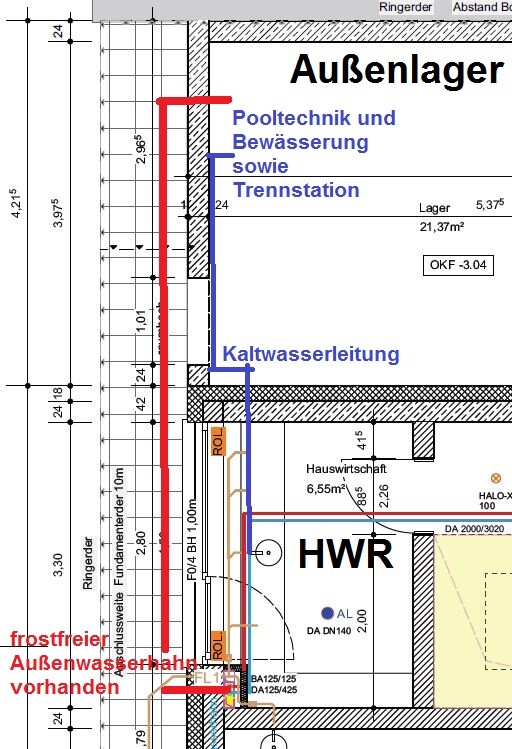
What do the experts say? Is the solution with the additional line harmless and cleaner? Or am I risking creating a hole that wouldn’t be necessary otherwise?
Best regards
We have decided to install a pool and want an automatic water refill system as well. This means we need water supply in our outdoor storage area, where the pool equipment and irrigation control will be located. Of course, we didn’t consider this during planning and construction, as the desire for a pool and automatic irrigation came much later. Anyway.
The outdoor storage is part of the house but is outside the thermal envelope and has no direct access from the house. Now the question is how to get the water connection into the outdoor storage. We would definitely install a backflow preventer. There are basically two options:
1) The pool installer suggested running an additional cold water line from the utility room on the opposite side of the house into the outdoor storage. We could tap off from there. However, this would require a core drill through the concrete wall and insulation, which I would prefer to avoid. The pool installer says this would pose no problem if the drill hole is properly foamed/sealed afterwards. So neither thermal nor sound insulation should be affected, especially since the outdoor storage already has a door and is otherwise tight.
2) I’ve only recently considered this option. We already have a frost-free outdoor faucet at the front. Would it theoretically be possible to modify this faucet or run a line from it through the garden and the front, uninsulated wall of the outdoor storage to supply the equipment? Or is this not advisable or feasible for some reason? The missing outdoor faucet could potentially be replaced by a water outlet if this works out.
What do the experts say? Is the solution with the additional line harmless and cleaner? Or am I risking creating a hole that wouldn’t be necessary otherwise?
Best regards

Here’s an update from me. After the on-site meeting with the landscaper and pool installer regarding the connections, both recommended using a cistern for garden irrigation. I think that’s a sensible idea. Especially since the pool installer is currently developing a filter to remove chlorine from the water, which would allow the weekly backwash to be redirected into the cistern. However, connecting it to the rainwater shaft is quite complex. They need to excavate two meters (6.5 feet) deep over a length of 10 meters (33 feet). Today, I received a quote for a Graf XL plastic cistern including delivery, installation, and connection for just under 10,000 € (euros). I find that quite steep… Does anyone have an opinion on this? I don’t really want to handle the connection myself and don’t have the experience for it.

You can direct the backwash water straight into the cistern. The chlorine is immediately neutralized.
There’s no need for a filter… just a money-making scheme.
There are plenty of tests showing that this is not a problem with the low chlorine levels.
We also have a cistern from Graf (76,000 liters (20,066 gallons)). I can only report positive experiences.
There’s no need for a filter… just a money-making scheme.
There are plenty of tests showing that this is not a problem with the low chlorine levels.
We also have a cistern from Graf (76,000 liters (20,066 gallons)). I can only report positive experiences.
rick2018 schrieb:
You can direct the backwash water straight into the cistern. The chlorine is immediately neutralized.
No filter needed… just a way to make money.
There are plenty of tests showing that this causes no issues with the low chlorine levels.
We also have a Graf cistern (76,000 liters (20,067 gallons)). I can only report positive experiences. Thanks for the quick reply. It’s convenient that you also have a Graf. Our landscaping contractor would install the 10,000-liter (2,642-gallon) version. Do you find that price reasonable? Around €10,000 including installation, connection, etc.?
The size of your cistern is quite impressive 🙂. Off the top of my head, I was leaning towards concrete. What convinced you to go with a plastic tank? Or what positives have you noticed in operation with the Graf tank?
To be fair to the pool builder, he only mentioned it briefly and was proud that the filter is fairly simple, not expensive if it works as planned, and can be filled by oneself. But if I don’t need it, that’s even better. How exactly or by what process is the chlorine neutralized?
Chlor is neutralized when it comes into contact with dirt, soil, water, and so on. The concentration in a pool is so low that this happens immediately. Backwash water contains less chlorine because the dirt in the filter has already reacted with it.
The plastic cistern from Graf is well designed. It has a proper pre-filter with a flushing function and a telescopic dome shaft to adjust the height. Concrete tends to become leaky more easily.
10,000€ is not an excessive amount for earthworks, installation, and the cistern. Is the filter included as well? Transport alone costs quite a bit.
You know yourself that everything is getting more expensive and has already done so.
Manufacturing plastic granules, injection molding, logistics, etc.
Also, with 10,000 liters (2,640 gallons), you have a larger cistern than the usual 5,000-7,000 liters (1,320-1,850 gallons).
The plastic cistern from Graf is well designed. It has a proper pre-filter with a flushing function and a telescopic dome shaft to adjust the height. Concrete tends to become leaky more easily.
10,000€ is not an excessive amount for earthworks, installation, and the cistern. Is the filter included as well? Transport alone costs quite a bit.
You know yourself that everything is getting more expensive and has already done so.
Manufacturing plastic granules, injection molding, logistics, etc.
Also, with 10,000 liters (2,640 gallons), you have a larger cistern than the usual 5,000-7,000 liters (1,320-1,850 gallons).
@rick2018: We’re starting next week. The cistern is ordered, and all the holes for the connections are drilled. Now I’m focusing on the materials for the irrigation system. I came across DVS irrigation products. They have several levels like eco, premium, and expert. Do you happen to have any experience with these and how to evaluate them? Is it worth going for the highest level, or would the basic or mid-range options be sufficient? I’m having a hard time figuring out what this really means for me.
Similar topics