
ᐅ Tongue-and-groove boards or OSB panels for the attic (potential future conversion)
Created on: 1 Aug 2019 15:25
J
julianpe
Hello everyone,
Recently, the shell of our house was completed. In the meantime, I would like to make the attic floor usable for walking.
There are two different opinions about which material is best for this purpose.
OSB or tongue-and-groove boards?
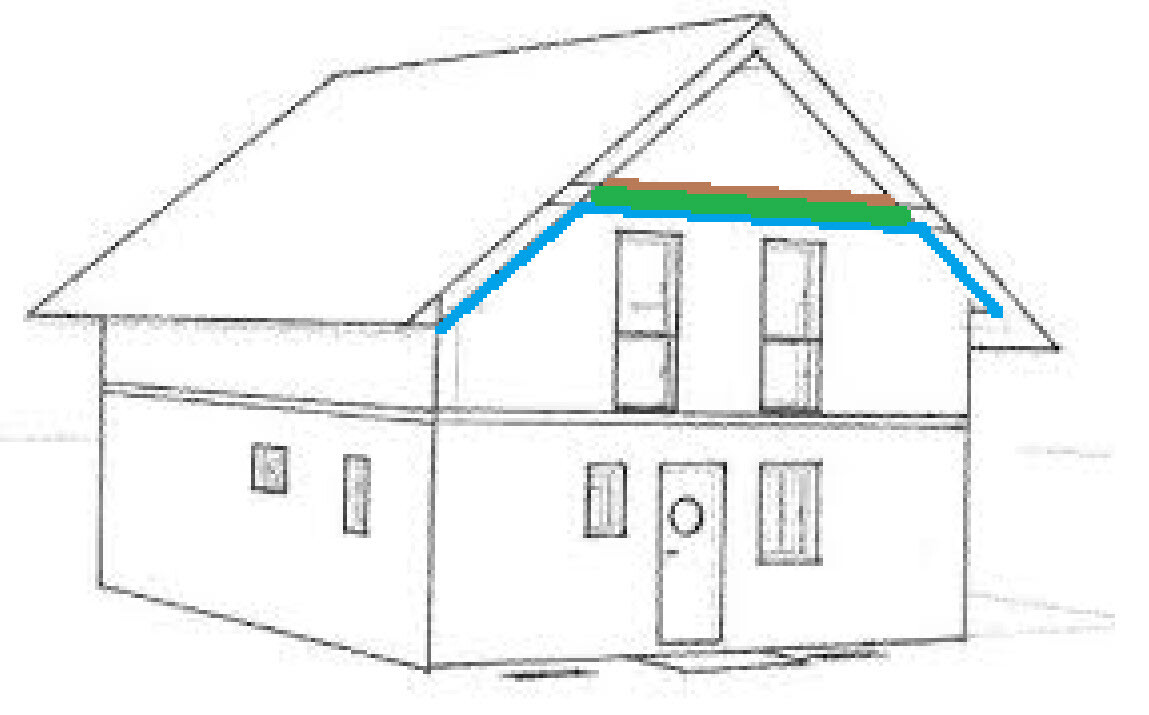
The following structure will be installed later (see attachment).
The vapor barrier (blue) will be applied from below to the wooden beam ceiling on the upper floor. The insulation (green) will be placed in the intermediate ceiling.
I would now like to install a covering (brown) on top of the rafters.
OSB is vapor-tight, whereas tongue-and-groove boards are not.
The attic will primarily be used as storage space.
For this reason, I would choose tongue-and-groove boards.
What needs to be changed or considered if, in x years, I decide to convert the attic into living space or an office?
New insulation on the inside of the roof, extending the vapor barrier up to the ridge and bonding it with the existing barrier, etc.?
Thank you very much for your assessments.
Best regards,
julianpe
Recently, the shell of our house was completed. In the meantime, I would like to make the attic floor usable for walking.
There are two different opinions about which material is best for this purpose.
OSB or tongue-and-groove boards?
The following structure will be installed later (see attachment).
The vapor barrier (blue) will be applied from below to the wooden beam ceiling on the upper floor. The insulation (green) will be placed in the intermediate ceiling.
I would now like to install a covering (brown) on top of the rafters.
OSB is vapor-tight, whereas tongue-and-groove boards are not.
The attic will primarily be used as storage space.
For this reason, I would choose tongue-and-groove boards.
What needs to be changed or considered if, in x years, I decide to convert the attic into living space or an office?
New insulation on the inside of the roof, extending the vapor barrier up to the ridge and bonding it with the existing barrier, etc.?
Thank you very much for your assessments.
Best regards,
julianpe
M
Mottenhausen2 Aug 2019 14:11The OSB panels in the roof structure might crack along some joints together with the wallpaper. So, either screw on another layer of gypsum boards directly and fill the joints (with mesh), or sand and fill the OSB panels directly and, for example, cover them with a durable painter’s fleece. OSB panels painted directly can also look good and are found this way in some new hotels. However, a more expensive sealing primer may be necessary here, as the adhesive in the panels can dissolve. I had forgotten that OSB may not be the best choice for living spaces. I wouldn’t want to know what fumes are released from the adhesive over the years. Since it only serves as a storage room for us, it wasn’t that important, and the “raw” look is acceptable overall.
The image in the original post was just an example. The ridge height is about 2.20 m (7 ft 3 in) from the beam level. Would it be advisable now to insulate the spaces between the rafters with insulation batts? This way, both the intermediate ceiling and the inside of the roof would be insulated. At which points would a vapor barrier be necessary, and which type of wood sheathing (OSB or tongue-and-groove boards) would be best in this situation?
Thank you for sharing your experiences.
Thank you for sharing your experiences.
M
Mottenhausen4 Aug 2019 21:02To be honest, the compressed mineral wool insulation (20cm thick, WLG40) performed quite poorly for us, with rafter spacing of about 63cm (25 inches). It slipped out here and there. This means it was necessary anyway to cover the rafters from below so the insulation would have something to rest against. If you want to prepare the space as living area, the "correct" construction method would be: a vapor barrier applied to the underside of the rafters, then counter battens, and then, for example, gypsum fiber boards. I don’t really see OSB boards being suitable here (as I mentioned earlier). However, for flooring, OSB works well due to minimal height loss and good stability.
The idea that "OSB equals vapor barrier" has its drawbacks, of course. Depending on the manufacturer and the thickness of the boards, they can be more or less airtight. Since you have the proper vapor retarder below the ceiling, not much moisture will build up there anyway. But in living spaces (like an office), it’s different. I’m no expert—I just did some research before finishing the space: what goes where and why—and concluded that the OSB option is optimal for a pure storage floor.
The idea that "OSB equals vapor barrier" has its drawbacks, of course. Depending on the manufacturer and the thickness of the boards, they can be more or less airtight. Since you have the proper vapor retarder below the ceiling, not much moisture will build up there anyway. But in living spaces (like an office), it’s different. I’m no expert—I just did some research before finishing the space: what goes where and why—and concluded that the OSB option is optimal for a pure storage floor.
So OSB with underlying counter battens or tongue-and-groove boards with underlying counter battens ultimately makes no difference, as in both cases air can circulate between the insulating mineral wool and the flooring. With proper sealing of the vapor barrier, no mold can develop.
Similar topics