
We have a groundwater heat pump, an electric heating element for hot water, and a 10 kW solar system with a 25 kWh (27 kWh) battery storage.
Now in winter, the solar system produces practically nothing. The electricity demand is supplied from the grid.
The system shows the daily electricity consumption.
What I don’t understand about these curves is the electricity demand around 4:00 AM. At that time, we are sleeping, and except for the heat pump, no electricity should be needed. I am not aware of any timer switch that turns anything on at that time.
What could that be?
Best regards,
Bernd
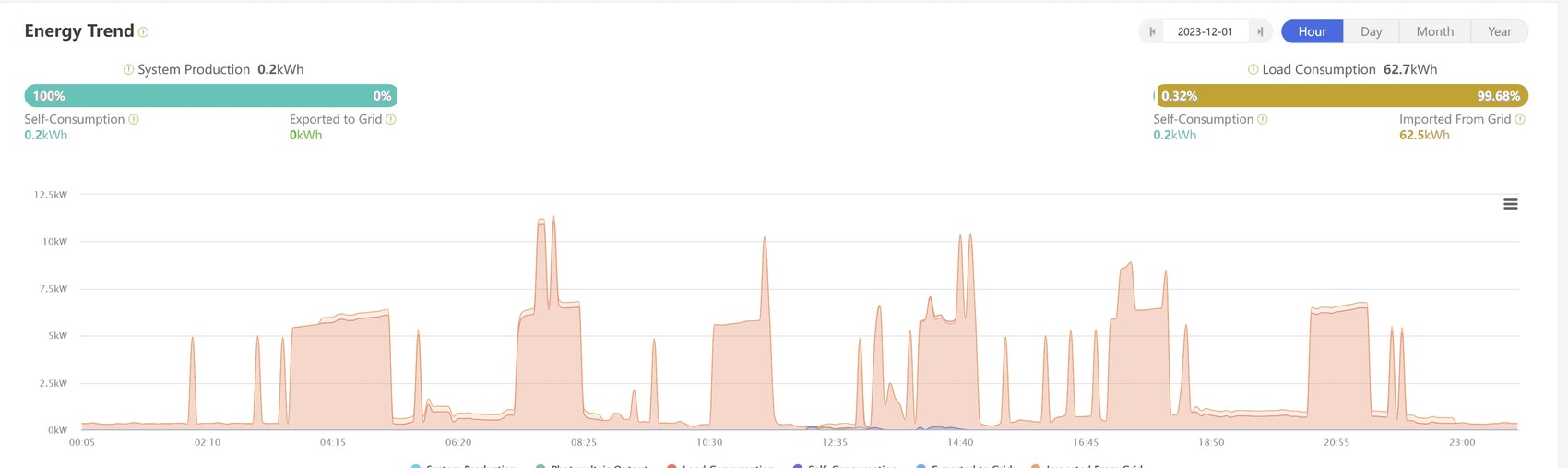
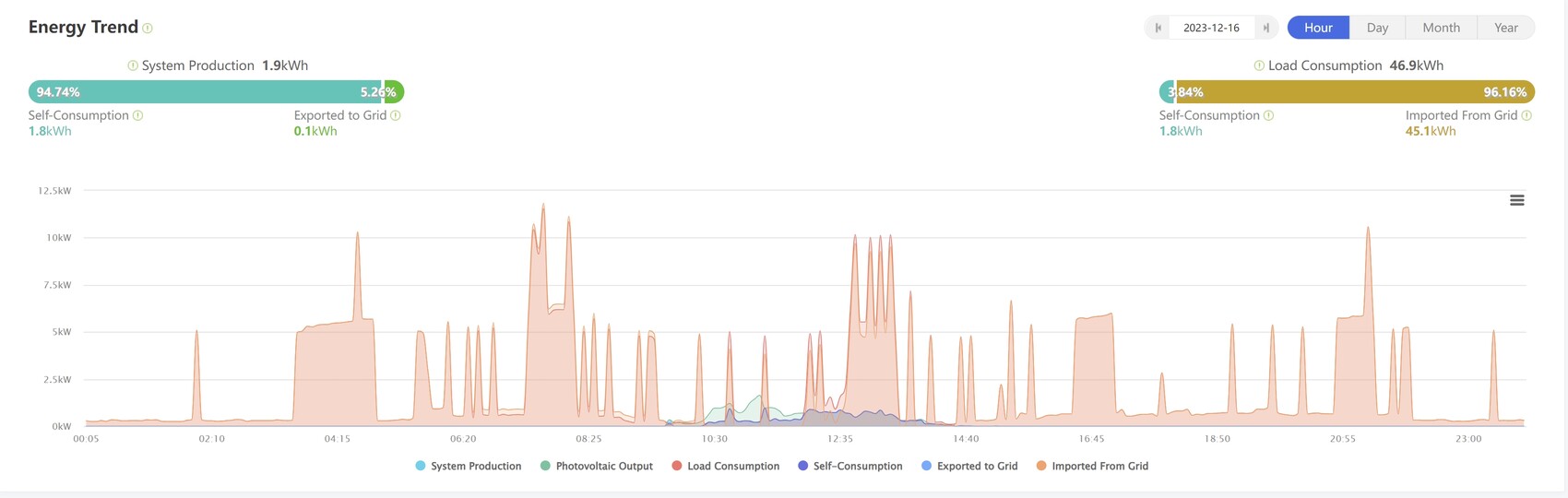
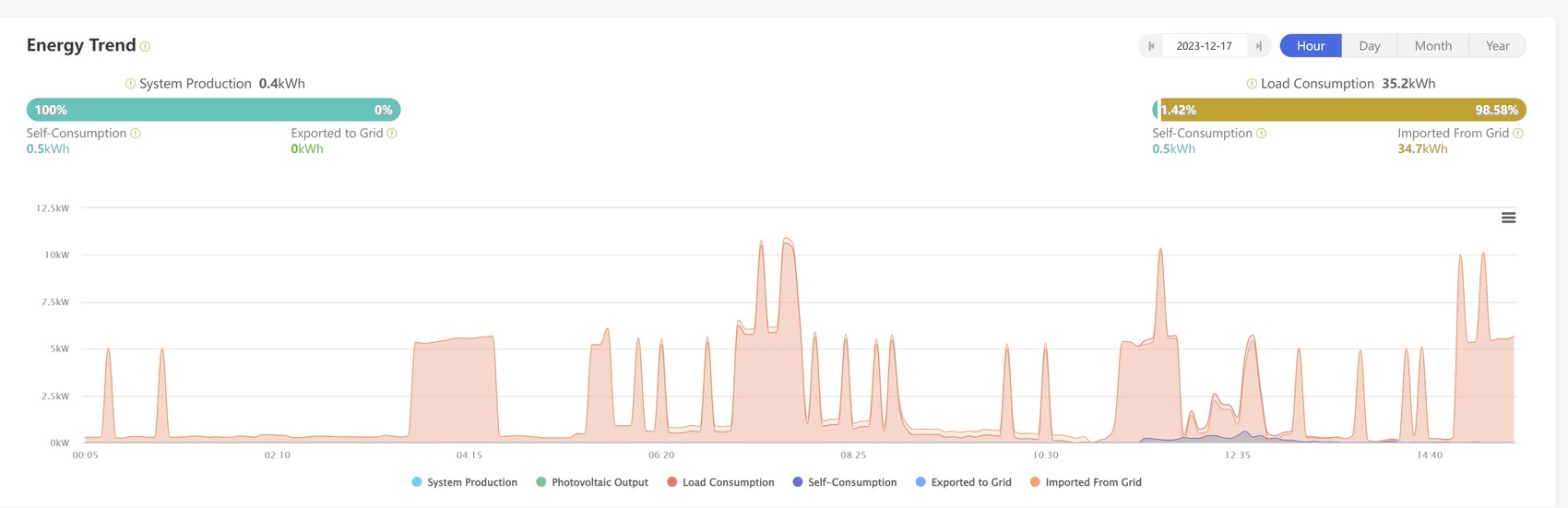
Now in winter, the solar system produces practically nothing. The electricity demand is supplied from the grid.
The system shows the daily electricity consumption.
What I don’t understand about these curves is the electricity demand around 4:00 AM. At that time, we are sleeping, and except for the heat pump, no electricity should be needed. I am not aware of any timer switch that turns anything on at that time.
What could that be?
Best regards,
Bernd
M
marienschatten19 Dec 2023 10:10The peaks clearly represent the electric heating element, while the broad blocks correspond to the heat pump or household electricity. It is highly unlikely that the outdoor temperature drops precisely at 4:00 AM every night enough to trigger the heating system. During the day, the blocks are distributed irregularly, and the household electricity usage typically follows the daily pattern. The large block occurring at night does not fit this pattern.
The heat pump requires 5 kW, the electric heating element 6 kW, and there are no other significant consumers.
There is no night setback. Since installing the solar system, we have had just one electricity tariff without any time-based switching.
The heat pump requires 5 kW, the electric heating element 6 kW, and there are no other significant consumers.
There is no night setback. Since installing the solar system, we have had just one electricity tariff without any time-based switching.

Then it is a night setback/night shutdown. The heating element doesn’t seem to always start at 4 either, but the heat pump does.
Do you have your user manual as a PDF? Try searching it with keywords like "night shutdown," "night setback," "night program," "timer," "weekly schedule," "programmed control," etc.
Do you have your user manual as a PDF? Try searching it with keywords like "night shutdown," "night setback," "night program," "timer," "weekly schedule," "programmed control," etc.

From 4 a.m., those are exactly the 5 kWh that the heat pump provides, right?
Since there is no block overnight, there must actually be a night shutdown that lasts until around 4 a.m. After that, the pump starts and catches up.
That’s why this is also the largest block.
It’s interesting that the blocks are always wedge-shaped. The electricity consumption increases the longer the heating runs, meaning the closer you get to the end of the cycle.
Since there is no block overnight, there must actually be a night shutdown that lasts until around 4 a.m. After that, the pump starts and catches up.
That’s why this is also the largest block.
It’s interesting that the blocks are always wedge-shaped. The electricity consumption increases the longer the heating runs, meaning the closer you get to the end of the cycle.
M
marienschatten19 Dec 2023 11:46Once again: There is no night shutdown because it makes little sense for underfloor heating.
R
RotorMotor19 Dec 2023 12:04Then the heat pump might just be operating normally, either for hot water or for heating.
The graphs clearly show that it doesn’t always run at 4:00, but rather throughout the day and sometimes at night as well.
What type of heat pump is installed exactly?
The graphs clearly show that it doesn’t always run at 4:00, but rather throughout the day and sometimes at night as well.
What type of heat pump is installed exactly?
That doesn’t seem plausible, because then these heat pump plateaus would also occur between 10 p.m. and 4 a.m. However, according to the diagrams you initially showed, they do not appear in that period (only short peaks). The fact that the target temperature is not undercut during that time, but is several times during the day, is also unlikely since it is usually cooler at night than during the day. But, of course, the sample size is small.
It may be that you do not want a night setback or shutdown, but the data suggests that there is one. So, it’s worth reviewing the manual and control menu again. Sometimes there are multiple settings that have the same effect.
Example: Night setback: scheduler that lowers the setpoint temperature (possibly the flow temperature target) during a defined period or sets a different temperature.
Example: Shutdown: lockout period during which the heat pump simply does not operate at all.
But this plateau, which according to the original poster is the heat pump in heating mode, always appears at 4 a.m. and never between 10 p.m. and 4 a.m. The short peaks are presumably domestic hot water.
It may be that you do not want a night setback or shutdown, but the data suggests that there is one. So, it’s worth reviewing the manual and control menu again. Sometimes there are multiple settings that have the same effect.
Example: Night setback: scheduler that lowers the setpoint temperature (possibly the flow temperature target) during a defined period or sets a different temperature.
Example: Shutdown: lockout period during which the heat pump simply does not operate at all.
RotorMotor schrieb:
The graphs clearly show that it is not always 4:00
But this plateau, which according to the original poster is the heat pump in heating mode, always appears at 4 a.m. and never between 10 p.m. and 4 a.m. The short peaks are presumably domestic hot water.
Similar topics