
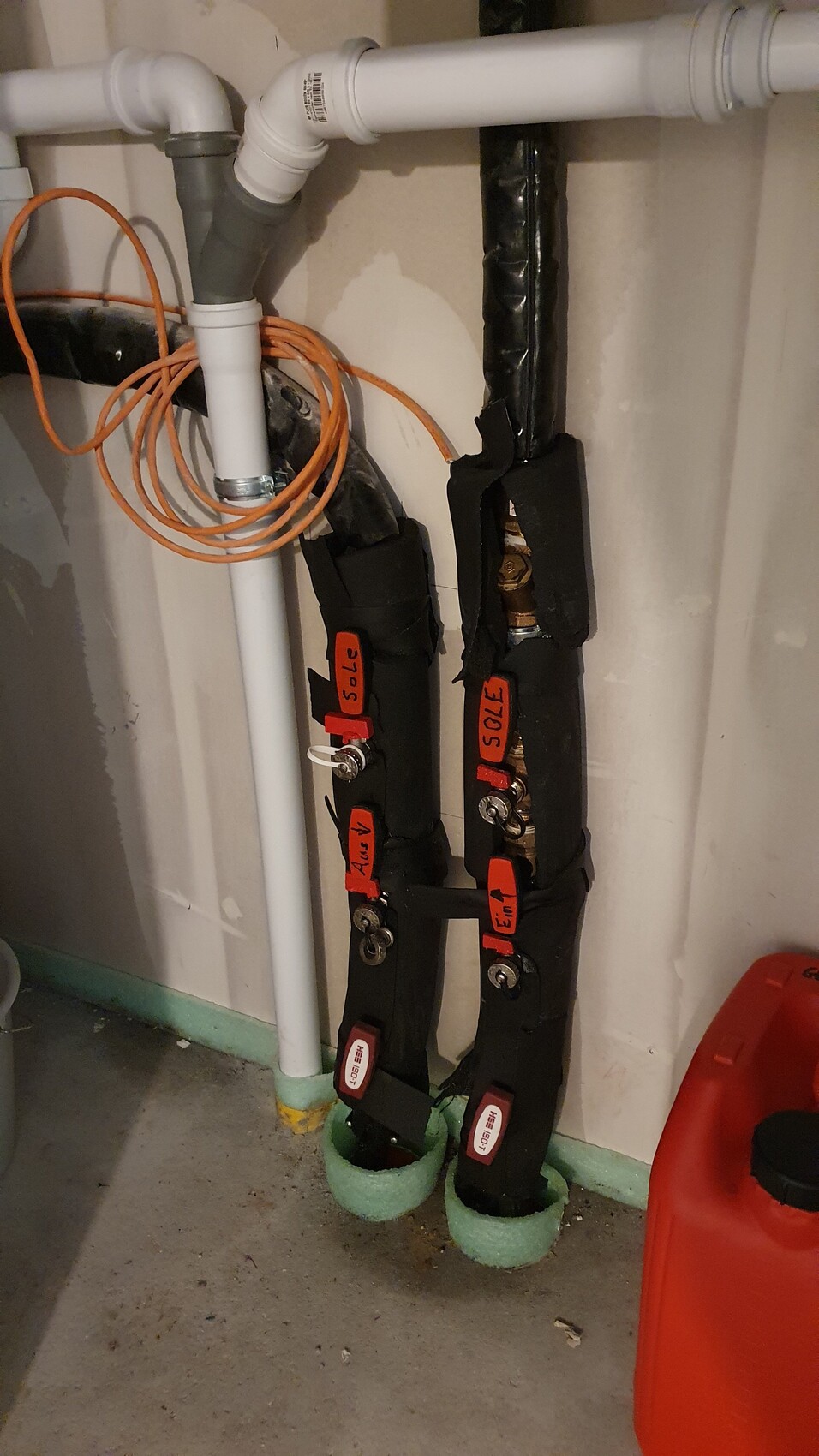
We have been using our Viessmann heat pump for a few weeks now. So far, it only needed to provide cooling and hot water, but now that the nights and days are getting colder, we noticed that the ground loop pipe has developed a thick layer of ice, especially in areas where there is little or no insulation on the pipe. During the day, the ice melts and drips, making the floor wet.
I thought this was due to insufficient insulation, and that fully and properly insulating the pipes should solve the problem. However, I recently read that while insulation may help prevent icing, it doesn’t address the root cause, and that this kind of ice buildup isn’t normal. Does anyone have experience with this?
I thought this was due to insufficient insulation, and that fully and properly insulating the pipes should solve the problem. However, I recently read that while insulation may help prevent icing, it doesn’t address the root cause, and that this kind of ice buildup isn’t normal. Does anyone have experience with this?
Phew, how is it possible to have such a low supply temperature in the ground loop during this season?! That of course explains the ice.
Two theories.
1) Screed heated with probes, the probes are overloaded and need to regenerate or are even irreparably damaged. Never dry the screed using the probes!
2) Probes are turned off, for example at the manifold.
Two theories.
1) Screed heated with probes, the probes are overloaded and need to regenerate or are even irreparably damaged. Never dry the screed using the probes!
2) Probes are turned off, for example at the manifold.
N
neo-sciliar29 Sep 2020 16:02guckuck2 schrieb:
Two theories.
1) Never dry the screed with the probes!
One of the (few) advantages of an air-to-water heat pump
S
Stadtvilla1929 Sep 2020 16:04No, the screed was done using the heating rod; our brine circuit wasn’t even connected at that point.
Well, we informed the company, but as long as we have hot water and don’t have to sit in the cold, it’s not considered an emergency for them... So it looks like we have to wait. Hopefully, this doesn’t cause any damage in the meantime.
Well, we informed the company, but as long as we have hot water and don’t have to sit in the cold, it’s not considered an emergency for them... So it looks like we have to wait. Hopefully, this doesn’t cause any damage in the meantime.
N
neo-sciliar29 Sep 2020 16:34No damage occurs; we also heated through an entire winter with such subzero temperatures. It is simply less efficient (smaller temperature difference between heat source in and heat source out), and at some point, the heat pump switches off (depending on the model, mine at -9°C (16°F)).
Stadtvilla19 schrieb:
No, the screed drying process was done using the heating element; our brine circuit wasn’t even connected at that time.
Well, we informed the company, but as long as we have hot water and don’t have to sit in the cold, they don’t consider it an emergency… So it seems we have to wait. Hopefully, it won’t cause any damage during this period. Can you check if the hot water is being produced using the heating element?
Do you have an access chamber outside where the probes are connected? Is everything opened up?
Has the heat pump ever worked without these freezing issues and the low brine temperature?
S
Stadtvilla1929 Sep 2020 18:04The heating system was put into operation on 01.07.2020 because we wanted to move in. Unfortunately, the brine piping was still not installed inside the house, so we had to heat water with the electric heating element for two weeks. Then the brine loop was connected and the checkmark for electric heating on the heat generator was removed, so I assume the heating system operates without it now. After the brine piping was connected, the heat pump ran for about 3 to 4 weeks without any ice formation or malfunctions. Then our central ventilation system was put into operation, which is also controlled by the heat pump. That’s when the problems started, around August. Two days after the technician left, we no longer had hot water because the system reported a fault.
So someone came again, inspected everything, adjusted a few settings, and then everything worked fine again for a few days. After that, the same error occurred, so another visit happened, but that didn’t solve the problem either. Two weeks ago, the entire brine loop was flushed again, and since then the heat pump has been running without interruptions. Ice now only forms at night when the nights are cold and the system apparently has a higher workload.
No, we do not have a shaft; the supply and return pipes enter the house directly, and all the valves are fully open.
Our probes are connected like a ring circuit, I believe. So all three boreholes are basically linked together, as I have sketched out.

So someone came again, inspected everything, adjusted a few settings, and then everything worked fine again for a few days. After that, the same error occurred, so another visit happened, but that didn’t solve the problem either. Two weeks ago, the entire brine loop was flushed again, and since then the heat pump has been running without interruptions. Ice now only forms at night when the nights are cold and the system apparently has a higher workload.
No, we do not have a shaft; the supply and return pipes enter the house directly, and all the valves are fully open.
Our probes are connected like a ring circuit, I believe. So all three boreholes are basically linked together, as I have sketched out.
Similar topics