
B
Bauherr220151 Mar 2015 13:48Hello everyone,
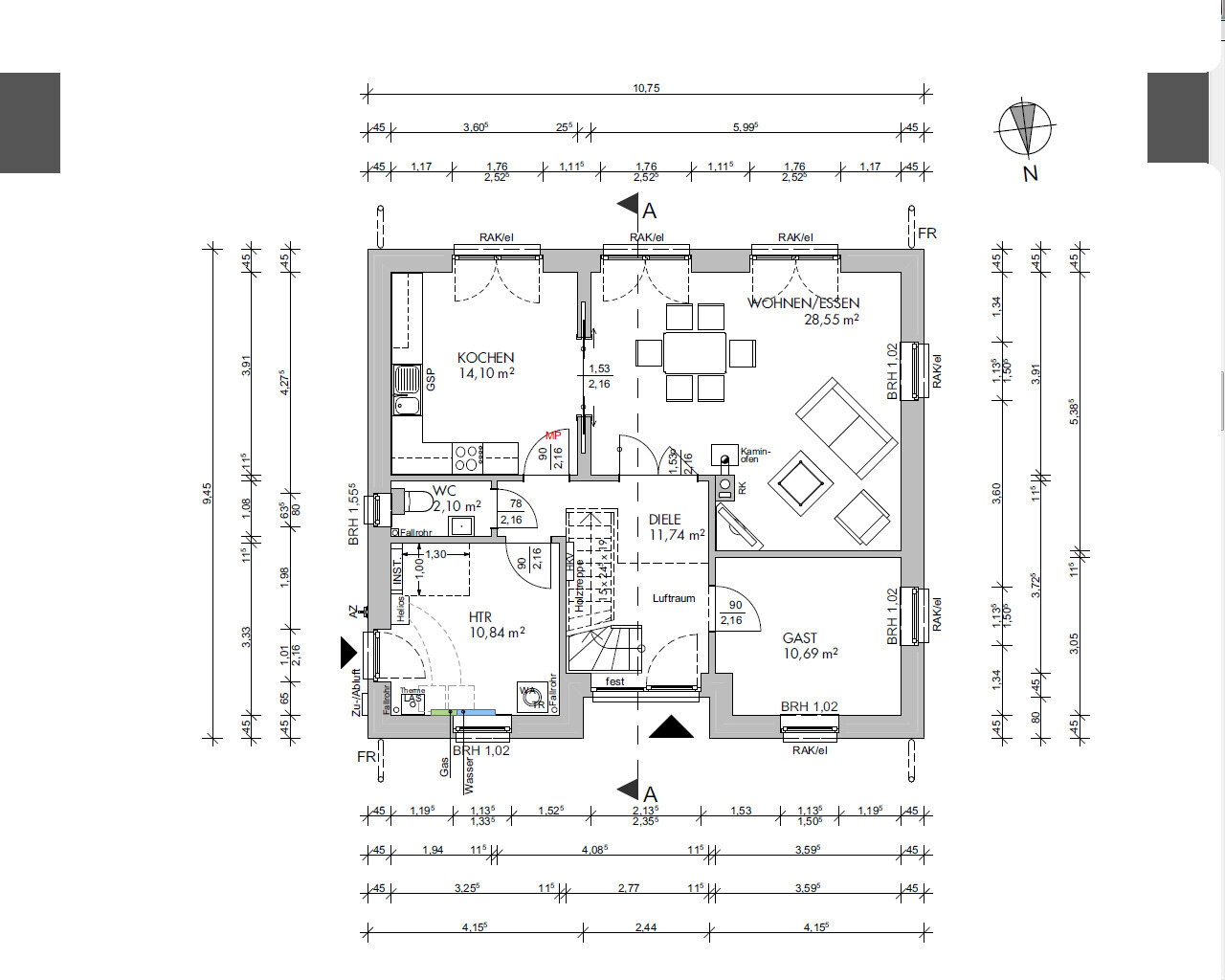
We are planning to install recessed LED downlights in the hallway area and now need to finalize their positions to complete the floor plan for drilling purposes.
Who can provide some assistance?
My ideas:
Idea 1: Three lights centered in the living/dining area, under the stairs, and in the kitchen/WC/utility room area.
Idea 2: Two lights in a row in the living/dining area, one light under the stairs, and one light in the kitchen/WC/utility room area.
Thanks for your support.
Regards,
Christian
We are planning to install recessed LED downlights in the hallway area and now need to finalize their positions to complete the floor plan for drilling purposes.
Who can provide some assistance?
My ideas:
Idea 1: Three lights centered in the living/dining area, under the stairs, and in the kitchen/WC/utility room area.
Idea 2: Two lights in a row in the living/dining area, one light under the stairs, and one light in the kitchen/WC/utility room area.
Thanks for your support.
Regards,
Christian
The key factors for determining the number of spotlights needed in a room are likely the following:
1. What level of illumination is desired in each room? A workspace for sewing requires a very different lighting level than basic lighting for cozy TV watching. Other possible light sources should also be considered, such as an additional reading lamp.
2. What is the light output (luminous flux) of the planned spotlights (how many lumens)? Actually, this question should be reversed: Which spotlights are even suitable for the intended purpose?
3. To calculate the resulting illuminance at the location being considered, further influencing factors must be taken into account:
3.a. What is the beam angle of the spotlights? There is a huge difference between a 120-degree and a 30-degree beam angle. One is more of an area light, the other more of a point light, for example to highlight pictures. The luminous intensity at distance for a 30-degree spotlight is certainly higher (more focused) at the same power consumption, so many more spotlights are needed if these are used for general area lighting, but the resulting illuminance will be higher.
3.b. What is the ceiling height? The higher the room, the less light reaches the floor if the same spotlight is used.
4. What are the reflective properties of the illuminated objects? White walls reflect a greater portion of light than furniture or floors made of dark wood.
5. How large is the area to be illuminated?
6. How evenly should the area be lit? A few point lights create bright spots with darker areas in between if they are spaced far apart. Area lights that possibly overlap can provide more uniform lighting, but that is not always desired. Sometimes you may want to specifically highlight certain objects (furniture, paintings).
(7.) There are also adjustable types of spotlights whose beam angle can be directed within certain limits, for example onto a picture on the wall.
Without knowing all these factors, it is basically impossible to estimate how best to arrange your spotlights. I am not an expert either and would simply test with one spotlight in the dark on site if in doubt. The three spotlights you mentioned for the hallway might be sufficient if they each have approximately a 120-degree beam angle and at least >300 lumens. With <200 lumens and 30 degrees beam angle, it could be tight or the lighting will be more point-like as described above.
1. What level of illumination is desired in each room? A workspace for sewing requires a very different lighting level than basic lighting for cozy TV watching. Other possible light sources should also be considered, such as an additional reading lamp.
2. What is the light output (luminous flux) of the planned spotlights (how many lumens)? Actually, this question should be reversed: Which spotlights are even suitable for the intended purpose?
3. To calculate the resulting illuminance at the location being considered, further influencing factors must be taken into account:
3.a. What is the beam angle of the spotlights? There is a huge difference between a 120-degree and a 30-degree beam angle. One is more of an area light, the other more of a point light, for example to highlight pictures. The luminous intensity at distance for a 30-degree spotlight is certainly higher (more focused) at the same power consumption, so many more spotlights are needed if these are used for general area lighting, but the resulting illuminance will be higher.
3.b. What is the ceiling height? The higher the room, the less light reaches the floor if the same spotlight is used.
4. What are the reflective properties of the illuminated objects? White walls reflect a greater portion of light than furniture or floors made of dark wood.
5. How large is the area to be illuminated?
6. How evenly should the area be lit? A few point lights create bright spots with darker areas in between if they are spaced far apart. Area lights that possibly overlap can provide more uniform lighting, but that is not always desired. Sometimes you may want to specifically highlight certain objects (furniture, paintings).
(7.) There are also adjustable types of spotlights whose beam angle can be directed within certain limits, for example onto a picture on the wall.
Without knowing all these factors, it is basically impossible to estimate how best to arrange your spotlights. I am not an expert either and would simply test with one spotlight in the dark on site if in doubt. The three spotlights you mentioned for the hallway might be sufficient if they each have approximately a 120-degree beam angle and at least >300 lumens. With <200 lumens and 30 degrees beam angle, it could be tight or the lighting will be more point-like as described above.
B
Bauherr220153 Mar 2015 18:41Hello Frank,
thank you for your feedback. I am fully aware that this whole issue is not easy to resolve. Since the three spotlights in the hallway are not intended to be the only source of lighting, I could live with a "not too bright illumination" as well. Additionally, the whole hallway is quite open due to the gallery.
Best regards
thank you for your feedback. I am fully aware that this whole issue is not easy to resolve. Since the three spotlights in the hallway are not intended to be the only source of lighting, I could live with a "not too bright illumination" as well. Additionally, the whole hallway is quite open due to the gallery.
Best regards

Similar topics