
ᐅ Flooring Direction for Parquet: Parallel or Perpendicular to the Hallway?
Created on: 22 Feb 2024 17:55
S
SimonSimon
Hello everyone,
I’m facing the often-asked question myself now: in which direction should I lay my hardwood flooring?
On the ground floor, we have 20cm (8 inches) wide planks, ranging from 2 to partly 6 meters (6.5 to 20 feet) in length.
On the upper floor, the planks have the same lengths but are only 15cm (6 inches) wide.
We are gluing down the flooring ourselves, meaning we also run the planks continuously through the doorways without expansion gaps.
Only the bathrooms and the utility room are tiled; the rest of the rooms, including the kitchen area, will have wood flooring.
I lean towards laying the planks parallel to the hallway on both floors.
This goes against the “rule” that you should enter a room across the direction of the planks. The stair treads would also run perpendicular to the plank direction.
However, the natural light would fall parallel to the planks, which I have read is the preferred approach.
The photos are roughly oriented to the cardinal directions, so the top is north. This means the evening sun comes from the right side into our living room, and on the upper floor through the large window at the right of the hallway.
What do you think, how would you do it?
I appreciate every opinion!
Best regards from southern Baden,
Simon
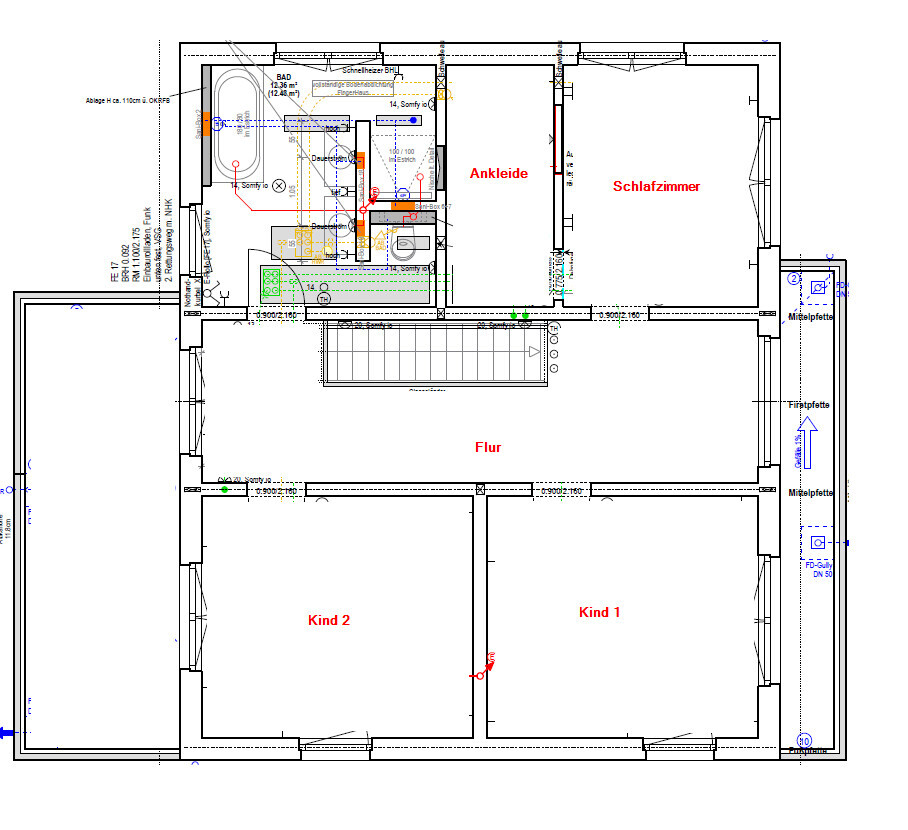
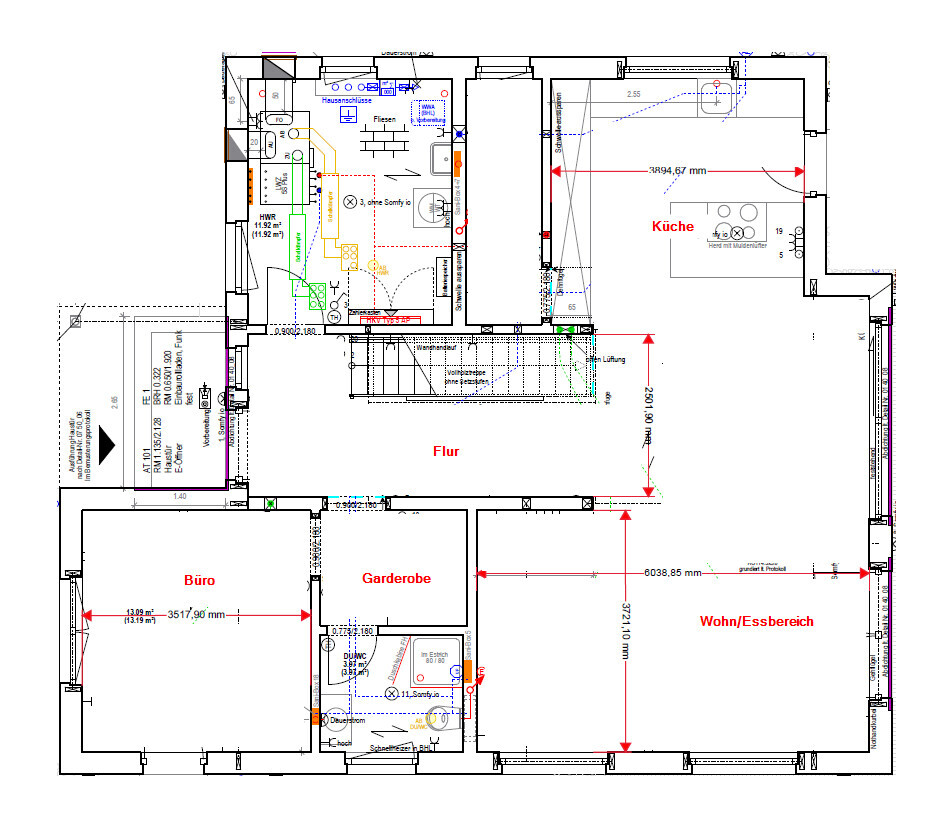
I’m facing the often-asked question myself now: in which direction should I lay my hardwood flooring?
On the ground floor, we have 20cm (8 inches) wide planks, ranging from 2 to partly 6 meters (6.5 to 20 feet) in length.
On the upper floor, the planks have the same lengths but are only 15cm (6 inches) wide.
We are gluing down the flooring ourselves, meaning we also run the planks continuously through the doorways without expansion gaps.
Only the bathrooms and the utility room are tiled; the rest of the rooms, including the kitchen area, will have wood flooring.
I lean towards laying the planks parallel to the hallway on both floors.
This goes against the “rule” that you should enter a room across the direction of the planks. The stair treads would also run perpendicular to the plank direction.
However, the natural light would fall parallel to the planks, which I have read is the preferred approach.
The photos are roughly oriented to the cardinal directions, so the top is north. This means the evening sun comes from the right side into our living room, and on the upper floor through the large window at the right of the hallway.
What do you think, how would you do it?
I appreciate every opinion!
Best regards from southern Baden,
Simon
W
WilderSueden22 Feb 2024 23:13Cutting them lengthwise is a valid point. On the other hand... the 6m (20 feet) floorboards are far too valuable to be cut into three pieces.

S
SimonSimon23 Feb 2024 09:18Thanks in advance for your answers.
I’m the one installing the parquet flooring myself, and I’m a beginner. At first, and in difficult areas, a professional will help me, but I’ll do the rest alone or with other novice friends. 😉
Unfortunately, I don’t know how many 6-meter (20-foot) boards there are; originally, it was said that the boards would be between 2 and 5 meters (6.5 and 16 feet) according to the quote, but now he says there are also some 6-meter (20-foot) boards.
The hallway right after the front door is 2.5 meters (8 feet) wide. Past the stairs, it narrows briefly to 1.5 meters (5 feet), but it’s an open staircase with glass railings, so it shouldn’t feel too cramped (currently there is still a temporary wooden railing, so it’s hard to judge).
The upstairs hallway is the same width at 2.5 meters (8 feet), and along the railing just 1.5 meters (5 feet) wide. Overall, the upstairs hallway is 8.5 meters (28 feet) long, so the long boards would fit well there.
There is no attic above the upstairs hallway (the roof is the ceiling), so there is plenty of headroom.
I’m really struggling with this—intuitively, I would lay the boards parallel to the hallway, since it makes a hallway look longer, which seems positive. However, most opinions I’ve read, including here in the forum, tend toward laying them perpendicular across the hallway.
Best regards
I’m the one installing the parquet flooring myself, and I’m a beginner. At first, and in difficult areas, a professional will help me, but I’ll do the rest alone or with other novice friends. 😉
Unfortunately, I don’t know how many 6-meter (20-foot) boards there are; originally, it was said that the boards would be between 2 and 5 meters (6.5 and 16 feet) according to the quote, but now he says there are also some 6-meter (20-foot) boards.
The hallway right after the front door is 2.5 meters (8 feet) wide. Past the stairs, it narrows briefly to 1.5 meters (5 feet), but it’s an open staircase with glass railings, so it shouldn’t feel too cramped (currently there is still a temporary wooden railing, so it’s hard to judge).
The upstairs hallway is the same width at 2.5 meters (8 feet), and along the railing just 1.5 meters (5 feet) wide. Overall, the upstairs hallway is 8.5 meters (28 feet) long, so the long boards would fit well there.
There is no attic above the upstairs hallway (the roof is the ceiling), so there is plenty of headroom.
I’m really struggling with this—intuitively, I would lay the boards parallel to the hallway, since it makes a hallway look longer, which seems positive. However, most opinions I’ve read, including here in the forum, tend toward laying them perpendicular across the hallway.
Best regards
O
Oberhäslich23 Feb 2024 11:09A professional from YT suggests positioning it perpendicular to the entrance or lengthwise along the room.
Interestingly, we have almost exactly the same floor plan on the upper floor as you, and I installed the floorboards lengthwise. I like it, and so do everyone else who has seen it so far. Do your floorboards have a bevel? That was one reason I laid the boards parallel to the incoming light (and therefore lengthwise).
You can handle the longitudinal cuts as well. You just have to not be afraid and take your time.
It is also important to measure the width very precisely beforehand and possibly start with a half board. Otherwise, it can be problematic if you end up with a 2cm (0.8 inch) gap on the other side of the room.
Have fun!
You can handle the longitudinal cuts as well. You just have to not be afraid and take your time.
It is also important to measure the width very precisely beforehand and possibly start with a half board. Otherwise, it can be problematic if you end up with a 2cm (0.8 inch) gap on the other side of the room.
Have fun!
Similar topics