
Hello,
we are currently at the shell construction stage of our KFW 55 bungalow.
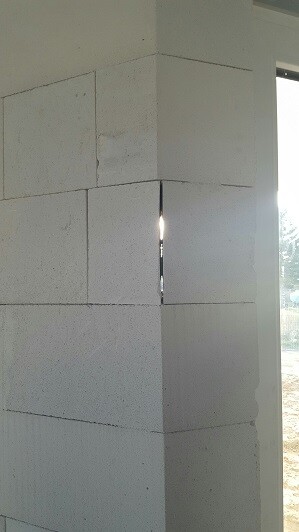
Since the sun was shining at a favorable angle today, we noticed several gaps in the masonry. In some areas, the sunlight shines completely through.
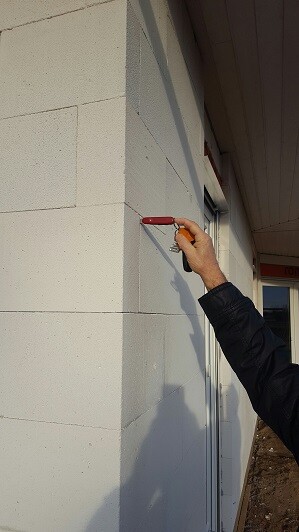
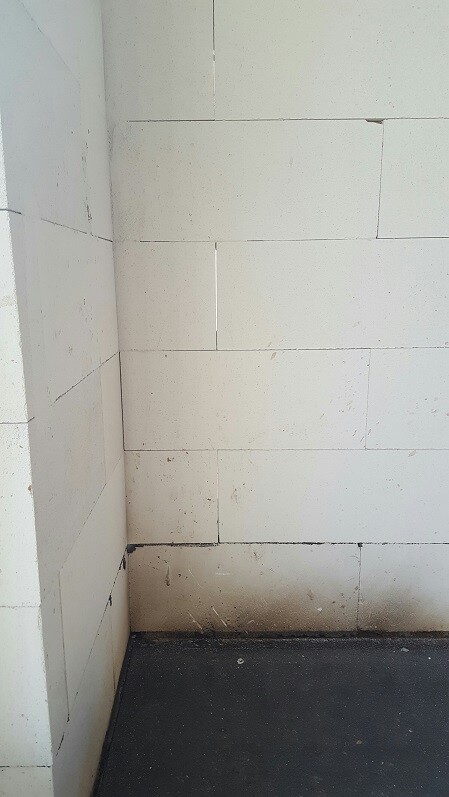
We then inspected the joints more closely. Hardly any joint is properly sealed. We can almost everywhere insert the blade of a pocket knife 2-4 cm (1-1.5 inches) deep.
The site manager’s comment was, "the plaster will take care of sealing that"—2 cm (0.8 inches) on the outside and 1 cm (0.4 inches) on the inside.
We deliberately chose a 36.5 cm (14.4 inches) thick block with a lambda value of 0.09. Am I correct in understanding that if the blocks are not fully bonded, the insulation value will significantly decrease? The blocks are not properly connected... neither horizontally nor vertically.
Best regards
Olaf Mayer
we are currently at the shell construction stage of our KFW 55 bungalow.
Since the sun was shining at a favorable angle today, we noticed several gaps in the masonry. In some areas, the sunlight shines completely through.
We then inspected the joints more closely. Hardly any joint is properly sealed. We can almost everywhere insert the blade of a pocket knife 2-4 cm (1-1.5 inches) deep.
The site manager’s comment was, "the plaster will take care of sealing that"—2 cm (0.8 inches) on the outside and 1 cm (0.4 inches) on the inside.
We deliberately chose a 36.5 cm (14.4 inches) thick block with a lambda value of 0.09. Am I correct in understanding that if the blocks are not fully bonded, the insulation value will significantly decrease? The blocks are not properly connected... neither horizontally nor vertically.
Best regards
Olaf Mayer

B
Bieber08159 Dec 2016 06:56We just covered this recently, https://www.hausbau-forum.de/threads/breite-stossfugen-im-Porenbeton.17817/ ...
Joint gaps should not be wider than 3 mm (0.12 inches) and do not need to be filled with mortar. Joint gaps wider than 5 mm (0.2 inches) must be sealed with appropriate mortar.
Joint gaps should not be wider than 3 mm (0.12 inches) and do not need to be filled with mortar. Joint gaps wider than 5 mm (0.2 inches) must be sealed with appropriate mortar.
O
Olaf Mayer9 Dec 2016 09:44Not comparable, since we are building monolithically. In the other thread, there is also an external thermal insulation composite system (ETICS) mentioned....
But Willo has the perfect answer... I can live with that....
But Willo has the perfect answer... I can live with that....
S
Steffen809 Dec 2016 10:20This is normal and the same everywhere. No need to panic. It looks odd... but it is correct.
--> "Still air insulates heat better than stone"
--> "Still air insulates heat better than stone"
Hello,
This is poorly executed. Only the bed joints (horizontal) are glued. The vertical joints are tightly butted together without any gap (butt joints). That is why blocks with tongue and groove profiles are used.
It is advisable to study the manufacturers' installation guidelines.
Best regards.
Olaf Mayer schrieb:
...Am I correct in understanding that if the block is not fully glued, the insulation value decreases significantly? The blocks are not properly connected... horizontally or vertically...
This is poorly executed. Only the bed joints (horizontal) are glued. The vertical joints are tightly butted together without any gap (butt joints). That is why blocks with tongue and groove profiles are used.
It is advisable to study the manufacturers' installation guidelines.
Best regards.
K
Knallkörper31 Dec 2016 09:24I find it confusing that you can actually see through the vertical joints. So there is no interlocking there? For me, it’s more about the mechanical stability, the insulation should be fine as others have already mentioned. I would also ask to see the technical documentation for the blocks.
Similar topics