
First of all: We are not interested in perfectly smooth walls. We will receive Q2-level plaster from the general contractor. From what we have seen at friends’ houses, Q2 plaster can look quite good.
We probably want to apply slightly textured or solid-color non-woven wallpapers. According to the construction manager, we should avoid using wallpapers that are too thin because they may visually emphasize any unevenness in the Q2 plaster. That makes sense.
I am now considering whether it would be worthwhile to buy a multi-sander and do some spot smoothing ourselves.
Is this a task that a beginner can learn to do, or is it better to avoid it?
Does anyone have a recommendation for a tool, in case we want to try it? We could start in the utility room, so there is little risk if it doesn’t work out.
We probably want to apply slightly textured or solid-color non-woven wallpapers. According to the construction manager, we should avoid using wallpapers that are too thin because they may visually emphasize any unevenness in the Q2 plaster. That makes sense.
I am now considering whether it would be worthwhile to buy a multi-sander and do some spot smoothing ourselves.
Is this a task that a beginner can learn to do, or is it better to avoid it?
Does anyone have a recommendation for a tool, in case we want to try it? We could start in the utility room, so there is little risk if it doesn’t work out.

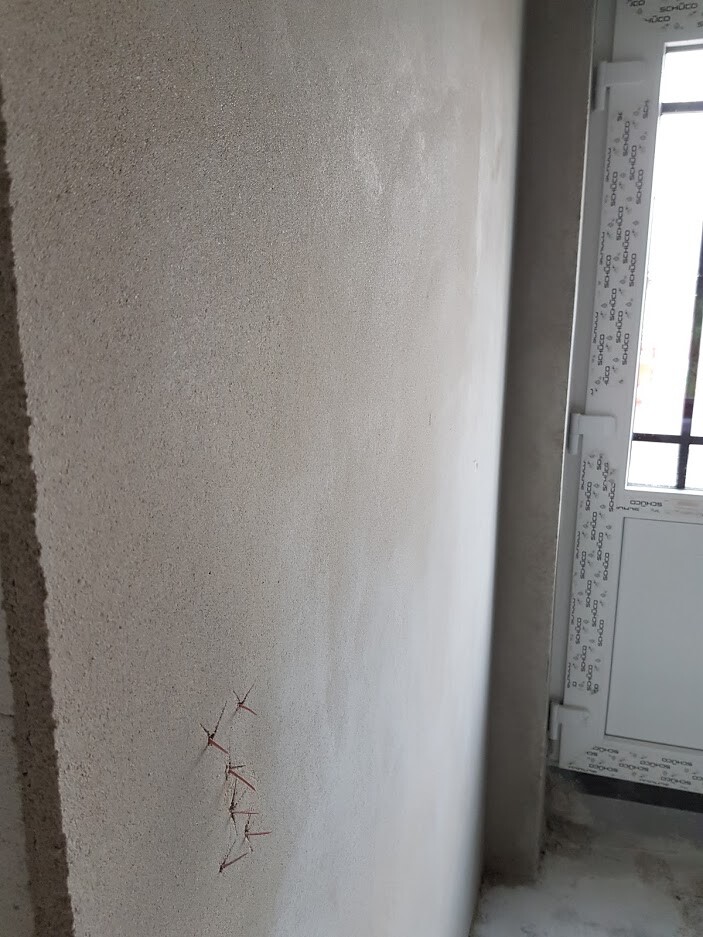
Today, we saw our Q2 plaster for the first time. I was positively surprised. I wasn’t exactly sure what to expect. For the utility room, we simply applied a primer and then painted it white. We’ll see how it looks when it’s dry. If needed, we might apply another coat, but I’m okay with it as it is.
Based on how the plaster looks, I’m thinking I’ll just paint the hallway white as well, unless we decide to have a professional do the entire house.
The only slightly crumbly spots are very isolated and can be easily smoothed out with a finger. I’ll skip the machine and work on those areas by hand. There are also some small holes to fill with filler. But overall, the wall feels smooth enough for me. Apparently, I don’t have very high expectations.
In any case, it should be easy to wallpaper over this. As long as you don’t use a very thin, paper-smooth wallpaper, it shouldn’t be a problem.
I’m attaching a picture (hallway).
Based on how the plaster looks, I’m thinking I’ll just paint the hallway white as well, unless we decide to have a professional do the entire house.
The only slightly crumbly spots are very isolated and can be easily smoothed out with a finger. I’ll skip the machine and work on those areas by hand. There are also some small holes to fill with filler. But overall, the wall feels smooth enough for me. Apparently, I don’t have very high expectations.
In any case, it should be easy to wallpaper over this. As long as you don’t use a very thin, paper-smooth wallpaper, it shouldn’t be a problem.
I’m attaching a picture (hallway).
P
pagoni20204 Jul 2020 22:18You can put non-woven wallpaper over it; afterwards, it looks like a baby's bottom.
S
Stefan0015 Jul 2020 09:40@kati1337 : Could you please share a photo of the primed and painted wall?
Stefan001 schrieb:
@kati1337 : Would you like to post a photo of the primed and painted wall?No, haha :P But I’ll do it anyway.
So, we’re definitely not professional painters, and the wall is still wet of course. In the second picture, you can see where it’s starting to dry in some spots. I’ll take another one tomorrow when it’s dry.
It’s only one coat. And we basically rolled the paint directly onto the primer without any waiting time—I’m not sure if that was a smart move. There were no instructions about drying time on the paint can, so we just went straight ahead.
Similar topics