
ᐅ Hydraulic short circuit? Radiator return line on the upper floor warmer than the supply line
Created on: 18 Nov 2023 18:45
T
Theo984
Good evening everyone,
In January of this year, we had an Arotherm Plus installed and, during this process, the fixed-value control unit of the underfloor heating was replaced (the actuator was defective, and no spare parts were available). The ground floor has underfloor heating, and the upper floor has radiators (which were replaced with Type 33 radiators during the renovation). The fixed-value control unit installed by the heating contractor did not work at all, so it was replaced with a Purmo Tempco Fix 3 Eco fixed-value control unit.
Unfortunately, the return flow temperature of the upper floor circuit is still higher than the supply flow. The upper floor return flow merges with the underfloor heating return flow (I hope this can be seen in the photo), and this seems to be where the problem lies. The pressure from the underfloor heating appears to be too high, pushing into the return of the upper floor circuit.
For me, there are two possible solutions:
1. Separate the two heating circuits, at least the return flows, up to just before the heat pump. The supply flow temperature would remain the same.
2. Integrate the upper floor return flow between the underfloor heating return and the fixed-value control unit, so that it uses both return flows for mixing and then sends the combined flow back to the heat pump through one pipe. The issue here is the available space and the connection.
What do you think about these options? Are there maybe other ideas? And is this a defect that the heating contractor needs to fix?
Thanks in advance and have a nice evening!
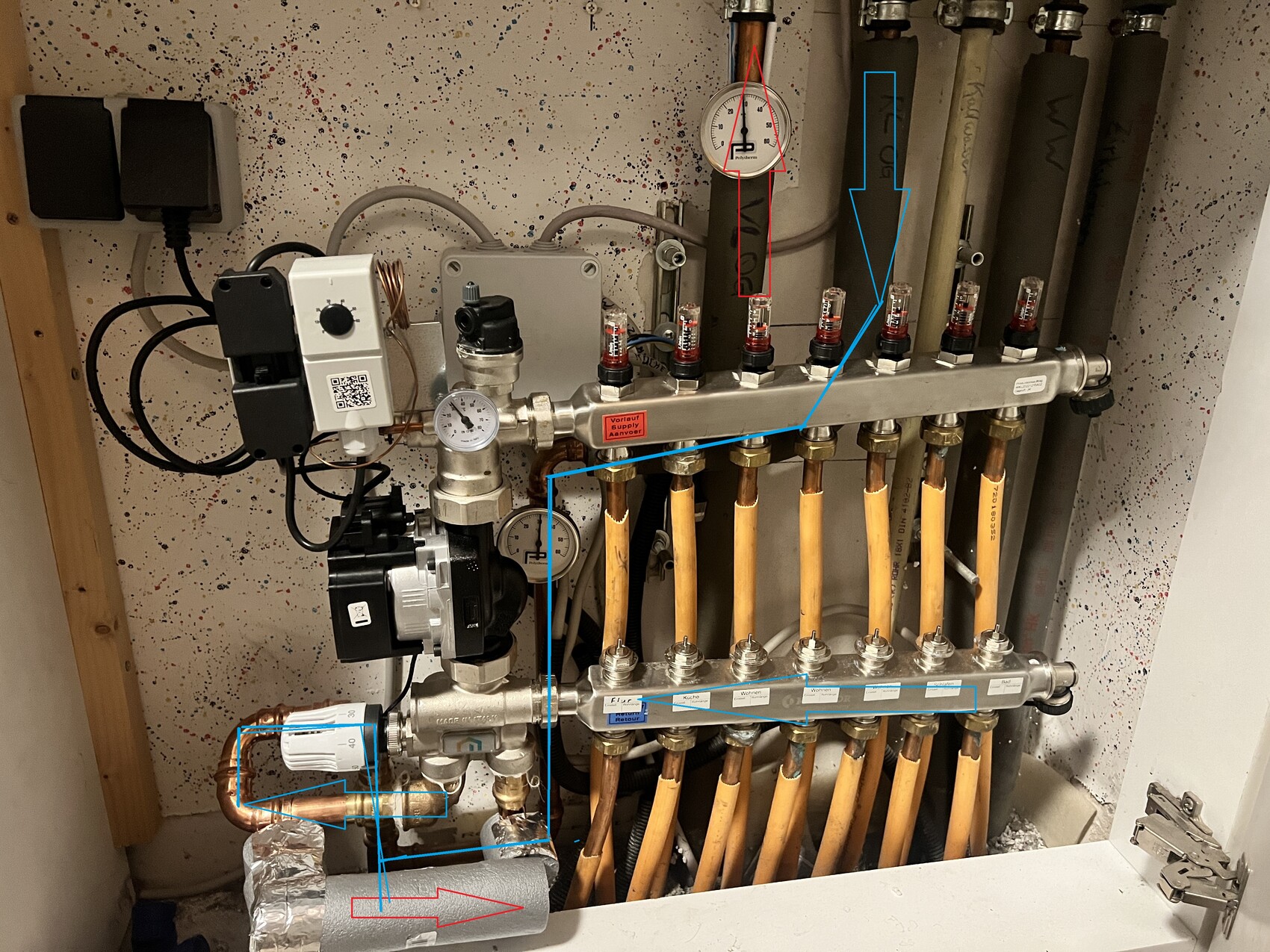
In January of this year, we had an Arotherm Plus installed and, during this process, the fixed-value control unit of the underfloor heating was replaced (the actuator was defective, and no spare parts were available). The ground floor has underfloor heating, and the upper floor has radiators (which were replaced with Type 33 radiators during the renovation). The fixed-value control unit installed by the heating contractor did not work at all, so it was replaced with a Purmo Tempco Fix 3 Eco fixed-value control unit.
Unfortunately, the return flow temperature of the upper floor circuit is still higher than the supply flow. The upper floor return flow merges with the underfloor heating return flow (I hope this can be seen in the photo), and this seems to be where the problem lies. The pressure from the underfloor heating appears to be too high, pushing into the return of the upper floor circuit.
For me, there are two possible solutions:
1. Separate the two heating circuits, at least the return flows, up to just before the heat pump. The supply flow temperature would remain the same.
2. Integrate the upper floor return flow between the underfloor heating return and the fixed-value control unit, so that it uses both return flows for mixing and then sends the combined flow back to the heat pump through one pipe. The issue here is the available space and the connection.
What do you think about these options? Are there maybe other ideas? And is this a defect that the heating contractor needs to fix?
Thanks in advance and have a nice evening!
R
RotorMotor19 Nov 2023 19:26Thank you for the information.
I think I understand it now.
I see the problem is with the second pump.
It would probably be best to have it removed.
Otherwise, we can see what happens if it is simply switched off.
However, I am still not clear about the thermostat in the manifold.
I think I understand it now.
I see the problem is with the second pump.
It would probably be best to have it removed.
Otherwise, we can see what happens if it is simply switched off.
However, I am still not clear about the thermostat in the manifold.
The problem is most likely caused by having an additional pump installed in the underfloor heating circuit, especially if there are no other valves on the supply and return lines.
You can think of it like this:
The circulation pump (UWP) in the heat pump creates a differential pressure of about 100 mbar (4 inches water column) between the supply and return (inside the heat pump). According to the pressure drops in the individual circuits (radiators and underfloor heating on the ground floor), the volume flow is usually divided, for example, 40/60%.
If you add another pump in the underfloor heating circuit that produces an extra pressure difference at this point between supply and return, in the current configuration this can cause flow through the radiators in the wrong direction.
How is this additional pump controlled? If it doesn’t cause a control error, I would first try switching it off completely, or otherwise deactivate the heating circuit assigned to this pump in the control system so that only the main pump runs.
In the correct flow direction, circulation pumps can be passed through with low resistance.
You can think of it like this:
The circulation pump (UWP) in the heat pump creates a differential pressure of about 100 mbar (4 inches water column) between the supply and return (inside the heat pump). According to the pressure drops in the individual circuits (radiators and underfloor heating on the ground floor), the volume flow is usually divided, for example, 40/60%.
If you add another pump in the underfloor heating circuit that produces an extra pressure difference at this point between supply and return, in the current configuration this can cause flow through the radiators in the wrong direction.
How is this additional pump controlled? If it doesn’t cause a control error, I would first try switching it off completely, or otherwise deactivate the heating circuit assigned to this pump in the control system so that only the main pump runs.
In the correct flow direction, circulation pumps can be passed through with low resistance.
Good morning,
@Rotor: The thermostat on the manifold (which is mounted directly on the constant value control set) is intended for regulating the temperature of the underfloor heating circuit. However, since I run the same supply temperature throughout the entire system, it doesn’t really serve a purpose.
@dertill: The circuits are not really separated; there is one outlet from the air-to-water heat pump that then feeds both the underfloor heating and the radiators (this can be seen in the photo). Since the second circulation pump on the underfloor heating now creates suction in the supply line of the overall system and some pressure on the return side, the whole system only works moderately well—it definitely causes backpressure in the radiator circuit. The pump for the underfloor heating is controlled only by a characteristic curve; there is no direct connection to the air-to-water heat pump. There is a PWM cable, but at the moment I don’t know if or how I can control the signal via the air-to-water heat pump.
I will try disabling the pump and hope that the pressure distributes “well” between the underfloor heating and radiator circuits. Yesterday, I noticed that the installer must have also set the constant value control set incorrectly because the entire return flow from the underfloor heating went back into the main return (the bypass of the constant value control set was set to 0), which obviously caused a lot of pressure in the return line. I will monitor this over the next few days and report whether these measures fix the problem!
Many thanks for the great advice; despite having some understanding of the system, sometimes it’s hard to see the forest for the trees. 😉
@Rotor: The thermostat on the manifold (which is mounted directly on the constant value control set) is intended for regulating the temperature of the underfloor heating circuit. However, since I run the same supply temperature throughout the entire system, it doesn’t really serve a purpose.
@dertill: The circuits are not really separated; there is one outlet from the air-to-water heat pump that then feeds both the underfloor heating and the radiators (this can be seen in the photo). Since the second circulation pump on the underfloor heating now creates suction in the supply line of the overall system and some pressure on the return side, the whole system only works moderately well—it definitely causes backpressure in the radiator circuit. The pump for the underfloor heating is controlled only by a characteristic curve; there is no direct connection to the air-to-water heat pump. There is a PWM cable, but at the moment I don’t know if or how I can control the signal via the air-to-water heat pump.
I will try disabling the pump and hope that the pressure distributes “well” between the underfloor heating and radiator circuits. Yesterday, I noticed that the installer must have also set the constant value control set incorrectly because the entire return flow from the underfloor heating went back into the main return (the bypass of the constant value control set was set to 0), which obviously caused a lot of pressure in the return line. I will monitor this over the next few days and report whether these measures fix the problem!
Many thanks for the great advice; despite having some understanding of the system, sometimes it’s hard to see the forest for the trees. 😉
Similar topics