
ᐅ Ground Source Heat Pump for a 200 m² Single-Family Home with Underfloor Heating, KfW55 Standard – Settings and Optimization
Created on: 4 Nov 2021 20:21
G
grericht
Hello. We moved into our new single-family house in March. I didn’t make any adjustments to the heating system at that time. Now that the temperatures are rising, I’ve started to take a closer look at it.
House details:
Heating system details (descriptions from the invoice):
My previous attempts:
Questions:
Personal preferences:

House details:
- Single-family house with a (heated) basement + 2.5 floors (usable gable roof/also underfloor heating) -> 4 heating circuits
- approximately 200 m² (2150 sq ft) of underfloor heating
- 2 bathrooms WITHOUT additional heating
- kfw55 energy standard
- ventilation system with heat recovery
- Currently 2 rooms in the basement are unoccupied/unutilized + the technical room
- There are also 2 children’s rooms in the attic that are unoccupied/unutilized
Heating system details (descriptions from the invoice):
- High-efficiency brine/water heat pump Dimplex SI 8TU
- High-efficiency brine system SZB 140E for brine/water heat pump with electronically controlled brine circulation pump Yonos Para 25/1-10
- Multifunctional storage tank Geysir MTL-WP650 efficiency class B (150 mm (6 inches) insulation thickness) with connection options for multiple heat generators, with layering plate for large volume flows, capacity 850 liters (225 gallons), domestic hot water preparation using counterflow principle with stainless steel heat exchanger, including differential temperature controller and flow sensor for hot water tapping system
- Hydraulic connection of the heat pump to the multifunctional storage tank with precision steel pipe 28x1.5 mm (1.1x0.06 inch) including insulation, 1 zone charging pump Dimplex UPH 75-25P with shut-off set, switchable between heating and domestic hot water charging
- Integration of the heating system with heating circuit sets Easyflow DN 25 R1" with EPP insulation type 2 including 3-way mixing valve, mixing valve actuator and circulation pump Grundfos UPM3 Auto
- (ERR in 3/4 of the rooms) - currently switched off
- Cooling station Dimplex PKS 14 Econ for passive cooling via geothermal probes, consisting of heat exchanger, brine circulation pump, cooling modules for network operation with heat pump manager and temperature sensor
- Room temperature controller Dimplex Smart RTC, for optimizing weather-compensated control via a reference room
My previous attempts:
- Domestic Hot Water:
- I first focused on the domestic hot water preparation. Initially, it was set to 50°C (122°F) with a 2° hysteresis. For Dimplex, this means that heating started again at 48°C (118°F). This setup was basically fine, but even without any hot water use, heating occurred 2-3 times a day. Since the pump ran only very briefly, the average summer consumption was about 0.7 kWh/day.
- I then experimented with lowering the temperature, setting lockout periods, and increasing the hysteresis. Our "optimal consumption" turned out to be 50°C (122°F) and 7° hysteresis with lockout from 8 pm to 5 pm. This sometimes resulted in the pump not running for an entire day. However, energy use was only reduced to 0.5 kWh/day, meaning hardly any consumption reduction at the cost of noticeable comfort reductions. Currently, I am at 48°C (118°F) and 4° hysteresis with lockout from 10 pm to 5 pm. Since we mostly use hot water in the evening, this works well. For bathing or higher demand, the water is reheated if necessary. I am currently experimenting with 5 or 6 degrees hysteresis, as the heat loss during ongoing heating operation seems lower and we might be able to skip a day sometimes. We’ll see...
- Now, regarding the heating, my attempts:
- All ERRs switched off, heating circuits opened roughly by feel, and tried to adjust by regulation. Control was via fixed return flow temperature, which I tested between 23 and 26°C (73°F and 79°F). The consumption and COP results were very satisfactory. Unfortunately, I couldn’t get the bathroom above 22°C (72°F) without other rooms becoming too warm (rooms quickly reached 22°C, which I find too high).
- Turned the ERR back on in the children’s rooms.
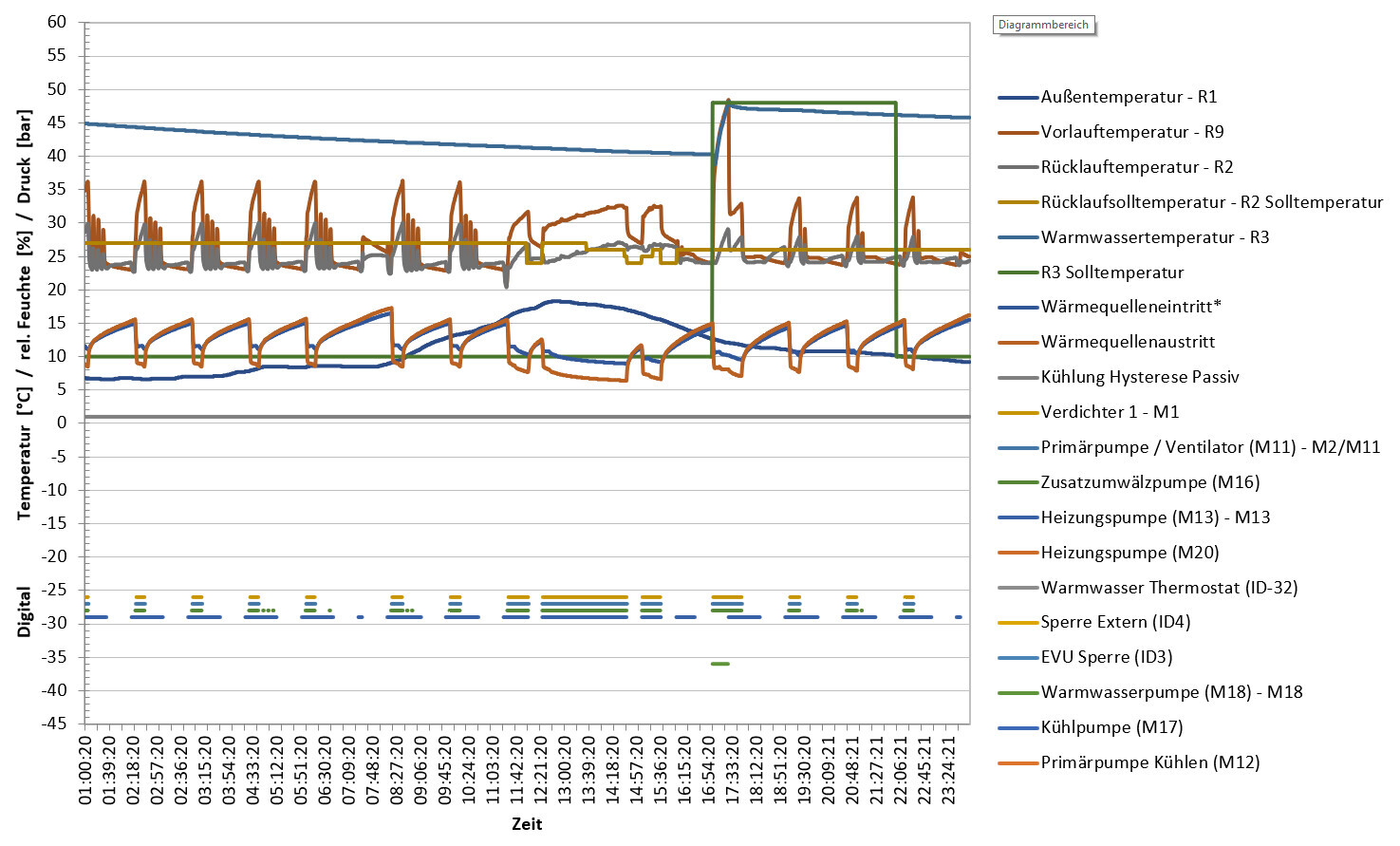
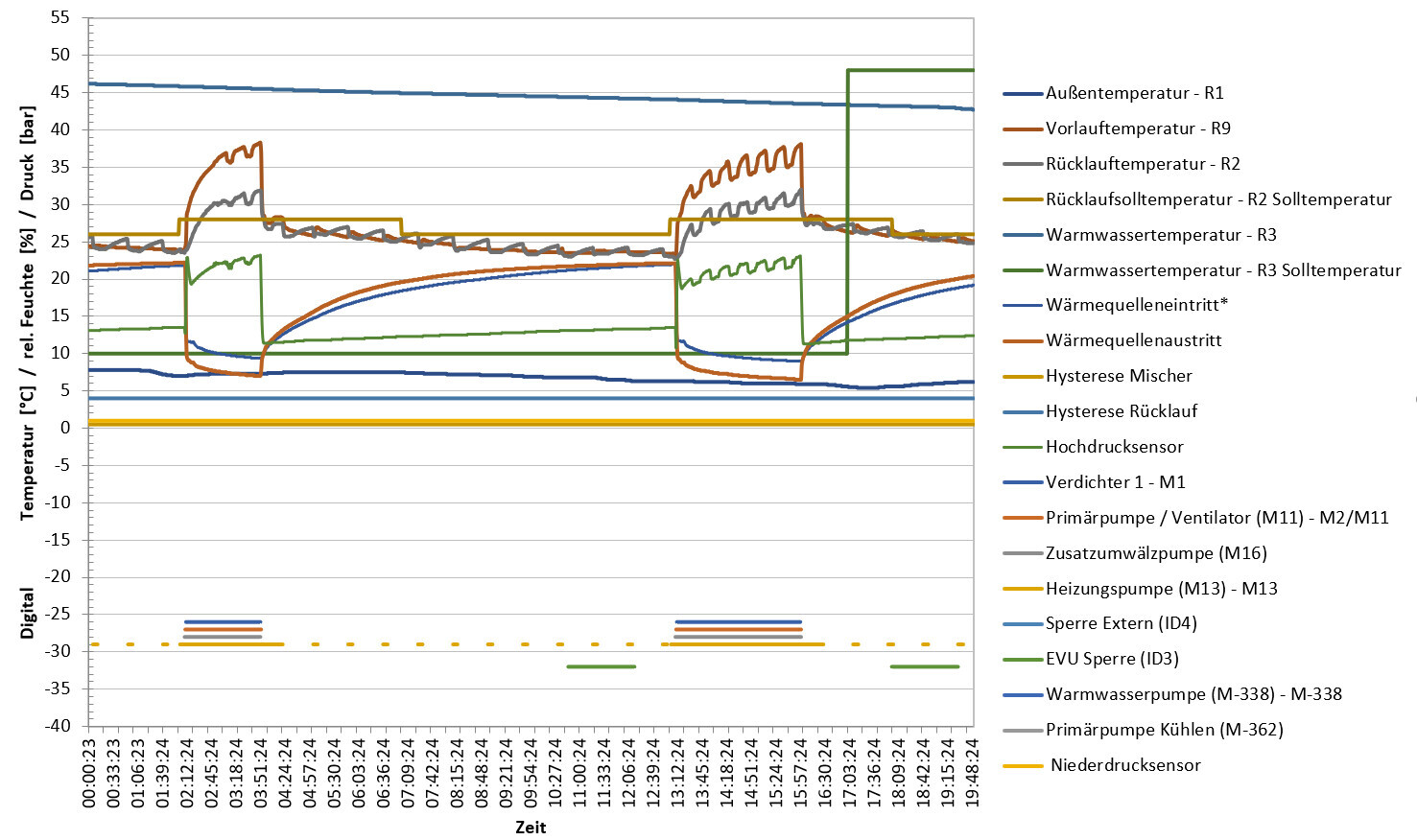
- After a one-week vacation during which I completely switched off the heating, I started over. I tried the recommended approach of fully opening the warmest room (bathroom) to about 2.2 liters/min (0.58 gallons/min) and then increasing the temperature until satisfied. But this meant the heating was massively oversized?! The heat pump came on about 20 times for 10-15 minutes each, the supply temperature was nicely between 30 and 33°C (86°F and 91°F) but the temperature felt like it never really got away from the heat pump’s threshold. I am attaching a picture of the behavior.
- Suspecting insufficient flow and hesitant to adjust the heating pump, I slowly opened other rooms slightly.
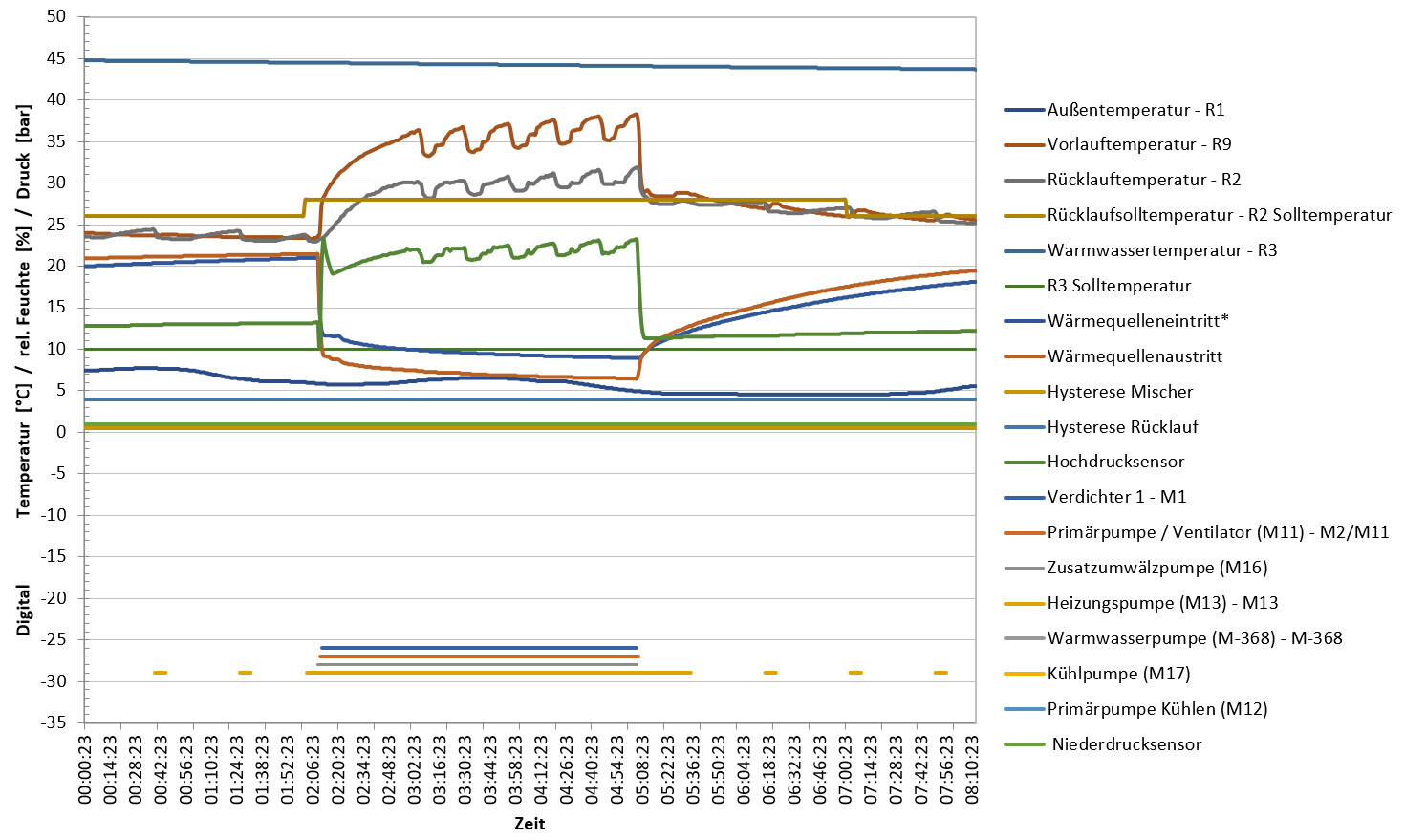
- I also tried increasing the fixed temperature to 27 or 28°C (81°F or 82°F) and used hysteresis to make the pump run less often but longer. I am now quite satisfied with the temperatures in the house. However, the numbers still look a bit odd to me. I believe there are now many rooms/areas/storage volumes with such low flow that “cooled down” mass just circulates in the loop and eventually reaches the return line repeatedly. I don’t mind that but I also do not want to risk any damage. I will attach another picture.
- Lastly, I reduced the temperature at night and in the morning so the heating starts at favorable times. Currently, two starts of about 2-3 hours each are sufficient.
Questions:
- Am I completely off track here or are these approaches generally valid? Unfortunately, I can’t really rely on the heating engineer. He is surely competent but firstly hardly reachable and secondly probably overwhelmed by such optimization considerations.
- What about rooms that are unused? Should I use the screed as a buffer and keep them slightly heated (<0.5 liters/min (0.13 gallons/min)) anyway?
- I increasingly believe that managing the large temperature difference between the bathroom at 23°C (73°F) and the rooms at 20.5°C (69°F) is not well controlled – is there really no alternative to an additional heat source? We only use the bathroom for about 2 hours and in the evening for 4 hours at 23°C (73°F). Otherwise, 21-22°C (70-72°F) would definitely be sufficient there.
- Any tips on settings?
Personal preferences:
- The underfloor heating is off in the bedroom – yet it quickly reaches 19-20°C (66-68°F), which is almost too warm.
- In the 3 children’s rooms, the ERR closes from 5 pm to 3 am (for sleeping – with time delay)
- Other rooms 20-21°C (68-70°F)
- Open-plan kitchen/living room 21-22°C (70-72°F)
- Bathrooms 23°C (73°F)
I would still appreciate an answer to the question of whether it makes sense, for example, to open the valve slightly in the bedroom. Currently, it is still closed, and with about 20°C (68°F) in there now, it feels rather warm to me. With more intensive ventilation, we might be able to maintain 19°C or at least 19.5°C (66°F or 67°F), but I don’t see why I should allow a small flow here.
And a completely different question: Are the heat meters installed in such devices standardized, calibrated, or tested?
If I assume these values are accurate, then during summer (when only hot water is used), I get a COP of about 4, and now during the heating plus hot water phase, it’s above 6. Overall, since starting in May, my COP is 5.4 and rising quickly. Is this because manufacturers’ heat output measurements tend to be optimistic, or is this realistic?
And a completely different question: Are the heat meters installed in such devices standardized, calibrated, or tested?
If I assume these values are accurate, then during summer (when only hot water is used), I get a COP of about 4, and now during the heating plus hot water phase, it’s above 6. Overall, since starting in May, my COP is 5.4 and rising quickly. Is this because manufacturers’ heat output measurements tend to be optimistic, or is this realistic?
Better performance values in winter are normal since only domestic hot water is produced in summer (short cycles, high temperature difference).
Whether your values are accurate often depends on whether the electricity meter also includes the power consumption of the pump, controller, etc.
Whether your values are accurate often depends on whether the electricity meter also includes the power consumption of the pump, controller, etc.
A
Alessandro8 Nov 2021 11:09If your ground source heat pump achieves a seasonal COP of over 4, that is already a good result.
guckuck2 schrieb:
Whether your values are accurate often depends on whether the electricity meter also measures the pump current, controller, etc. That would be my next question. The meter is a secondary meter (with specific heat pump electricity and therefore controlled load periods) "only for the heat pump." However, some heating components run on the main household electricity, for example, the heating pump. The heat pump itself is also connected to the household electricity. This means that in summer, only the consumption for the compressor and primary pump, i.e., for domestic hot water production, is measured. Passive cooling, heating pump (e.g., for flushing during cooling off), are not included.
At the main household meter, there is a separate circuit breaker/residual-current device, but I do not have a dedicated submeter for the heat pump. Should these consumers be included in a realistic COP calculation, or are they excluded?
Does this mean that the heat energy meters in these heat pumps can be trusted, or are they somewhat optimistic? Should they be checked or recalibrated for realistic calculations? If so, how?
D
Daniel-Sp8 Nov 2021 11:43grericht schrieb:
Should these consumers be accounted for in a realistic evaluation of the COP...YesThere are 4 words and characters missing

Alessandro schrieb:
If you achieve a seasonal COP of over 4 with a ground-source heat pump, that’s already quite good.I find that a bit hard to believe: our heating system is probably not super optimized because at such a ridiculously low consumption, I somehow lack the motivation to improve it. Still, since we started using it, we have a COP of 4.2 for domestic hot water, 5.9 for space heating, and 5.6 combined.
Similar topics