
Hello everyone,
I would like to introduce myself briefly. We started building a new single-family house five years ago. We moved in about 2.5 years ago.
Unfortunately, after the first few weeks, we had to part ways with the architect and construction management, as their services (planning, etc.) were a disaster, and some of the craftsmen were far from professional (just my personal opinion).
But this is not meant to be a story about our struggles; by now, we are living very satisfactorily in our home.
However, we plan to build again in the near future. To avoid going through the same issues, we want to form our own opinion as thoroughly as possible beforehand.
Now, onto the topic:
Heat pump
Water-circulating stove (to provide support during cold temperatures)
No solar panels (energy saving regulations are met)
Heating load approximately 7000 kWh per year excluding hot water
Flow temperature 26-32°C (79-90°F), temperature spread is 5°C (9°F)
Room volume approximately 600 m³ (21,200 ft³)
These values are based on our current house; the new house will be built almost the same but possibly with better insulation. So I think it can be used as a reference.
Example: At 0°C (32°F) outside and 23°C (73°F) inside, we have a flow temperature of 30°C (86°F) and a return temperature of 25°C (77°F), which equals a 5°C (9°F) spread.
In summary:
- The heat pump should be able to heat and cool the house independently.
- The concrete ceiling should be actively cooled (down to the dew point), possibly also the floor heating.
- The water-circulating stove is intended to provide supplementary heating and create a cozy atmosphere.
- Solar panels are not to be installed (optional).
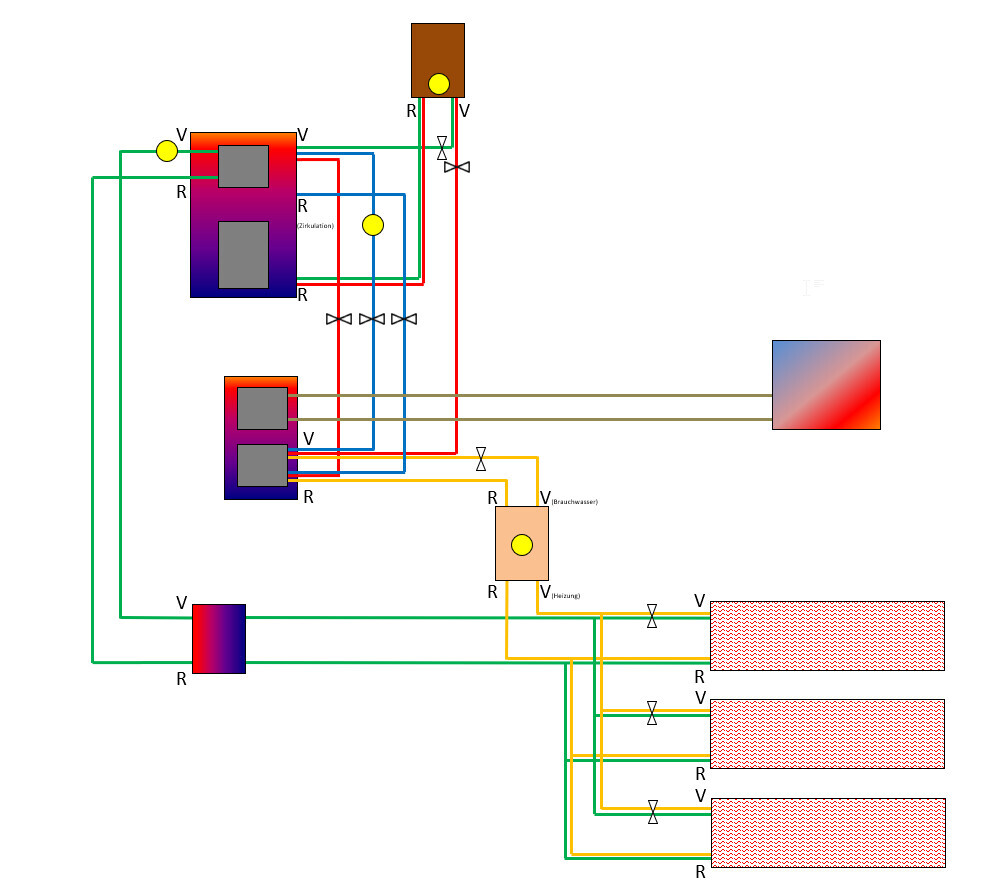
I have drawn a simple schematic with two storage tanks (1000-liter buffer / 300-liter domestic hot water tank).
How it works:
- Normally / summer, the heat pump heats the domestic hot water tank to 50°C (122°F), starting at a certain time (yellow).
- When the stove is turned on, it first heats the domestic hot water tank via the lower heat exchanger and then cools down the buffer tank (red).
- When the stove is off, water from the buffer tank is circulated until the domestic hot water tank reaches 60°C (140°F) or the same temperature as the buffer (blue).
- Solar panels could possibly be connected to the upper heat exchanger of the domestic hot water tank (brown). Additionally, the buffer tank might also be heated via the lower heat exchanger.
- If the domestic hot water tank is cold, the stove is off, and hot water is needed quickly, the heat pump switches on and an electric heating element in the domestic hot water tank supports heating. Otherwise, heating is controlled normally by the heat pump according to the schedule.
- The underfloor heating and ceiling heating are supplied by the heat pump or via the buffer tank.
The control system is very simple and would be managed by a programmable controller. Also, there are few components, which reduces potential failures or troubleshooting complexities.
I do not want a combined unit / combined storage tank, as I consider them relatively expensive, and they always require a service technician if something goes wrong.
If problems do occur, the valves can be switched manually, and the heat pump will operate independently.
This is very important to me.
The domestic (fresh) water is not connected to the heating circuit.
Please do not discuss the type of heat source (heat pump, solar, etc.) at this time. I would like to do that later, unless it’s related to the system’s function. Thank you.
The control system for underfloor and ceiling heating needs to be discussed in a second step, but that can only happen after the system is installed.
Thank you very much for the support.
I would like to introduce myself briefly. We started building a new single-family house five years ago. We moved in about 2.5 years ago.
Unfortunately, after the first few weeks, we had to part ways with the architect and construction management, as their services (planning, etc.) were a disaster, and some of the craftsmen were far from professional (just my personal opinion).
But this is not meant to be a story about our struggles; by now, we are living very satisfactorily in our home.
However, we plan to build again in the near future. To avoid going through the same issues, we want to form our own opinion as thoroughly as possible beforehand.
Now, onto the topic:
Heat pump
Water-circulating stove (to provide support during cold temperatures)
No solar panels (energy saving regulations are met)
Heating load approximately 7000 kWh per year excluding hot water
Flow temperature 26-32°C (79-90°F), temperature spread is 5°C (9°F)
Room volume approximately 600 m³ (21,200 ft³)
These values are based on our current house; the new house will be built almost the same but possibly with better insulation. So I think it can be used as a reference.
Example: At 0°C (32°F) outside and 23°C (73°F) inside, we have a flow temperature of 30°C (86°F) and a return temperature of 25°C (77°F), which equals a 5°C (9°F) spread.
In summary:
- The heat pump should be able to heat and cool the house independently.
- The concrete ceiling should be actively cooled (down to the dew point), possibly also the floor heating.
- The water-circulating stove is intended to provide supplementary heating and create a cozy atmosphere.
- Solar panels are not to be installed (optional).
I have drawn a simple schematic with two storage tanks (1000-liter buffer / 300-liter domestic hot water tank).
How it works:
- Normally / summer, the heat pump heats the domestic hot water tank to 50°C (122°F), starting at a certain time (yellow).
- When the stove is turned on, it first heats the domestic hot water tank via the lower heat exchanger and then cools down the buffer tank (red).
- When the stove is off, water from the buffer tank is circulated until the domestic hot water tank reaches 60°C (140°F) or the same temperature as the buffer (blue).
- Solar panels could possibly be connected to the upper heat exchanger of the domestic hot water tank (brown). Additionally, the buffer tank might also be heated via the lower heat exchanger.
- If the domestic hot water tank is cold, the stove is off, and hot water is needed quickly, the heat pump switches on and an electric heating element in the domestic hot water tank supports heating. Otherwise, heating is controlled normally by the heat pump according to the schedule.
- The underfloor heating and ceiling heating are supplied by the heat pump or via the buffer tank.
The control system is very simple and would be managed by a programmable controller. Also, there are few components, which reduces potential failures or troubleshooting complexities.
I do not want a combined unit / combined storage tank, as I consider them relatively expensive, and they always require a service technician if something goes wrong.
If problems do occur, the valves can be switched manually, and the heat pump will operate independently.
This is very important to me.
The domestic (fresh) water is not connected to the heating circuit.
Please do not discuss the type of heat source (heat pump, solar, etc.) at this time. I would like to do that later, unless it’s related to the system’s function. Thank you.
The control system for underfloor and ceiling heating needs to be discussed in a second step, but that can only happen after the system is installed.
Thank you very much for the support.
My intention:
The key points were clear from my perspective. Heat pump with a stove and possibly solar panels.
The heat pump is intended to primarily heat the house and provide hot water. The stove is mainly for coziness and to ease the load on the heat pump when it is running anyway. Additionally, a stove that is not water-connected tends to overheat the house. Therefore, I want to store and distribute the energy in a buffer tank.
When choosing the heating system, my focus was more on the brand and whether solar panels make sense or not.
The key points were clear from my perspective. Heat pump with a stove and possibly solar panels.
The heat pump is intended to primarily heat the house and provide hot water. The stove is mainly for coziness and to ease the load on the heat pump when it is running anyway. Additionally, a stove that is not water-connected tends to overheat the house. Therefore, I want to store and distribute the energy in a buffer tank.
When choosing the heating system, my focus was more on the brand and whether solar panels make sense or not.

The idea of a wood-burning stove with water heating is flawed—I have been saying this here for years. It does not provide any relief. With the extra cost for the hydraulics and controls, you could produce your hot water for decades using only the heat pump. Where should the active cooling come from? What heat pump manufacturers claim is mostly marketing.
So it doesn’t make sense to choose a water-driven stove. I also wanted to use it for heating. Is it pointless if I get the wood for free?
The active cooling should come from the air heat pump or, in the case of a ground-source heat pump, from the ground loop, but then only indirectly.
By the way.
1) I would prefer a gas boiler, but unfortunately, there is no gas connection available.
2) Are there oil heating systems with only 2 kW capacity?
The active cooling should come from the air heat pump or, in the case of a ground-source heat pump, from the ground loop, but then only indirectly.
By the way.
1) I would prefer a gas boiler, but unfortunately, there is no gas connection available.
2) Are there oil heating systems with only 2 kW capacity?
T
toxicmolotof24 Dec 2017 12:15Since I cannot read, understand, or even interpret the diagram, I cannot comment on it and have even pointed this out explicitly.
I have only shared what is often mentioned here and what I have learned myself. If that does not apply to you, even better.
Then the issue of energy loss in the storage tank is no longer relevant when it comes to electricity.
With wood, the issue remains, but you can’t really do without a storage tank in that case. Then there are the additional installation costs for the piping, mixing system, buffer tank, and water-heated fireplace.
When you look at the total cost, I wonder if it wouldn’t be possible to heat only with a heat pump for 10 or 20 years for the same amount of money. Then it becomes more of a mathematical problem than a system planning one.
I have only shared what is often mentioned here and what I have learned myself. If that does not apply to you, even better.
Then the issue of energy loss in the storage tank is no longer relevant when it comes to electricity.
With wood, the issue remains, but you can’t really do without a storage tank in that case. Then there are the additional installation costs for the piping, mixing system, buffer tank, and water-heated fireplace.
When you look at the total cost, I wonder if it wouldn’t be possible to heat only with a heat pump for 10 or 20 years for the same amount of money. Then it becomes more of a mathematical problem than a system planning one.
T
toxicmolotof24 Dec 2017 12:19If I estimate 5,000 euros (no idea if that amount would be sufficient), that could cover 10 years of providing 100% heating and hot water. If 50% of the heating load is covered by the stove (which still requires wood, so additional cost and time), then the heating could last for 20 years.
If you calculate very precisely, taking all variables into account, it is probably possible to manage for significantly longer than 20 years.
If you calculate very precisely, taking all variables into account, it is probably possible to manage for significantly longer than 20 years.
Similar topics