
Hello,
We moved into our end-terrace house in February and so far have only had the landscaper do the essentials (paths, terrace, lawn). Unfortunately, there was little time for garden planning during the construction phase, so we now want to tackle it.
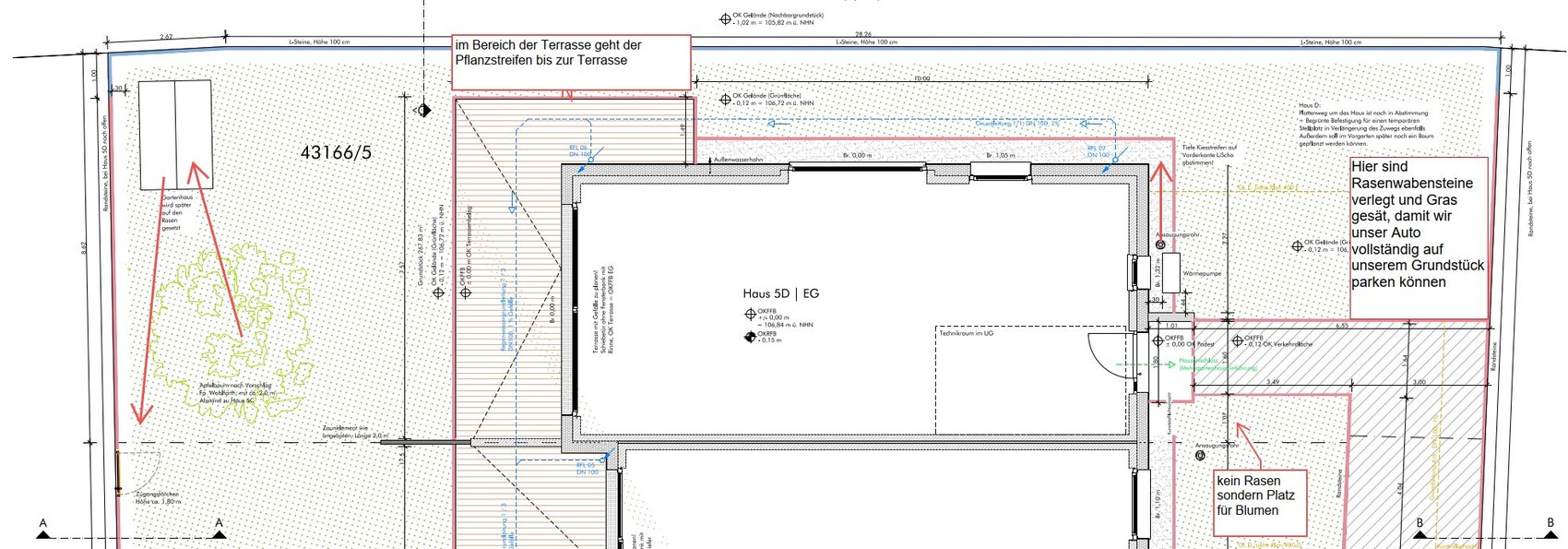
Here is the site plan with some comments:
We are still unsure about the following points and would appreciate some ideas and support:
1) Since we have neighbors on all sides, we would like some privacy screening. We don’t like chain-link fences or hedges, but prefer flowering hedges or similar. Do you have any tips on their arrangement or other ideas? The most important privacy screening is in front of the floor-to-ceiling 3m (10 feet) glass wall on the long side of the house, as well as in the garden area and next to the terrace. We made the planting strip wider there and up to the terrace so we can plant more. For the other areas, the privacy screen doesn’t need to be completely dense; it’s okay if you can still see a bit of the neighbors.
2) We will probably rotate the shed and the tree (see arrows). Otherwise, we want to design the garden to look modern and not too cramped despite its small size. Any ideas for that?
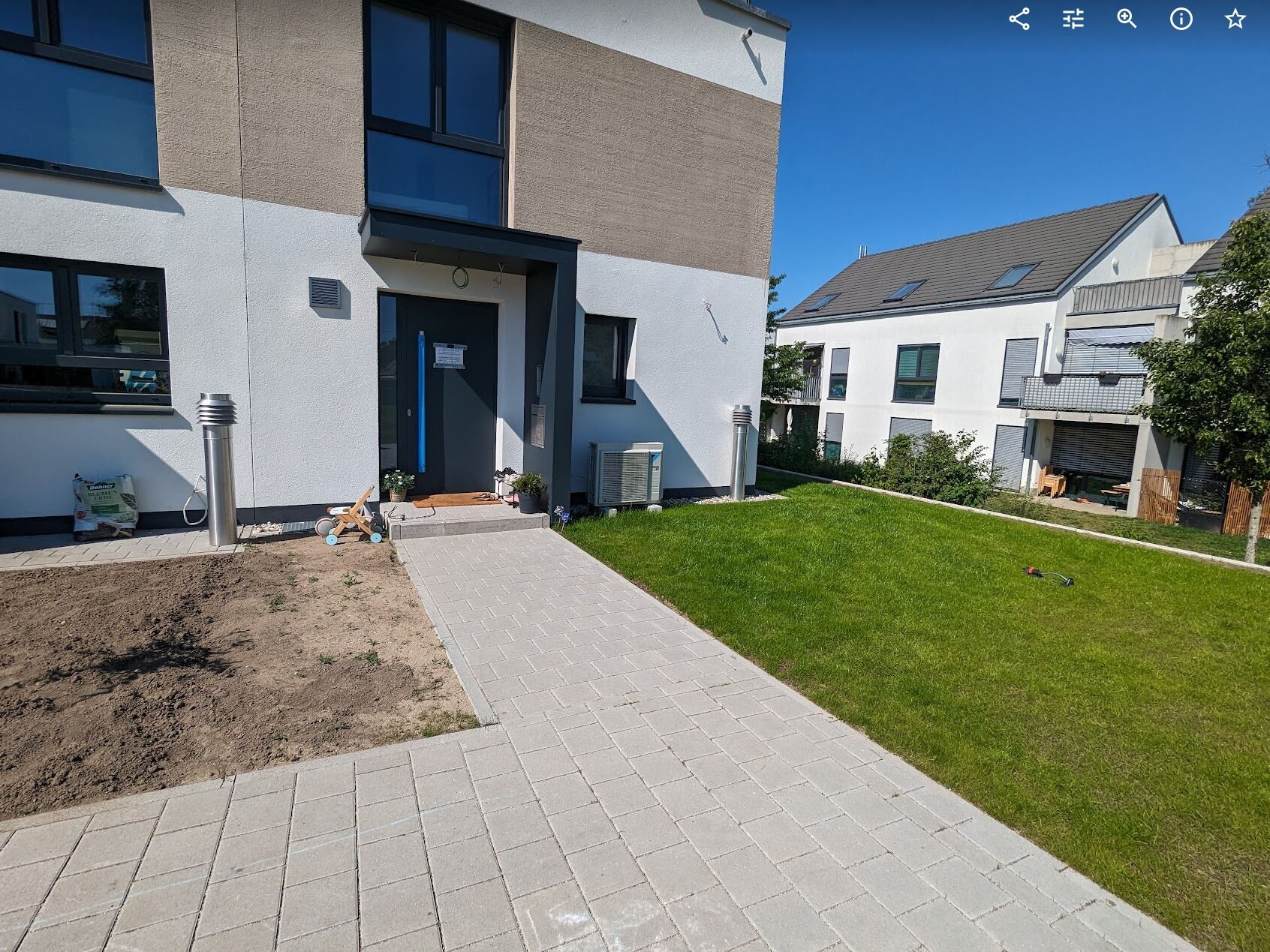
3) We can still fully design the front garden but have no ideas yet. We would like raised beds and a path around the house. Raised beds, for example, behind the lawn grid stones. Perhaps something nice in front of the heat pump as well, to cover it.
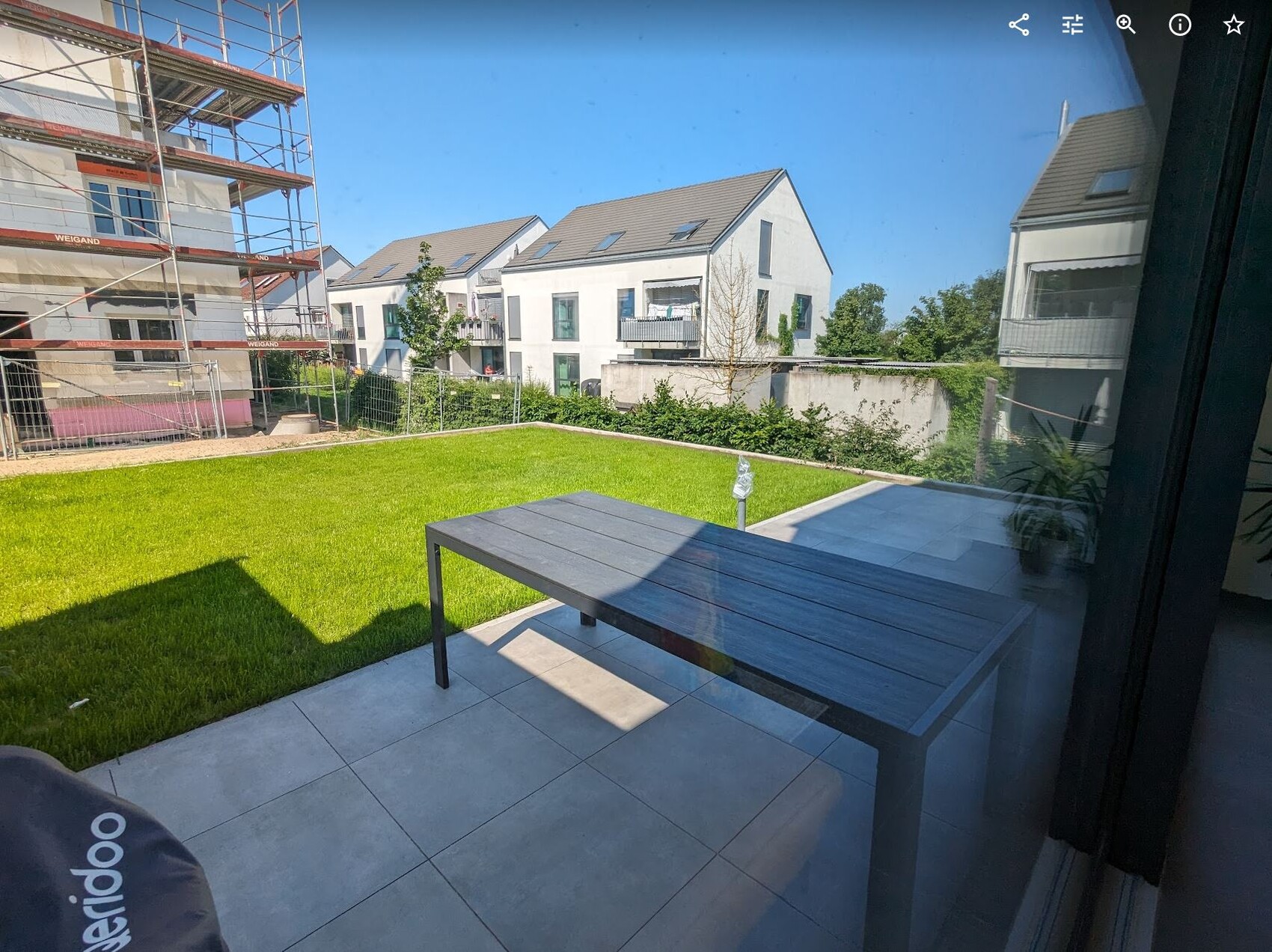
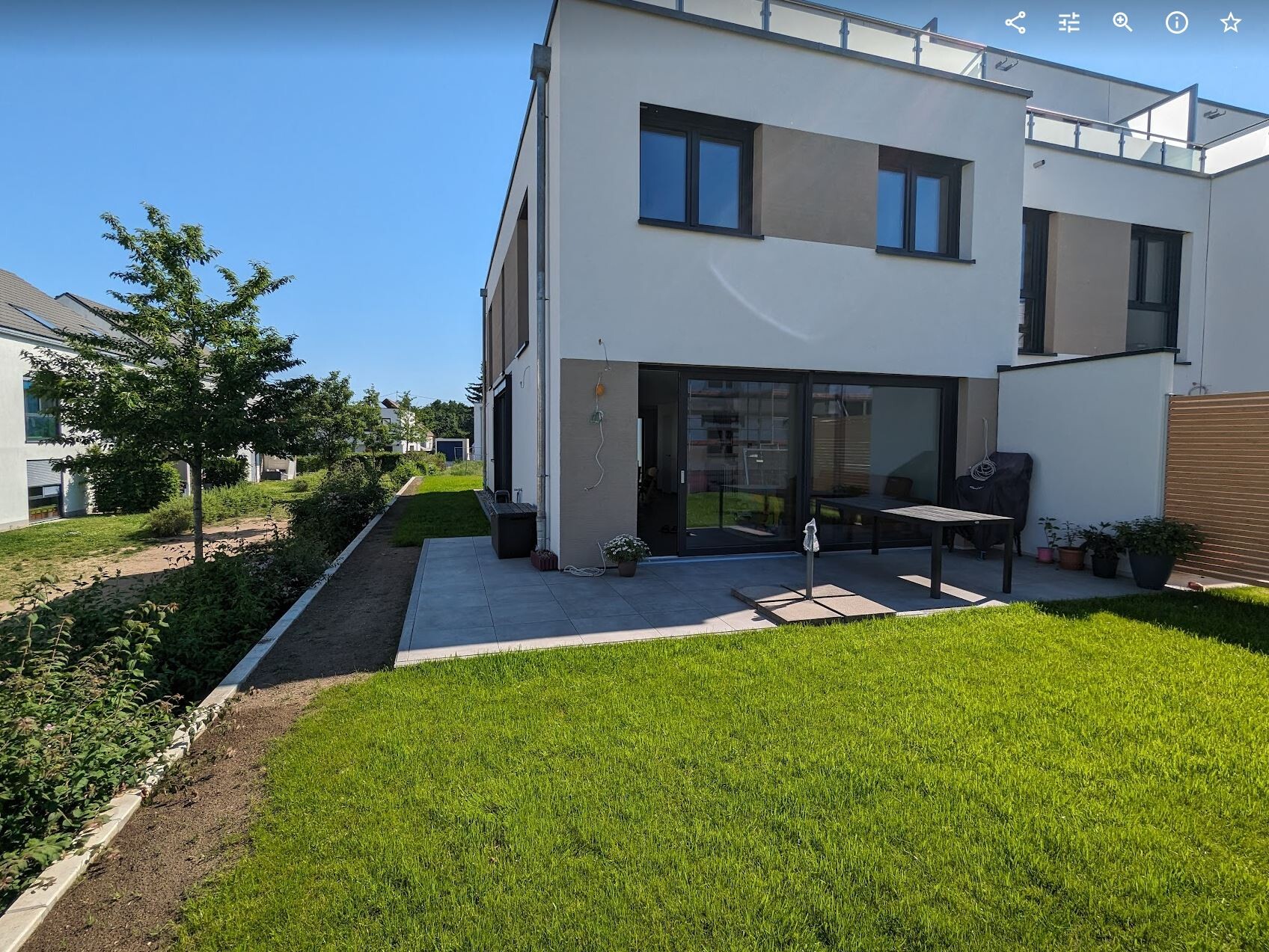
To help you get a better impression, here are a few pictures:
If you have any questions, just write.
Regards,
Nicola
We moved into our end-terrace house in February and so far have only had the landscaper do the essentials (paths, terrace, lawn). Unfortunately, there was little time for garden planning during the construction phase, so we now want to tackle it.
Here is the site plan with some comments:
We are still unsure about the following points and would appreciate some ideas and support:
1) Since we have neighbors on all sides, we would like some privacy screening. We don’t like chain-link fences or hedges, but prefer flowering hedges or similar. Do you have any tips on their arrangement or other ideas? The most important privacy screening is in front of the floor-to-ceiling 3m (10 feet) glass wall on the long side of the house, as well as in the garden area and next to the terrace. We made the planting strip wider there and up to the terrace so we can plant more. For the other areas, the privacy screen doesn’t need to be completely dense; it’s okay if you can still see a bit of the neighbors.
2) We will probably rotate the shed and the tree (see arrows). Otherwise, we want to design the garden to look modern and not too cramped despite its small size. Any ideas for that?
3) We can still fully design the front garden but have no ideas yet. We would like raised beds and a path around the house. Raised beds, for example, behind the lawn grid stones. Perhaps something nice in front of the heat pump as well, to cover it.
To help you get a better impression, here are a few pictures:
If you have any questions, just write.
Regards,
Nicola
M
motorradsilke31 May 2024 18:32Fuchsbau35 schrieb:
Why not consider native plants? There are also many beautiful perennials, shrubs, climbing plants, etc., that provide food and shelter for numerous insect species. Photinia are unfortunately not native. I do believe that, given the current loss of biodiversity, we should be a bit mindful about what we plant in our gardens. That doesn’t mean you have to use only native plants 100%, but a whole hedge is a larger habitat, so I wouldn’t choose exotic species for that. Unfortunately, there are no native hedging plants that are evergreen and grow relatively fast. Not everything non-native should be dismissed. The garden is also for the residents. I find Photinia very attractive, and there are various varieties. As far as I know, it is not invasive.
N
nordanney31 May 2024 18:45motorradsilke schrieb:
Unfortunately, there are no native hedge plants that are evergreen and grow fairly quickly.No, but for example, a European beech hedge grows about 40-60cm (16-24 inches) per year and does not lose all its leaves (although they are not green in winter).M
motorradsilke31 May 2024 18:49nordanney schrieb:
No, but for example a European beech hedge grows 40-60cm (16-24 inches) per year and does not lose its leaves either (although they are not green in winter).Exactly, not green. And I think having a bit of green is especially important in winter; otherwise, everything looks even more dull.B
Bertram10031 May 2024 19:33Ivy is evergreen and great for nature. And if you take the time to get to know it, it can also be quite attractive.
Honeysuckle is semi-evergreen and low-maintenance. Some grapevine varieties are too.
Winter jasmine could also work.
Honeysuckle is semi-evergreen and low-maintenance. Some grapevine varieties are too.
Winter jasmine could also work.
F
Fuchsbau351 Jun 2024 11:08There are quite a few attractive evergreen plants, almost native, that are suitable for hedges:
Wintergreen privet (probably fast-growing as well, sheds leaves only after winter depending on the temperature)
Barberry (more suitable for lower hedges)
European yew (grows quite slowly)
Firethorn (better for lower hedges)
You can also plant mixed hedges.
Ultimately, local climate and soil quality determine what you can grow. You can’t have everything in one hedge. Personally, I would always prefer a hedge that provides habitat for insects and birds. But that might be influenced by my profession 🙂
Wintergreen privet (probably fast-growing as well, sheds leaves only after winter depending on the temperature)
Barberry (more suitable for lower hedges)
European yew (grows quite slowly)
Firethorn (better for lower hedges)
You can also plant mixed hedges.
Ultimately, local climate and soil quality determine what you can grow. You can’t have everything in one hedge. Personally, I would always prefer a hedge that provides habitat for insects and birds. But that might be influenced by my profession 🙂
Thank you for the suggestions regarding insect-friendly planting. However, I think I’m not quite at that stage yet. First, the floor plan needs to be more or less finalized, which we will work on over the next few weeks. After that, we will focus on the specific selection of plants.
What do you think about plants that can already be bought trained as espaliers? In my opinion, the advantage is that privacy screening is available earlier and less depth is lost. Is the lattice that comes with them only temporary, and do you have to transfer the plants to a proper espalier structure later?
That would be suitable for the large side windows, combined with a few vertical posts. To the right, privacy screens don’t need to be that high, and we would use lower flowers or shrubs there, which also don’t grow too deep.
Am I correct in understanding that espaliers generally require more maintenance?
What do you think about plants that can already be bought trained as espaliers? In my opinion, the advantage is that privacy screening is available earlier and less depth is lost. Is the lattice that comes with them only temporary, and do you have to transfer the plants to a proper espalier structure later?
That would be suitable for the large side windows, combined with a few vertical posts. To the right, privacy screens don’t need to be that high, and we would use lower flowers or shrubs there, which also don’t grow too deep.
Am I correct in understanding that espaliers generally require more maintenance?
Similar topics