
Hello everyone,
We recently came across Tibber and are considering whether it might be suitable for us and economically viable. Does anyone here use it? Specifically, we’re interested in the hourly, dynamic billing and this Pulse device that you need to buy for it. Is it some kind of submeter? They throw around terms like “smart home,” but I haven’t fully understood it yet.
Can the Pulse device be installed by yourself, or does it require a certified electrician? The idea seems to be that it measures electricity consumption in real time.
We have photovoltaic panels, an electric car, and a fairly large battery storage system, so we would presumably be well equipped for this. However, I’m not sure if with our setup we can specifically control if and when power is drawn from the grid. Depending on the price (which can sometimes even be negative), it might make sense to feed everything from the photovoltaic system into the grid and power the household from the grid when the price (like yesterday) was as low as -40ct.
If anyone has any experience with this, good or bad, please feel free to share.
We recently came across Tibber and are considering whether it might be suitable for us and economically viable. Does anyone here use it? Specifically, we’re interested in the hourly, dynamic billing and this Pulse device that you need to buy for it. Is it some kind of submeter? They throw around terms like “smart home,” but I haven’t fully understood it yet.
Can the Pulse device be installed by yourself, or does it require a certified electrician? The idea seems to be that it measures electricity consumption in real time.
We have photovoltaic panels, an electric car, and a fairly large battery storage system, so we would presumably be well equipped for this. However, I’m not sure if with our setup we can specifically control if and when power is drawn from the grid. Depending on the price (which can sometimes even be negative), it might make sense to feed everything from the photovoltaic system into the grid and power the household from the grid when the price (like yesterday) was as low as -40ct.
If anyone has any experience with this, good or bad, please feel free to share.
W
WilderSueden3 Jul 2023 16:03Energy charts also include the spot market electricity price, both intraday and day ahead. If we assume costs of 15c, the price would have to drop below -150€/MWh (megawatt-hours) for you to still receive money. For feeding photovoltaic energy into the grid to be profitable, the price would need to fall to about -70€/MWh. You can experiment with these values a bit.

WernStö schrieb:
I have been using Tibber since February 2023, and since March also with the Pulse monitoring my bidirectional meter.
I have a photovoltaic system with a peak output of 7.2 kWpeak, a 7.0 kW SolarEdge inverter, a BYD battery storage with 8 kW, and an APL wall charger.
I drive a BMW 2 Series PHEV with an 8 kWh battery that powers a 50 kW electric motor at the rear. In addition, the car has a 160 hp gasoline engine.
In March, I paid €58.33 for 170 kWh (632,000 BTU); in April €39.12 for 93 kWh (317,000 BTU); in May €32.65 for 67 kWh (228,000 BTU); and I expect to pay €44 for 177 kWh (637,000 BTU) in June.
On top of the fluctuating market price, there is a monthly fee of €14.94 for Tibber’s basic charge, metering point fee, and network usage charge. The prices I mentioned already include this basic fee.
Overall, I have never paid so little for my residual electricity as I do with Tibber. Rarely, but it is possible that you get paid for the electricity you consume. Yesterday, for one hour, we even had a negative price of €0.48 per kWh (minus $0.55)!
The Tibber app communicates directly with my BMW. If I arrive in the afternoon and my photovoltaic system is producing more than 3.6 kWh (12,300,000 BTU) of surplus power, I charge the car directly. Otherwise, I let Tibber decide; usually, charging pauses after a short time and resumes during the night.
The only thing I have to do in the app is turn the "Smart Charging" function ON or OFF depending on the surplus power from the roof.
P.S.: The photovoltaic battery doesn’t interfere with this. I don’t want to store the cheap electricity in the battery only to charge the car from it later. That makes no sense during expensive morning and evening times. Then I need the electricity from the BYD storage.
One more tip: I have a hot water controller that heats domestic hot water during the day using surplus power. Additionally, I can set the controller to heat water until 6 a.m. using energy from the photovoltaic storage. This means warm water in the morning and at least a half-full battery storage for the expensive morning hours. The battery is recharged during the day for at least seven months a year and is available for evening use. Despite this, I still earn about €35–40 per month by feeding surplus power back into the grid.
My electricity consumption has decreased from 3,800 kWh (13,000,000 BTU) to about 1,800 kWh (6,100,000 BTU) over two years during the setup of the photovoltaic system, battery storage, and hot water controller.
I can only advise everyone: cover your roofs with panels and use Tibber for your residual electricity needs. Thank you very much for your detailed report.
We are a bit concerned about two scenarios.
First: a case similar to Texas during that Blizzard Blackout, where the market electricity price rose to $9,000 per MWh for several days and people were overwhelmed by enormous bills. I don’t think this is very likely to happen in Germany or that consumers would be hit that hard, but is it possible? What’s your assessment of such a situation?
Secondly:
How will winter look? Like many solar systems, ours will produce less energy in this season. Wind power should still operate, but generally I expect electricity prices to rise in winter. The energy price charts from the last 2–3 years are hard to interpret with crises, war, and uncertainties causing strong volatility.
We will definitely have to buy more power in winter than in spring, summer, and fall. With a heat pump, electric car, large house, home office, and gaming PCs, our electricity consumption is generally high. We wonder if winter might mess up our plans.
The bills you quoted are very tempting (although we’d roughly double them for our consumption estimate). But in a traditional electricity contract, you pay installments based on annual consumption, which smooths out fluctuations. I’d be interested to know what Tibber’s purchase costs look like in the winter months.
Just a thought experiment: Do you always fill up at the same gas station, or do you only refuel (car, gas, oil tank) when the price is guaranteed not to drop further for two months?
When it comes to refueling my car and heating oil tank, I pay attention to prices and refill when they are low, not when the tank is empty.
American grid issues don’t apply to Germany’s Europe-wide interconnected electricity grid. The likelihood of a major blackout (worst-case scenario) is like playing the lottery.
I also assume that a) my consumption increases in winter, and b) the price for wind power with Tibber will rise as well.
Two years ago, I paid a monthly advance of 78 € for electricity, in spring last year 109 €, and from July I was expected to pay 146 € per month for an average electricity price that was far from the market price. Today, I say: thank you, the greedy power companies forced me to take action.
What the grid regulator is aiming for, and what the government supports, are exactly the flexible electricity prices. Combined with photovoltaic panels, I have halved my electricity consumption, reduced my heating oil usage, now pay on average 21 ct/kWh, and also “refuel” about 200 kWh per month into my car.
Let’s be honest: for all I care, electricity with Tibber can cost 80 ct/kWh in winter—I save drastically compared to before.
When it comes to refueling my car and heating oil tank, I pay attention to prices and refill when they are low, not when the tank is empty.
American grid issues don’t apply to Germany’s Europe-wide interconnected electricity grid. The likelihood of a major blackout (worst-case scenario) is like playing the lottery.
I also assume that a) my consumption increases in winter, and b) the price for wind power with Tibber will rise as well.
Two years ago, I paid a monthly advance of 78 € for electricity, in spring last year 109 €, and from July I was expected to pay 146 € per month for an average electricity price that was far from the market price. Today, I say: thank you, the greedy power companies forced me to take action.
What the grid regulator is aiming for, and what the government supports, are exactly the flexible electricity prices. Combined with photovoltaic panels, I have halved my electricity consumption, reduced my heating oil usage, now pay on average 21 ct/kWh, and also “refuel” about 200 kWh per month into my car.
Let’s be honest: for all I care, electricity with Tibber can cost 80 ct/kWh in winter—I save drastically compared to before.
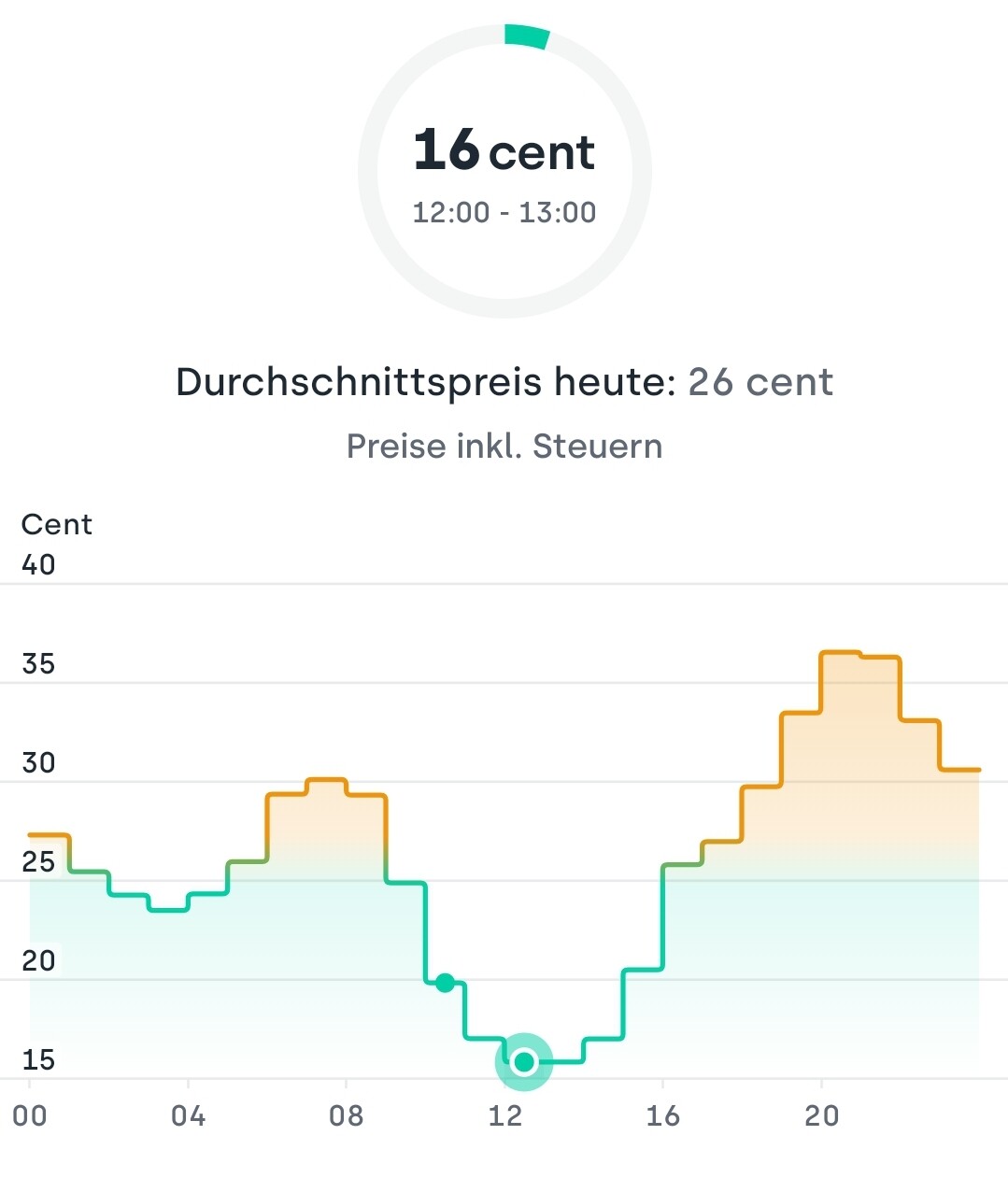
Today is a good example:
Around midday, the price is approximately 16 cents
In the evening at the peak, about 37 cents
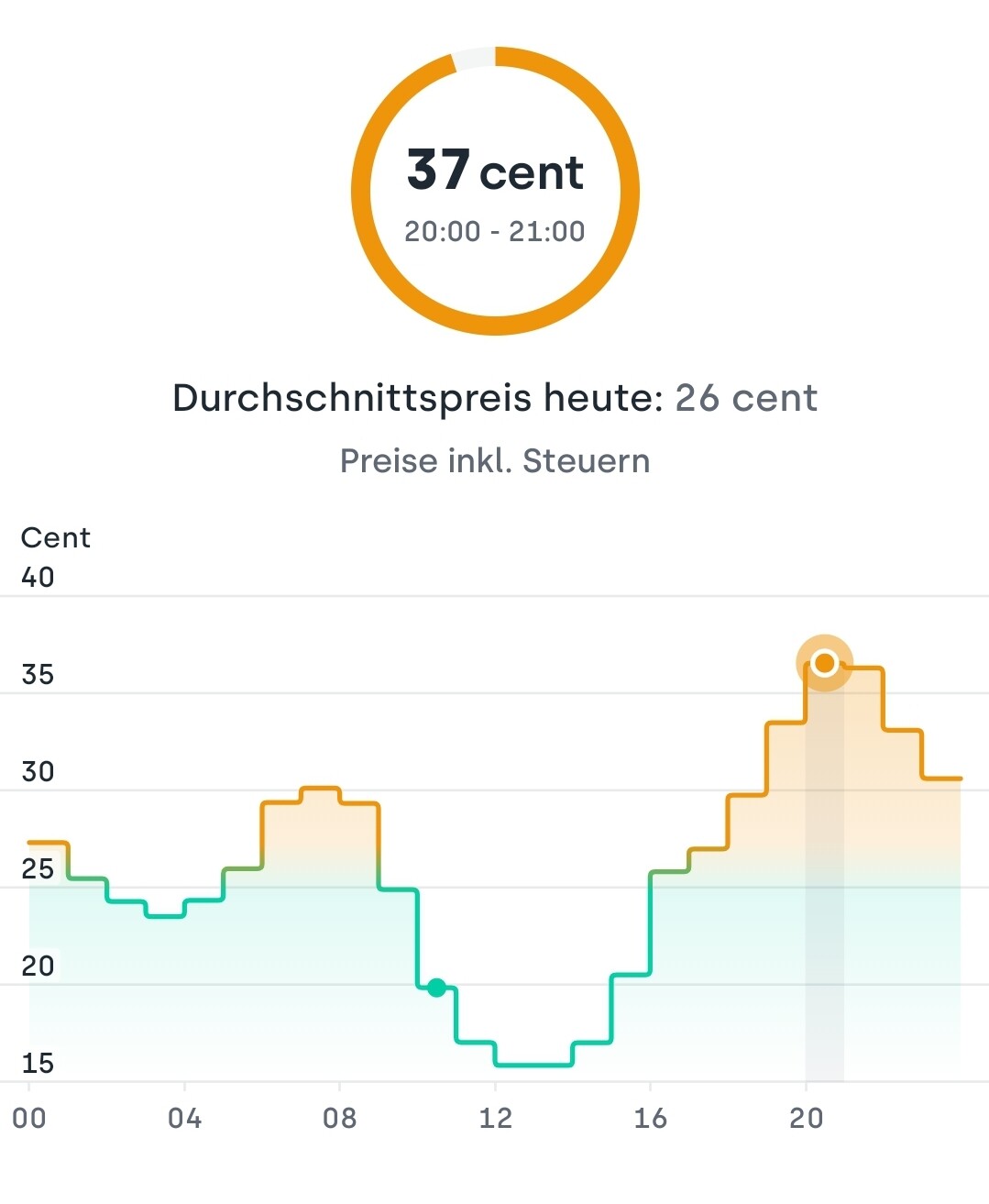
If the photovoltaic system does not produce enough, I would charge the battery from the grid around midday and use it in the evening. Considering the price difference, conversion losses are acceptable. This can be well automated using solar forecasting and self-consumption data. Charging a hot water storage tank can also be automated. It is especially advantageous if someone is at home at midday and can run the washing machine or similar appliances at that time.
Around midday, the price is approximately 16 cents
In the evening at the peak, about 37 cents
If the photovoltaic system does not produce enough, I would charge the battery from the grid around midday and use it in the evening. Considering the price difference, conversion losses are acceptable. This can be well automated using solar forecasting and self-consumption data. Charging a hot water storage tank can also be automated. It is especially advantageous if someone is at home at midday and can run the washing machine or similar appliances at that time.
H
HeimatBauer4 Jul 2023 10:14That is exactly why open interfaces are more important to me than a locally adjustable "automatic" mode on the device itself – something like Tibber wasn’t even available on the market at the time of my photovoltaic installation, so I HAVE to retrofit it by setting the discharge lock through the home automation system.
For the remote-controlled start of the often-mentioned washing machine, there are now small adhesive devices that physically press the start button. Of course, everything needs to be prepared for this, obviously.
For the remote-controlled start of the often-mentioned washing machine, there are now small adhesive devices that physically press the start button. Of course, everything needs to be prepared for this, obviously.
K
KarstenausNRW4 Jul 2023 10:15Pretty expensive for a summer day – does that already include the costs for Tibber?
And a much more interesting question is how it looks in winter, when a) electricity production during the day is very different and b) you can’t fully charge the battery.
And a much more interesting question is how it looks in winter, when a) electricity production during the day is very different and b) you can’t fully charge the battery.
Similar topics