
ᐅ Energy management systems and control of washing machines, dryers, and the property
Created on: 27 Jan 2022 13:18
H
HoisleBauer22
My question is: How do you control or switch on your washing machine, dryer, or dishwasher when you want to specifically use energy from your photovoltaic system? What control or energy management systems are available for this? What interfaces do the common appliance manufacturers use?
Is a battery absolutely necessary? It is said that such storage might not be economically worthwhile...
This is a continuation of this post: https://www.hausbau-forum.de/threads/wenn-nochmal-bauen-was-anders-machen.42145/post-553913
Apparently, Siemens offers something called "Home Connect".
Is a battery absolutely necessary? It is said that such storage might not be economically worthwhile...
This is a continuation of this post: https://www.hausbau-forum.de/threads/wenn-nochmal-bauen-was-anders-machen.42145/post-553913
Apparently, Siemens offers something called "Home Connect".
Evening 🙂 I think this is my first post in the forum 🙂
I have automated my entire house myself for years – a lot of tinkering, nothing off the shelf. No photovoltaic system or heat pump yet – but: we are going to demolish the current house and build a new one. So I’m gathering information and thinking things through on my own as well.
On the topic:
I currently have an electricity contract with Tibber and a main meter from Discovergy. With a bit of programming, you can get data from both (current hourly electricity price and from 2 PM the electricity price for the next day). Because Tibber charges by the hour and the electricity price can vary quite significantly during off-peak times(!), I wrote a small tool that basically shows the best times to run the washing machine/dryer for our lifestyle. This means I might not start the washing machine immediately when it’s full but rather 2-3 hours later. It’s probably just a few cents saved, but it’s quite easy to incorporate into the daily routine. There are days when the price stays at 18 cents per kWh (including taxes and fees) for hours, basically just grid fees, and then for example after noon it jumps to 40 or 50 cents.
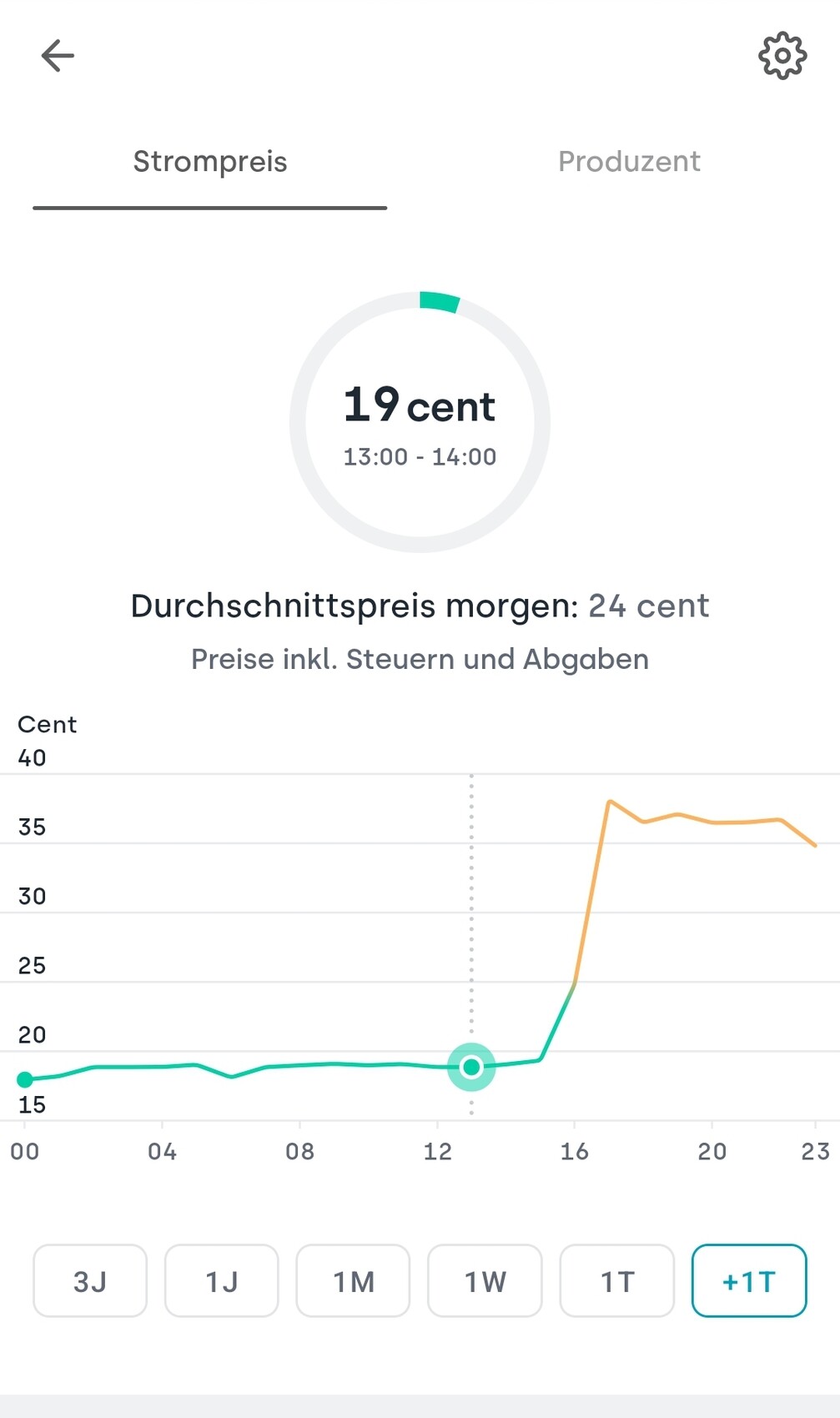
As an example: price for tomorrow (January 30, 2021) – around 18 cents until 3 PM, then about 37 cents.
Would I start the dishwasher earlier because of this? No.
But would I like to have my laundry done before 3 PM? Hell yeah!
For the new build, I am considering something different: the photovoltaic system will also have a battery storage. In winter, this is basically idle capital. High consumption due to the heat pump – low output.
My thought: charge the battery at night (usually cheaper, but sometimes for a few hours during the day as well) with “cheap electricity” and basically use it during the day when prices are favorable. Since I can 1. somewhat predict electricity prices into the future (maximum one day ahead) and 2. automate retrieving at least an approximate weather forecast, this should make sense. That way, I can avoid “smart” appliances.
I have automated my entire house myself for years – a lot of tinkering, nothing off the shelf. No photovoltaic system or heat pump yet – but: we are going to demolish the current house and build a new one. So I’m gathering information and thinking things through on my own as well.
On the topic:
I currently have an electricity contract with Tibber and a main meter from Discovergy. With a bit of programming, you can get data from both (current hourly electricity price and from 2 PM the electricity price for the next day). Because Tibber charges by the hour and the electricity price can vary quite significantly during off-peak times(!), I wrote a small tool that basically shows the best times to run the washing machine/dryer for our lifestyle. This means I might not start the washing machine immediately when it’s full but rather 2-3 hours later. It’s probably just a few cents saved, but it’s quite easy to incorporate into the daily routine. There are days when the price stays at 18 cents per kWh (including taxes and fees) for hours, basically just grid fees, and then for example after noon it jumps to 40 or 50 cents.
As an example: price for tomorrow (January 30, 2021) – around 18 cents until 3 PM, then about 37 cents.
Would I start the dishwasher earlier because of this? No.
But would I like to have my laundry done before 3 PM? Hell yeah!
For the new build, I am considering something different: the photovoltaic system will also have a battery storage. In winter, this is basically idle capital. High consumption due to the heat pump – low output.
My thought: charge the battery at night (usually cheaper, but sometimes for a few hours during the day as well) with “cheap electricity” and basically use it during the day when prices are favorable. Since I can 1. somewhat predict electricity prices into the future (maximum one day ahead) and 2. automate retrieving at least an approximate weather forecast, this should make sense. That way, I can avoid “smart” appliances.

When using batteries, you have to account for about 20% charge/discharge losses (that’s actually the case). If electricity prices fluctuate by more than that amount, there might be some potential savings. Is it really true that spot prices are significantly lower at night?
What kind of house are you planning to build? We have a total electricity consumption of about 4,200 kWh per year and, even without automation, achieve 70% self-sufficiency, meaning only about 1,200 kWh per year is drawn from the grid. What else is there to optimize? Of course, a hobby is a hobby.
What kind of house are you planning to build? We have a total electricity consumption of about 4,200 kWh per year and, even without automation, achieve 70% self-sufficiency, meaning only about 1,200 kWh per year is drawn from the grid. What else is there to optimize? Of course, a hobby is a hobby.
Hangman schrieb:
When using batteries, you have to account for about 20% charging/discharging losses (it really is that much). If electricity prices fluctuate by more than that percentage, there might be some benefit. Are spot prices at night really that much cheaper? I understand the losses. That’s why I wrote: At least during winter, the battery is dead capital.
You can see in my screenshot what can happen from 18 to 37 cents, which is a 100% increase. So, as long as no solar yield is forecasted, I would charge the battery fully until 3 p.m. And yes, these fluctuations do happen! Not every day, but quite often.
Hangman schrieb:
What are you planning to build? We have a total electricity consumption of about 4,200 kWh/year and even without automation 70% self-sufficiency, meaning only about 1,200 kWh/year drawn from the grid. What else is there to optimize? Of course, hobbies are hobbies. I have appointments in two weeks for more detailed evaluations and calculations with a specialist.
H
Hausbau 5529 Jan 2022 20:50FloHB123 schrieb:
What you’re saying sounds great in theory, but I still find it disconnected from reality. We usually run the dishwasher in the evening because that’s when it’s full. Often there are items inside that need to be clean by the next morning. That’s how many families I know operate. The alternative would be to run it at midday and then wash by hand all the items I want to use in the morning. Great progress and exactly what I want 🙄
And for the washing machine, is there only one load per day? That doesn’t make much sense for 4-5 people and isn’t very realistic.
Automation is all well and good, but there are some things people prefer to control themselves because it’s just much more complicated otherwise. In my opinion, automation will never catch on for things like this—at least not with the household appliances currently available. For your world, you’re doing everything right...a real worrywart at its finest...
Mycraft schrieb:
The train has long since left the station and is only gaining speed. Do you have any concrete everyday examples? Not just future possibilities, but something that already works now with reasonable effort? We are still talking about household appliances here, not, for example, controlling lighting, heating, or ventilation systems.
Mycraft schrieb:
No, the alternative is: you use it as you normally would, and if you want to save a bit, you can fill it in the morning before leaving. The dishwasher then takes care of the rest. @Zubi123 explained this exactly right. Exactly what am I saving if I have to invest a lot of time and money beforehand into automation?
At work (an IT company), I am constantly required to find processes that can be automated. Of course, only those processes are chosen where a benefit can be expected within a reasonable time frame. And I don’t see that benefit in the examples shared in this thread either. You haven’t been able to provide one so far but have only kept it very general. Automation is your hobby, not mine. I am an average user. Therefore, I need to see a benefit. The automation must either save time or money, or make things simpler or better. But in any case, the ratio must be right.
Hausbau 55 schrieb:
For your world, you’re doing everything right... Finest worrywarts... Sorry, but that’s nonsense. Any kind of automation costs money and has to provide a benefit, especially for those who haven’t taken it up as a hobby. Otherwise, it simply doesn’t make sense for most households and won’t be used.
To stick with household appliances: with a dishwasher, you can adjust and save money. But how is that supposed to work with laundry? In our household of four, we simply can’t manage to have a load of fairly similar laundry almost every day. To use such a function effectively, that would need to be the case. Otherwise, I (and surely many others) wouldn’t be willing to spend money on it.
Similar topics