
Hello everyone,
We recently came across Tibber and are considering whether it might be suitable for us and economically viable. Does anyone here use it? Specifically, we’re interested in the hourly, dynamic billing and this Pulse device that you need to buy for it. Is it some kind of submeter? They throw around terms like “smart home,” but I haven’t fully understood it yet.
Can the Pulse device be installed by yourself, or does it require a certified electrician? The idea seems to be that it measures electricity consumption in real time.
We have photovoltaic panels, an electric car, and a fairly large battery storage system, so we would presumably be well equipped for this. However, I’m not sure if with our setup we can specifically control if and when power is drawn from the grid. Depending on the price (which can sometimes even be negative), it might make sense to feed everything from the photovoltaic system into the grid and power the household from the grid when the price (like yesterday) was as low as -40ct.
If anyone has any experience with this, good or bad, please feel free to share.
We recently came across Tibber and are considering whether it might be suitable for us and economically viable. Does anyone here use it? Specifically, we’re interested in the hourly, dynamic billing and this Pulse device that you need to buy for it. Is it some kind of submeter? They throw around terms like “smart home,” but I haven’t fully understood it yet.
Can the Pulse device be installed by yourself, or does it require a certified electrician? The idea seems to be that it measures electricity consumption in real time.
We have photovoltaic panels, an electric car, and a fairly large battery storage system, so we would presumably be well equipped for this. However, I’m not sure if with our setup we can specifically control if and when power is drawn from the grid. Depending on the price (which can sometimes even be negative), it might make sense to feed everything from the photovoltaic system into the grid and power the household from the grid when the price (like yesterday) was as low as -40ct.
If anyone has any experience with this, good or bad, please feel free to share.
K
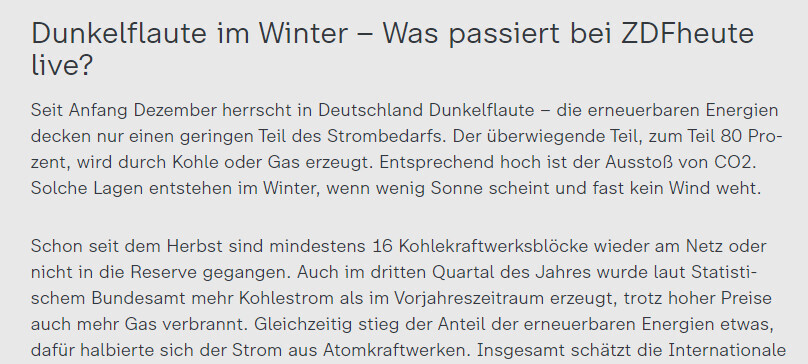
KarstenausNRW4 Jul 2023 11:23Just a quick note about last winter. This is from ZDF:

Tolentino schrieb:
Yes, I also thought about it a lot, but we use so much more electricity in winter because of the grow lights (not for heating but for lighting) that it probably doesn’t pay off for me. I find it hard to judge because 2022 is not very representative, but those are the only figures Tibber has on the website.
So far in 2023, the electricity price has behaved much more linearly again. However, I don’t know what that means for prices in December and January since I have no data for those months except for 2022.
We will probably use most of our electricity from the grid in winter, I guess, because of the heat pump.
W
WilderSueden4 Jul 2023 11:45kati1337 schrieb:
The assumption that the tariff is so expensive in winter due to the wholesale market price is not currently confirmed. Private photovoltaic systems might drop out, and demand increases because of heat pumps, but how much does that really affect the price? The wind keeps blowing, and currently, wind contributes more to our electricity mix. It is clear that electricity consumption is significantly higher in winter than in summer, and this will continue to be the case. At the same time, not only private photovoltaic systems are mostly unavailable during that time, but commercial ones as well. What wind power cannot provide must therefore come from coal and gas or be purchased from neighbors. Currently, our electricity prices are around 28c, which corresponds to a wholesale electricity price of 130€/MWh, making a fixed price more favorable. There is not much room for prices to drop.
Looking ahead, we are all expected to use more electricity, while coal-fired power plants are planned to be phased out by 2030. This clearly increases dependence on wind and gas. If the wind fails, dependence on gas becomes even greater.
O
os24laenger4 Jul 2023 11:48I have been using Awattar for about 4 years (similar to Tibber, but without an app) and have also been using Tibber for a few weeks now. We have an electric car with a smart wallbox that charges when electricity is cheap, and a heat pump that knows the prices and adjusts its operation accordingly.
Here is my conclusion:
- Negative prices are very rare, and extremely low prices like -0.45 EUR/kWh (-45 cents) only occur perhaps once every few years. You shouldn’t necessarily rely on this.
- It should be noted that the spot market mainly represents residual trading; in other words, everything not covered by fixed contracts is traded here. This can sometimes cause strong fluctuations.
- Spot prices can also remain very high (40 - 60 cents per kWh) for extended periods around the clock, as happened last summer when nuclear power plants in France were offline. In such cases, I preferred to charge at an ENBW charging station (35 cents) rather than at home.
- It is very difficult to be "much" cheaper than a fixed price. If you have your own photovoltaic system on the roof (we don’t yet), I believe it may no longer be financially worthwhile.
- It’s definitely fun, no doubt about that. And charging the car with very cheap electricity is nice.
For our new house (with a photovoltaic system), I would rather opt for a fixed-price contract again, provided prices return to normal around 30-35 cents. A reputable provider usually buys electricity in advance at a fixed price for a longer period and can therefore offer its customers a fixed price without being subject to spot market fluctuations.
PS: On the Awattar homepage, it is possible to view historical electricity prices for a longer period, including "highlights" showing when prices were low.
Here is my conclusion:
- Negative prices are very rare, and extremely low prices like -0.45 EUR/kWh (-45 cents) only occur perhaps once every few years. You shouldn’t necessarily rely on this.
- It should be noted that the spot market mainly represents residual trading; in other words, everything not covered by fixed contracts is traded here. This can sometimes cause strong fluctuations.
- Spot prices can also remain very high (40 - 60 cents per kWh) for extended periods around the clock, as happened last summer when nuclear power plants in France were offline. In such cases, I preferred to charge at an ENBW charging station (35 cents) rather than at home.
- It is very difficult to be "much" cheaper than a fixed price. If you have your own photovoltaic system on the roof (we don’t yet), I believe it may no longer be financially worthwhile.
- It’s definitely fun, no doubt about that. And charging the car with very cheap electricity is nice.
For our new house (with a photovoltaic system), I would rather opt for a fixed-price contract again, provided prices return to normal around 30-35 cents. A reputable provider usually buys electricity in advance at a fixed price for a longer period and can therefore offer its customers a fixed price without being subject to spot market fluctuations.
PS: On the Awattar homepage, it is possible to view historical electricity prices for a longer period, including "highlights" showing when prices were low.

On Nord Pool, you can browse hourly values up to early 2022.
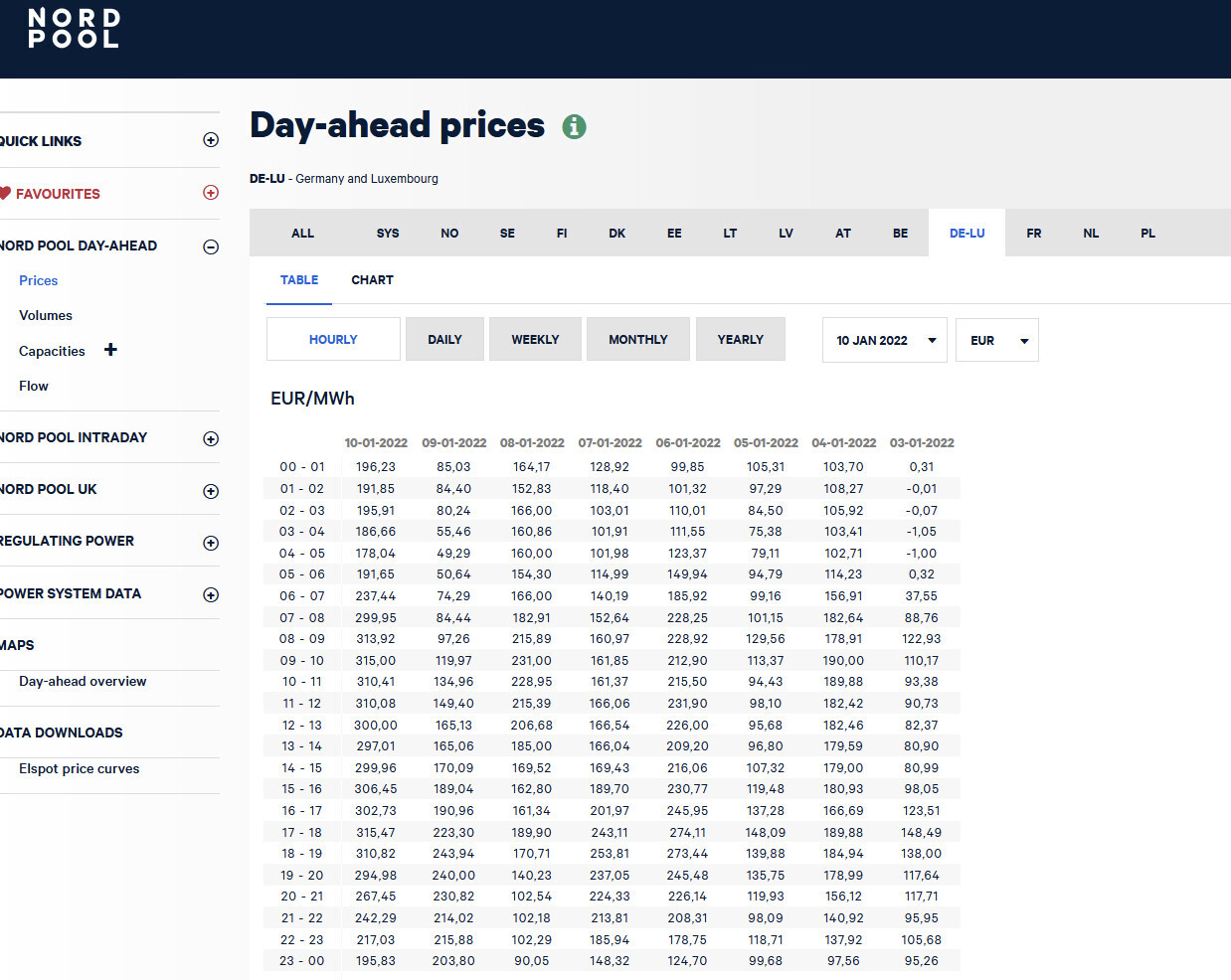
Here is one week in January outside the holiday season. On average, significantly cheaper than what retail consumers can get if you add the margin and grid fees from Tibber/Awattar.
However, you also need to be able to pay your electricity bill when prices stay as high as last August for weeks.
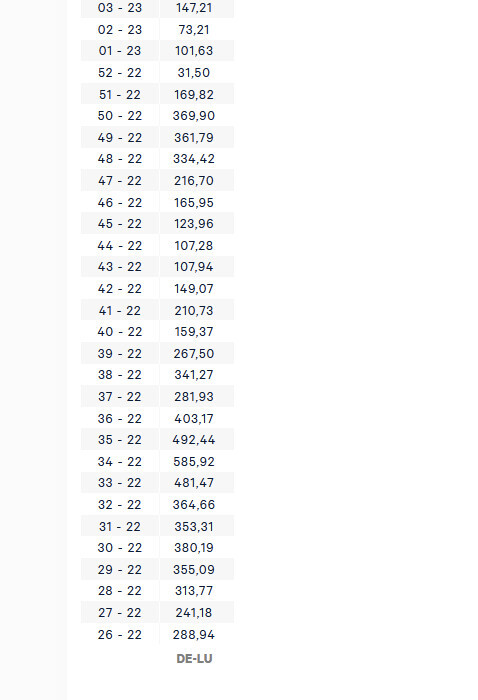
Here is one week in January outside the holiday season. On average, significantly cheaper than what retail consumers can get if you add the margin and grid fees from Tibber/Awattar.
However, you also need to be able to pay your electricity bill when prices stay as high as last August for weeks.
Similar topics