
ᐅ Number and Placement of Exterior Lights for a Square House Approximately 9.40m x 9.40m
Created on: 4 Aug 2021 18:34
P
Pinkiponk
Our selection appointment is approaching, so I would like to ask for some feedback. I know it’s a fairly standard, plain house, but it suits us well.
Attached you will find the house elevations from the four cardinal directions. Could you please advise where and how many exterior lights you would install on the outer walls? I’m unsure whether one or two exterior lights on a 9.40m (31 feet) wall might be too few. The house is 9.20m (30 feet) high including the roof. Without the roof, meaning the wall height, it is 6.51m (21 feet). At a later stage, we might add shutters, if that is relevant for the placement of the exterior lights.
The blue dots mark my initial suggested mounting points. On the east and west sides, I have initially planned two exterior lights each, and on the south and north sides, one each. Our main terrace will be on the west side. On the other three sides, there will only be small seating areas, more like garden spots than terraces.
There will also be various other lighting fixtures in the garden among the plants, but their exact locations will be decided during the landscaping planning. We might also add solar-powered gutter lights to the rain gutters, but that would be at a later time.

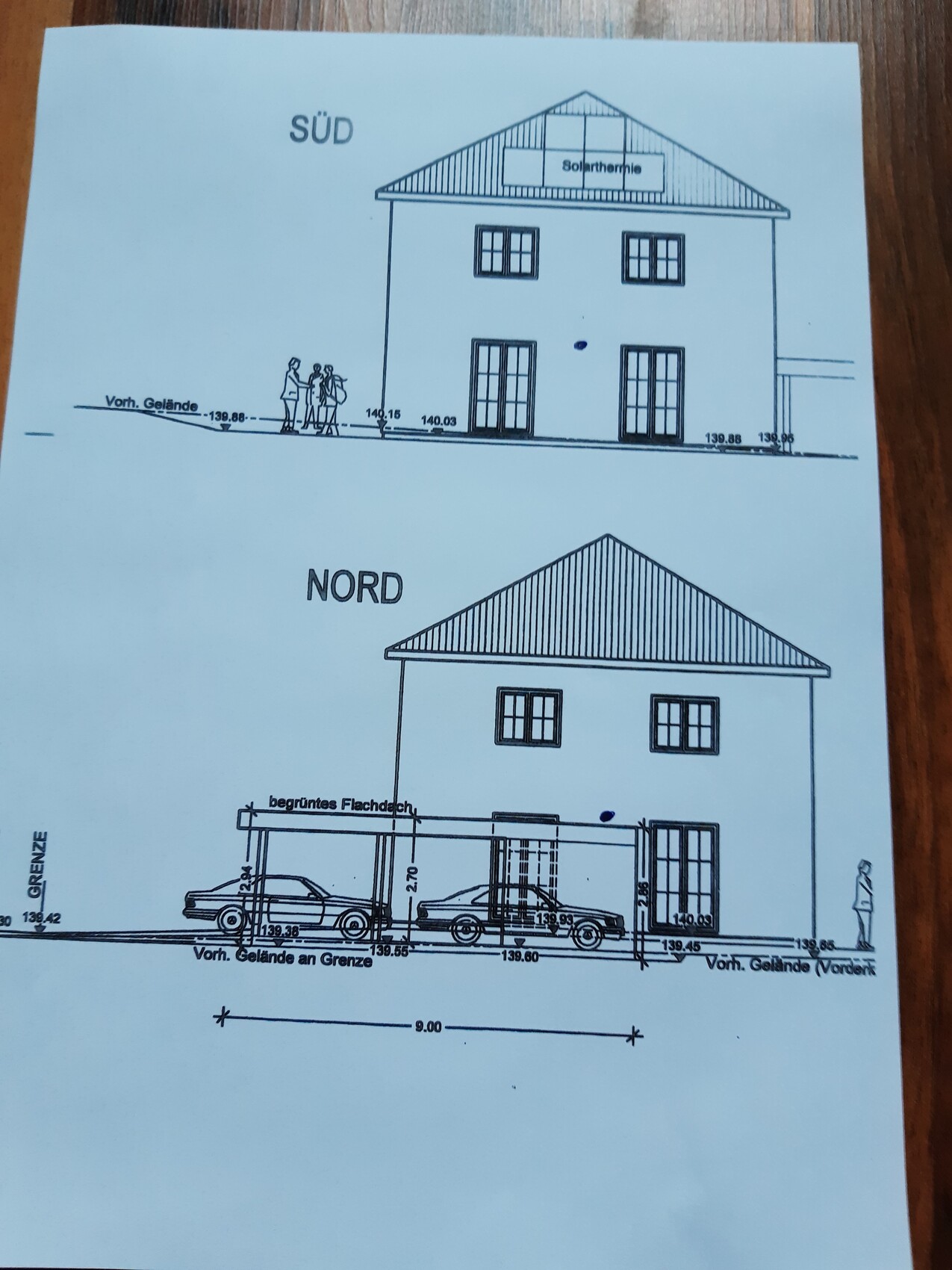
Attached you will find the house elevations from the four cardinal directions. Could you please advise where and how many exterior lights you would install on the outer walls? I’m unsure whether one or two exterior lights on a 9.40m (31 feet) wall might be too few. The house is 9.20m (30 feet) high including the roof. Without the roof, meaning the wall height, it is 6.51m (21 feet). At a later stage, we might add shutters, if that is relevant for the placement of the exterior lights.
The blue dots mark my initial suggested mounting points. On the east and west sides, I have initially planned two exterior lights each, and on the south and north sides, one each. Our main terrace will be on the west side. On the other three sides, there will only be small seating areas, more like garden spots than terraces.
There will also be various other lighting fixtures in the garden among the plants, but their exact locations will be decided during the landscaping planning. We might also add solar-powered gutter lights to the rain gutters, but that would be at a later time.

haydee schrieb:
Or take a city tour in Vienna organized by the SPÖ.Why – do the comrades tell me there about prefabricated panels for social housing facades?https://www.instagram.com/11antgmxde/
https://www.linkedin.com/company/bauen-jetzt/
No. The conditions in which the ordinary workers lived behind the impressive facades were very different.
Let’s just say the poor Rhön builder lived better in comparison. The tour was different once. Usually, only the grand buildings with their prominent residents are shown.
Living without dampness, the cramped spaces, the poverty—eventually, the houses were completed and the wealthier residents moved in.
Any homeowner can create beautiful facades while renting out under such living conditions.
Any factory owner can afford a splendid villa as long as their workers live in poverty. This is called exploitation.
Regarding the rural population, multiple generations lived in the houses, sometimes including unmarried members. Hands and skills were available. In some generation, there was always someone who could produce something decorative.
Despite the cramped conditions, the houses were not torn down but maintained.
No one knows how old the house is. It has always been old. This is not just a saying in our region.
Let’s just say the poor Rhön builder lived better in comparison. The tour was different once. Usually, only the grand buildings with their prominent residents are shown.
Living without dampness, the cramped spaces, the poverty—eventually, the houses were completed and the wealthier residents moved in.
Any homeowner can create beautiful facades while renting out under such living conditions.
Any factory owner can afford a splendid villa as long as their workers live in poverty. This is called exploitation.
Regarding the rural population, multiple generations lived in the houses, sometimes including unmarried members. Hands and skills were available. In some generation, there was always someone who could produce something decorative.
Despite the cramped conditions, the houses were not torn down but maintained.
No one knows how old the house is. It has always been old. This is not just a saying in our region.

haydee schrieb:
Any manufacturer can afford a luxury villa if their workers live in poverty. That is called exploitation."I do not pay good wages because I have plenty of money; I have plenty of money because I pay good wages." (Robert Bosch, 1931)
H
hampshire20 Nov 2021 20:55haydee schrieb:
In our area, the houses were plain and small. People really had to struggle to have enough food. The struggle to have enough to eat was probably no different in the Rhineland and Bergisches Land. Certainly, many old houses are very simple. Yet, the craftsmanship behind the basics makes my heart beat faster – wood joints were made with traditional carpentry techniques, doors and frames were handmade, bricks were genuine bricks and not today’s fancy facing bricks, and light switches, if present, were made of Bakelite. These are details that would have been found even in the simplest houses, as that was simply the state of the art at the time. Today, this kind of handcraft is pure luxury, as it is much more expensive than industrialized system products. Some roof structures of simple 200-year-old barns look like priceless works of art today – and with the same level of craftsmanship, they would be pure luxury compared to the commonly used glued laminated timber trusses assembled on-site nowadays.
@RomeoZwo
The Gründerzeit period ended before World War I. The two world wars brought many changes.
Even in the 1920s, many housemaids worked for room and board plus some money.
What was possible in 1931 seemed like utopian fantasies in 1880.
@hampshire
Glue and nails were expensive, so joints were dovetailed. Probably someone in every rural household knew how to do it. Even my father learned it from his grandfather. Many things were built for durability, not for consumption.
Who still knows how to make shingles?
We have sandstone walls built in the old style, even double-walled like before. One person knows how to do it, and the rest help. It’s not more expensive than L-shaped blocks, it just takes longer—much longer. Still not finished.
The Gründerzeit period ended before World War I. The two world wars brought many changes.
Even in the 1920s, many housemaids worked for room and board plus some money.
What was possible in 1931 seemed like utopian fantasies in 1880.
@hampshire
Glue and nails were expensive, so joints were dovetailed. Probably someone in every rural household knew how to do it. Even my father learned it from his grandfather. Many things were built for durability, not for consumption.
Who still knows how to make shingles?
We have sandstone walls built in the old style, even double-walled like before. One person knows how to do it, and the rest help. It’s not more expensive than L-shaped blocks, it just takes longer—much longer. Still not finished.
Similar topics