
Hello everyone,
before I hire an expensive company, I would rather get advice and information from you ^^
I want to convert my second building into a workshop and garage.
Currently, there are still two horses in the second area until about the end of September.
After that, two large Hörmann sectional doors will be installed, and I would like to clad the roof and the interior.
My intention is to add a small amount of insulation, not mainly for energy efficiency but to provide some soundproofing.
If I work in the evenings, I don’t want too much noise to escape through the roof.
I understand it’s not possible to avoid noise completely, but it can be reduced with insulation.
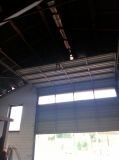
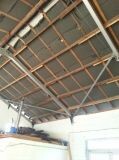
As you can see in the photos, a vapor barrier (is it really one?) has already been installed.
However, since the building stood unused for 3–4 years, the swallows damaged parts of it.
Now my question for you:
I would like to fill the insulation between the rafters and then install OSB boards underneath (with a sprayed plaster finish on them).
As you can see, the membrane is damaged in some places... what should I do now?
Patch the holes and tape everything to make it airtight? Use special insulation materials that can handle a bit of moisture?
Before I get advised by a roofer as a layperson, I would rather hear some ideas from you and apply them.

before I hire an expensive company, I would rather get advice and information from you ^^
I want to convert my second building into a workshop and garage.
Currently, there are still two horses in the second area until about the end of September.
After that, two large Hörmann sectional doors will be installed, and I would like to clad the roof and the interior.
My intention is to add a small amount of insulation, not mainly for energy efficiency but to provide some soundproofing.
If I work in the evenings, I don’t want too much noise to escape through the roof.
I understand it’s not possible to avoid noise completely, but it can be reduced with insulation.
As you can see in the photos, a vapor barrier (is it really one?) has already been installed.
However, since the building stood unused for 3–4 years, the swallows damaged parts of it.
Now my question for you:
I would like to fill the insulation between the rafters and then install OSB boards underneath (with a sprayed plaster finish on them).
As you can see, the membrane is damaged in some places... what should I do now?
Patch the holes and tape everything to make it airtight? Use special insulation materials that can handle a bit of moisture?
Before I get advised by a roofer as a layperson, I would rather hear some ideas from you and apply them.

What temperature control or heating measures are planned for the interior of the hall? A vapor retarder is generally necessary when there are temperature differences causing condensation.
The existing vapor barrier/underlay, or whatever it is, would (if I understand your assembly correctly) be in the wrong place because it would be above the insulation. This means that if condensation occurs, it would happen within the insulation. In general, OSB boards can act as a vapor retarder if installed properly. Whether this is sufficient or if an additional membrane should be placed underneath is beyond my expertise as a non-professional.
The existing vapor barrier/underlay, or whatever it is, would (if I understand your assembly correctly) be in the wrong place because it would be above the insulation. This means that if condensation occurs, it would happen within the insulation. In general, OSB boards can act as a vapor retarder if installed properly. Whether this is sufficient or if an additional membrane should be placed underneath is beyond my expertise as a non-professional.
Also, the plan is to have only a workshop chimney to provide some occasional heat.
Primarily, I actually want to insulate to reduce noise.
Now the question is whether the underlay membrane can be repaired?
If OSB boards are sufficient and I can do without the vapor barrier, that would of course be great ^^
Primarily, I actually want to insulate to reduce noise.
Now the question is whether the underlay membrane can be repaired?
If OSB boards are sufficient and I can do without the vapor barrier, that would of course be great ^^
What you insulate for is secondary when it comes to condensation.
Once larger temperature differences occur, condensation becomes an issue. Even in unheated steel garages, condensation can happen under unfavorable weather conditions. That’s why an anti-condensation layer is installed on the ceiling in those cases.
You should do more research yourself or, ideally, consult a professional. You don’t want to have to remove the insulation after six months because it’s completely soaked.
In my opinion, this is also the wrong forum for that kind of question. Most users here are house builders who commission their houses to be built.
Once larger temperature differences occur, condensation becomes an issue. Even in unheated steel garages, condensation can happen under unfavorable weather conditions. That’s why an anti-condensation layer is installed on the ceiling in those cases.
Hanske schrieb:
If OSB boards are sufficient and I can do without a vapor barrier, that would of course be great ^^
You should do more research yourself or, ideally, consult a professional. You don’t want to have to remove the insulation after six months because it’s completely soaked.
In my opinion, this is also the wrong forum for that kind of question. Most users here are house builders who commission their houses to be built.
Similar topics