
ᐅ Solid hardwood flooring with underfloor heating and a dry subfloor system?
Created on: 26 Nov 2020 13:15
C
Cest CaHello,
we are planning to install a large-area solid wood parquet or plank floor with underfloor heating and a raised floor structure in a new low-energy single-family house and are looking for experiences, advantages, but especially disadvantages.
From our own research, there are several different approaches, for example:
- Litotherm with lava gravel stones in which plastic pipes with a diameter of 14mm (0.55 inches) are embedded
Thermal conductivity 0.89 W/mK
Impact sound improvement reportedly about 24-25 dB
(according to one source – I am unfortunately not allowed to post the link here…)
- Quick-Tec Greenline: plastic pipes on aluminum plates on a wood fiber board
Minimum thermal resistance ≥ 1.25 m2K/W
DIN 1264: floors on ground floors (as in our case)
No data on impact sound improvement
- Thermisto (similar to Quick-Tec) with wood planks ≤ 22mm (0.87 inches)
Minimum thermal resistance 0.75 m2K/W
Impact sound improvement 21 dB
- Janssen underfloor heating with copper pipes and copper plates in a raised floor structure
No data on impact sound
No data on minimum thermal resistance
Reasons for preferring a dry floor build-up:
- no adhesive
- elastic underfoot feeling (is this the case with Lithotherm, Quick-Tec, Thermisto?)
I would be very interested in experiences as well as advantages and disadvantages of these systems and look forward to your comments.
we are planning to install a large-area solid wood parquet or plank floor with underfloor heating and a raised floor structure in a new low-energy single-family house and are looking for experiences, advantages, but especially disadvantages.
From our own research, there are several different approaches, for example:
- Litotherm with lava gravel stones in which plastic pipes with a diameter of 14mm (0.55 inches) are embedded
Thermal conductivity 0.89 W/mK
Impact sound improvement reportedly about 24-25 dB
(according to one source – I am unfortunately not allowed to post the link here…)
- Quick-Tec Greenline: plastic pipes on aluminum plates on a wood fiber board
Minimum thermal resistance ≥ 1.25 m2K/W
DIN 1264: floors on ground floors (as in our case)
No data on impact sound improvement
- Thermisto (similar to Quick-Tec) with wood planks ≤ 22mm (0.87 inches)
Minimum thermal resistance 0.75 m2K/W
Impact sound improvement 21 dB
- Janssen underfloor heating with copper pipes and copper plates in a raised floor structure
No data on impact sound
No data on minimum thermal resistance
Reasons for preferring a dry floor build-up:
- no adhesive
- elastic underfoot feeling (is this the case with Lithotherm, Quick-Tec, Thermisto?)
I would be very interested in experiences as well as advantages and disadvantages of these systems and look forward to your comments.
HarvSpec schrieb:
Here are some construction photos: screwed solid wood planks (oak) with underfloor heating without screed
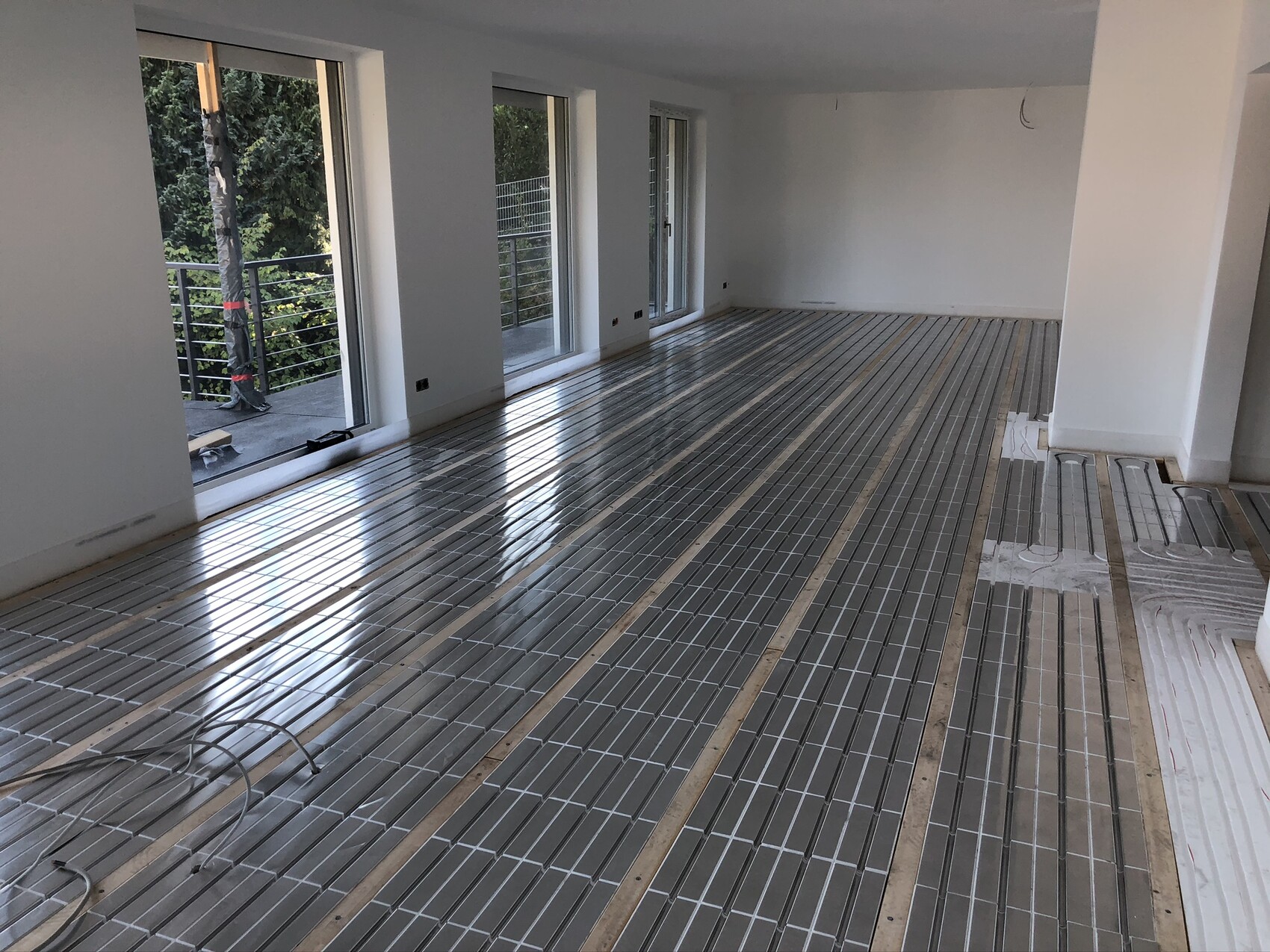
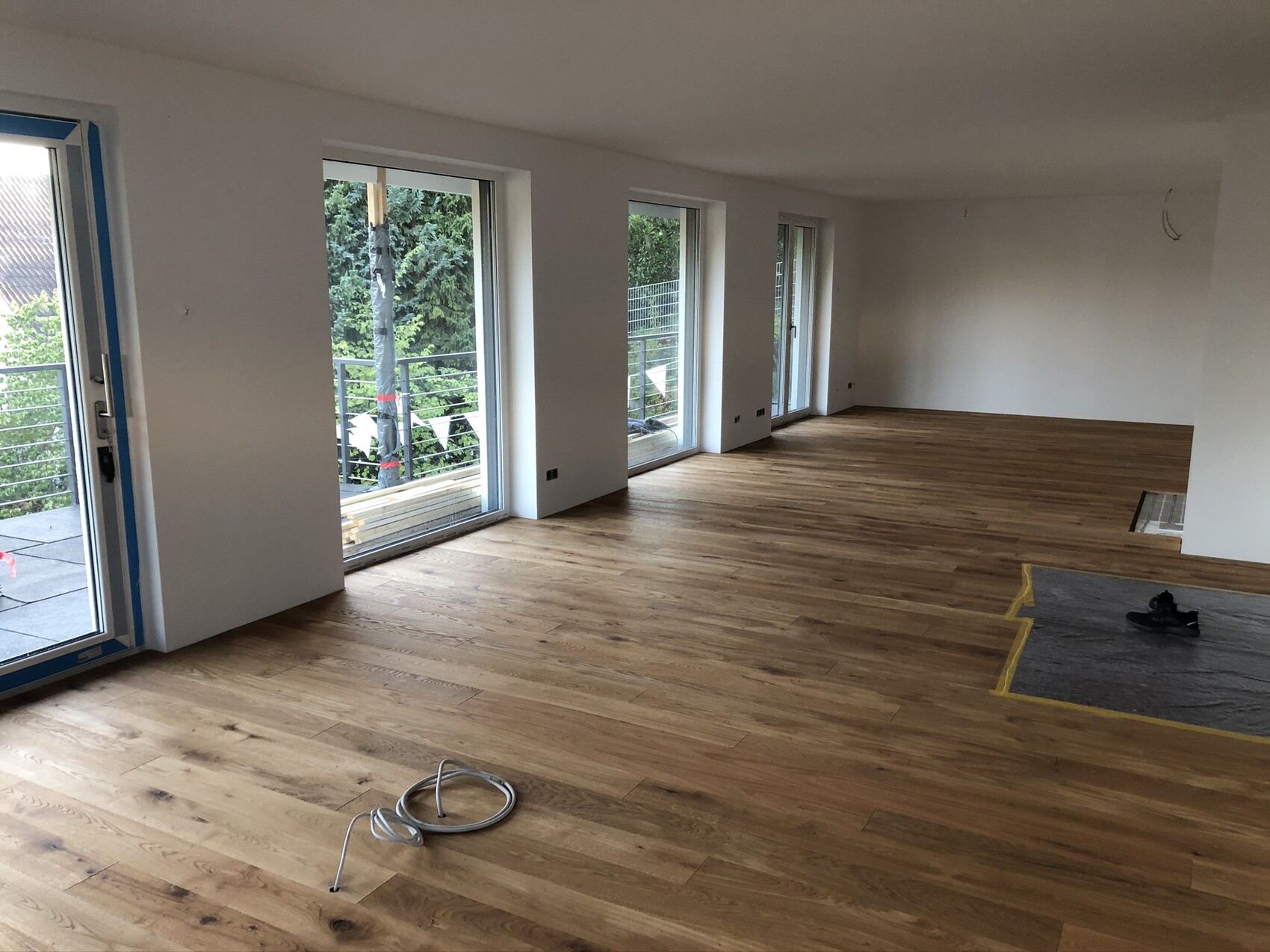
There is some information about this in the thread
P
pagoni202027 Nov 2020 12:20@Cest Ca I was actually going to recommend @HarvSpec to you, as they gave me very good information; thanks again for that, because I only had "outdated" methods before. You can find the most important details in the mentioned thread about solid wood planks.
There are different options available, which you can easily find on the first pages of online searches. From there, it’s mostly a matter of personal preference.
Why is impact sound insulation so important on the ground floor? Of course, solid wood planks resonate more than glued parquet on screed, but that’s not necessarily a disadvantage.
You will find plenty of pros and cons for all types of systems online. Ultimately, it’s a matter of personal philosophy. The mainstream approach (not in a negative sense) would be underfloor heating with screed and glued flooring on top. Anything different will attract critics. But you can see everywhere that it works if you look for it.
I think screwed planks are great. A friend has glued parquet, which feels too hard for me, almost like concrete or stone. Currently, we have large areas of floating parquet on screed with impact sound insulation. Occasionally it creaks in one spot but not much. So I find this type of installation acceptable. However, we really wanted solid wood planks and screwed installation because I’ve had that for 30 years and liked it a lot. We are doing it without underfloor heating, but it works just as well with underfloor heating.
Some people screw the joists directly to the floor and insulate between them, while others install the insulation as a floating layer and place engineered wood systems like Steico between, into which the planks are then screwed. I like that method best so far. There are other systems as well from companies like WEM, Ripal, etc., but in the end, they are all quite similar.
There are different options available, which you can easily find on the first pages of online searches. From there, it’s mostly a matter of personal preference.
Cest Ca schrieb:
Floors on ground floors (like in our case)
no information about impact sound insulation
Why is impact sound insulation so important on the ground floor? Of course, solid wood planks resonate more than glued parquet on screed, but that’s not necessarily a disadvantage.
You will find plenty of pros and cons for all types of systems online. Ultimately, it’s a matter of personal philosophy. The mainstream approach (not in a negative sense) would be underfloor heating with screed and glued flooring on top. Anything different will attract critics. But you can see everywhere that it works if you look for it.
I think screwed planks are great. A friend has glued parquet, which feels too hard for me, almost like concrete or stone. Currently, we have large areas of floating parquet on screed with impact sound insulation. Occasionally it creaks in one spot but not much. So I find this type of installation acceptable. However, we really wanted solid wood planks and screwed installation because I’ve had that for 30 years and liked it a lot. We are doing it without underfloor heating, but it works just as well with underfloor heating.
Some people screw the joists directly to the floor and insulate between them, while others install the insulation as a floating layer and place engineered wood systems like Steico between, into which the planks are then screwed. I like that method best so far. There are other systems as well from companies like WEM, Ripal, etc., but in the end, they are all quite similar.
Impact sound insulation mainly depends on the type and structure of your subfloor construction.
You can add extra insulation and screed to any system, then the rest is mostly a matter of personal preference.
An alternative to the Jansen system is Ripal.
With both (Jansen and Ripal), it’s important to be aware that a different build-up is required in tiled areas.
We used the Cosmo system (similar to your Quicktherm). This allows you to lay tiles within the same system using load distribution plates.
I would definitely check the pipe diameters as well, since your heating installer cannot simply reduce the spacing between pipes if the specified pipe spacing is fixed.
You can add extra insulation and screed to any system, then the rest is mostly a matter of personal preference.
An alternative to the Jansen system is Ripal.
With both (Jansen and Ripal), it’s important to be aware that a different build-up is required in tiled areas.
We used the Cosmo system (similar to your Quicktherm). This allows you to lay tiles within the same system using load distribution plates.
I would definitely check the pipe diameters as well, since your heating installer cannot simply reduce the spacing between pipes if the specified pipe spacing is fixed.
Similar topics