
ᐅ Replacing Old Wiring: Should the Terrace Be Separated from the Living Room?
Created on: 6 Oct 2025 10:59
H
Hanniball2kH
Hanniball2k6 Oct 2025 10:59Hello everyone,
As part of the renovation, I’m unsure about how to handle the connection for my terrace. To begin with: an electrician has been hired to replace the distribution board and, if needed, connect some newly installed wiring. He is also advising me and will be coordinating with me over the next few weeks.
Still, I’m looking for some everyday practical experience.
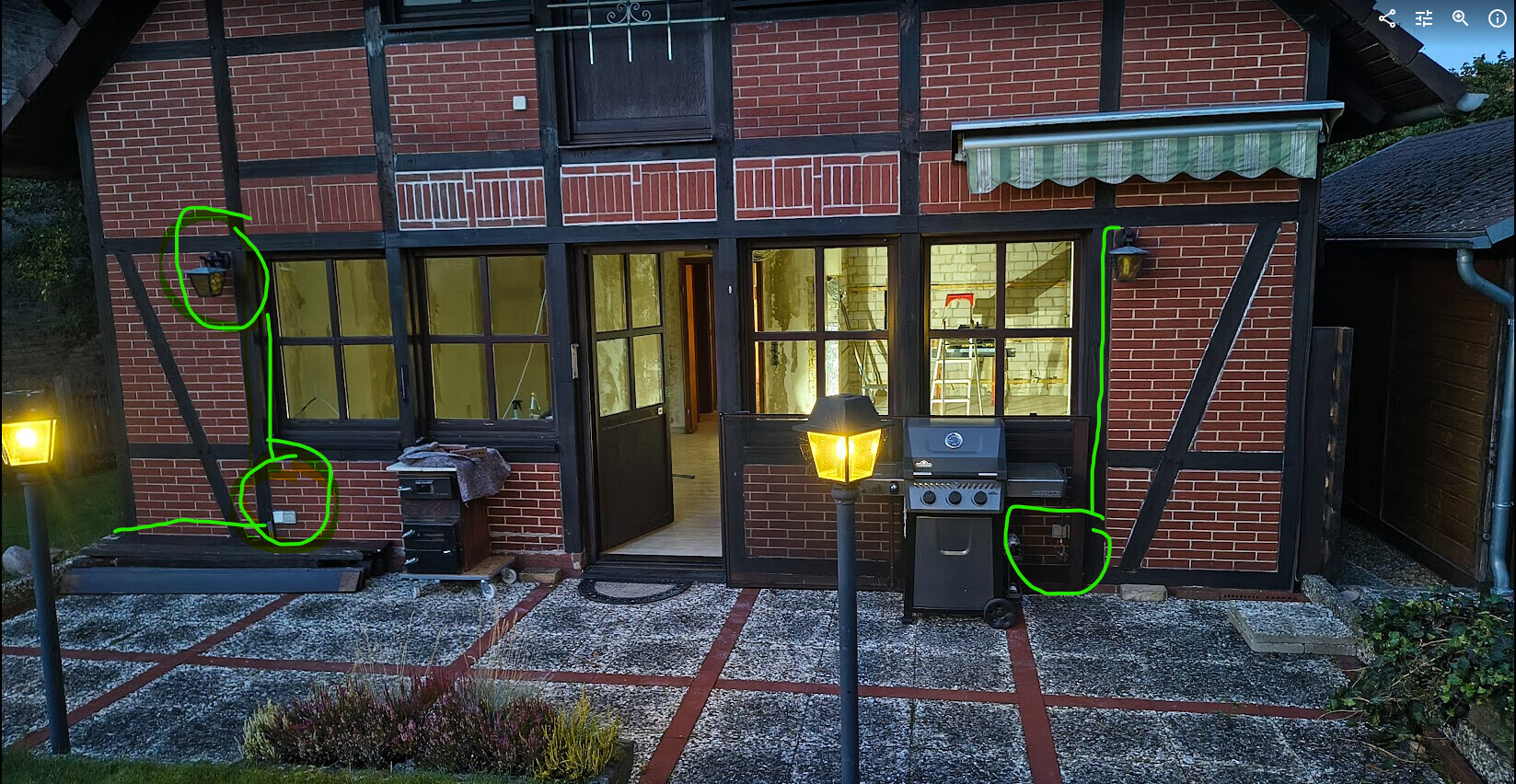
Currently, the terrace lighting is connected through the living room circuit, but this will be separated. There is a main switch in the living room that can completely shut off power to the outside. In addition, there are three switches outside controlling four lights and one socket outlet, which are rather poorly installed flush-mounted on the outside of the brickwork.
I broke my SweetHome3D, so I used PowerPoint instead… 😀 I hope it’s clear enough.
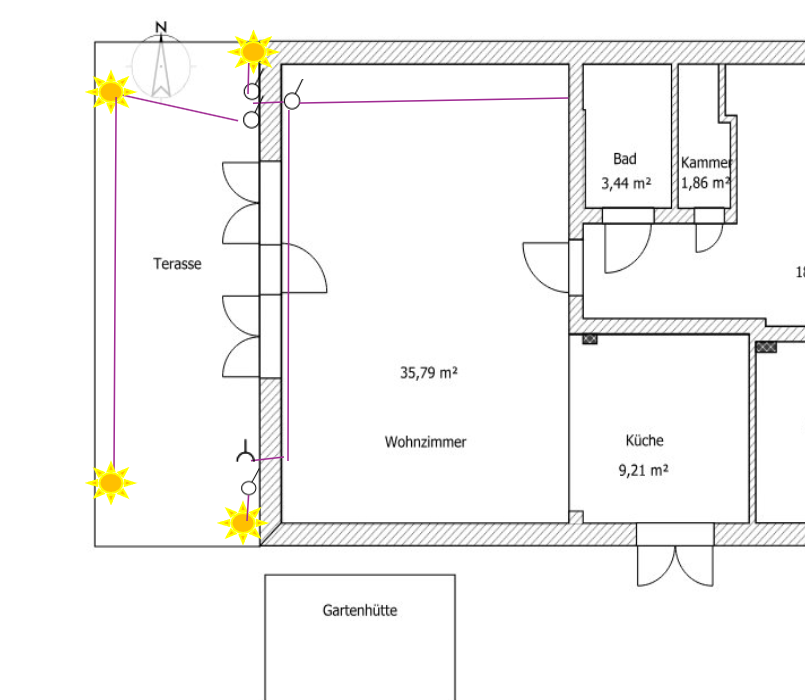
I want to have one switch for all four lights, and possibly an outlet as well. This should be separated from the living room circuit. The electrician has already suggested installing an RCD/MCB for both the garden shed and the garage.
Now, the question... How does this work in everyday life? Is it really necessary to have a switch for the lighting inside the house, or is an outside switch sufficient? Should sockets also be switchable from inside?
I can very well imagine supplying power through the garden shed, and instead of flush-mounted switches, using surface-mounted ones.
- One light switch outside on the terrace
- One light switch inside the living room, both switches connected using a Shelly device to create a two-way switching system so all four lights can be controlled
- Socket outlets supplied with continuous power from the garden shed (--> also designed to be switchable, possibly switched from the garden shed? It can theoretically be locked).
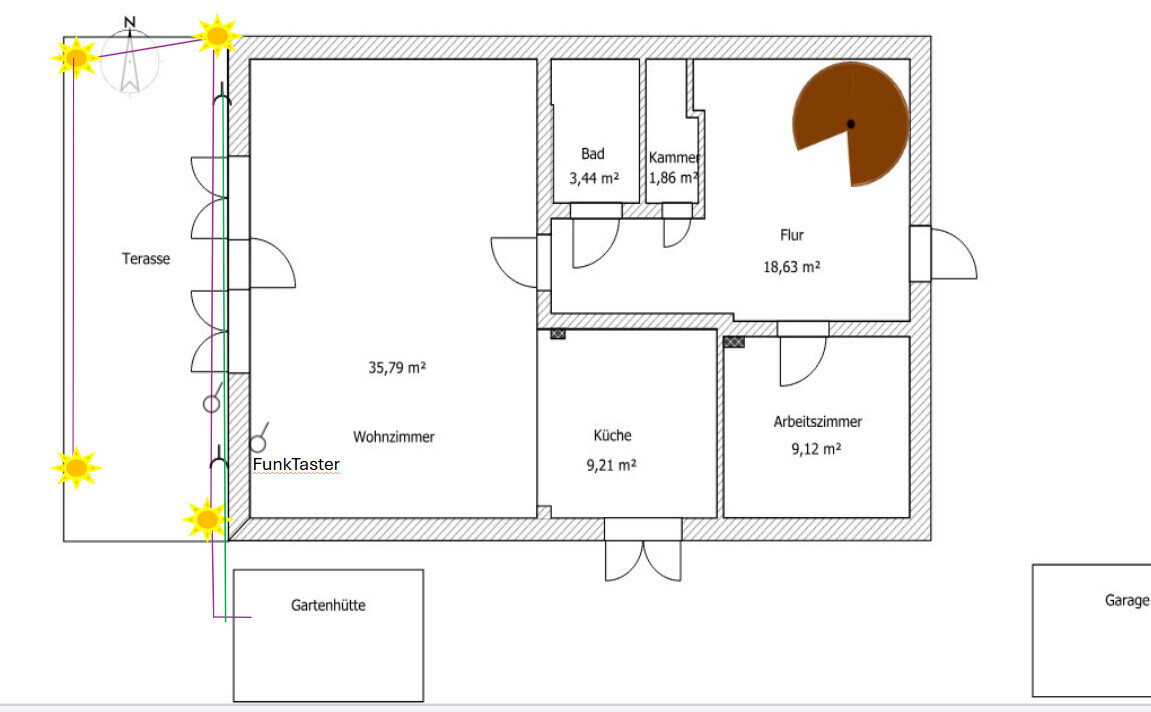
Any opinions, ideas, or everyday experience? So far, we have lived on the second floor without any of these setups 😀
As part of the renovation, I’m unsure about how to handle the connection for my terrace. To begin with: an electrician has been hired to replace the distribution board and, if needed, connect some newly installed wiring. He is also advising me and will be coordinating with me over the next few weeks.
Still, I’m looking for some everyday practical experience.
Currently, the terrace lighting is connected through the living room circuit, but this will be separated. There is a main switch in the living room that can completely shut off power to the outside. In addition, there are three switches outside controlling four lights and one socket outlet, which are rather poorly installed flush-mounted on the outside of the brickwork.
I broke my SweetHome3D, so I used PowerPoint instead… 😀 I hope it’s clear enough.
I want to have one switch for all four lights, and possibly an outlet as well. This should be separated from the living room circuit. The electrician has already suggested installing an RCD/MCB for both the garden shed and the garage.
Now, the question... How does this work in everyday life? Is it really necessary to have a switch for the lighting inside the house, or is an outside switch sufficient? Should sockets also be switchable from inside?
I can very well imagine supplying power through the garden shed, and instead of flush-mounted switches, using surface-mounted ones.
- One light switch outside on the terrace
- One light switch inside the living room, both switches connected using a Shelly device to create a two-way switching system so all four lights can be controlled
- Socket outlets supplied with continuous power from the garden shed (--> also designed to be switchable, possibly switched from the garden shed? It can theoretically be locked).
Any opinions, ideas, or everyday experience? So far, we have lived on the second floor without any of these setups 😀
Hanniball2k schrieb:
Now the question... How does this work in everyday life? Do you really need a switch for the lighting inside, or is it enough to have it outside? Should you also be able to switch off power outlets from inside? "Necessary" is not the right word. You need some way to turn it on and off, but whether that’s with a switch inside, outside, only via a motion sensor, or something else entirely doesn’t really matter.
What’s truly needed depends more on what suits you best, and that depends on your situation. For example, how easy is it for your neighbor to use your power outlets while you’re on vacation or away for a longer period? In that case, you’d probably want them to be switchable from inside (who thinks to turn off circuit breakers every time they go on holiday?). I’m more familiar with the lighting question the other way around — do you really need a switch outside, when one inside is enough and safer from accidental operation by others?
And if you’re already running new wiring, why use a Shelly device? Just run a cable from outside to inside and build a proper circuit instead of relying on a workaround like a Shelly?

Regarding power outlets: Based on my experience, I would generally advise against making them switchable! The issue is that standard switches are usually rated for only 10A and must be protected accordingly. This means that a garden shredder can already reach or exceed the fuse limit. Higher-rated switches for continuous load are rare and therefore come at a premium price. It is better to leave them out; a separate circuit breaker should be sufficient.
W
wiltshire6 Oct 2025 15:32Tolentino schrieb:
Regarding sockets: Based on my experience, I would generally recommend not making them switchable!We installed the outdoor sockets on the house as switchable. In case we need outdoor equipment with high power demand, there is a 32A CEE socket controlled from the breaker panel—wired with a generous cross-section and properly protected. This way, neither a shredder nor a log splitter is an issue, without having to use a combustion engine or having cables lying around the terrace.
My advice: assign a separate circuit breaker for each terrace, and run garden power separately.
M
MachsSelbst6 Oct 2025 20:23Why integrate Shellys? To run automations, possibly to include PMs and BMs, and to control the lighting remotely on a whim. Although this obviously goes against traditional switching technology. Philips offers a practical retrofit with its Hue system, which allows lamps to remain permanently powered without losing the function of the switches. Whether this is also the case with Shelly... I assume so...
For outdoor areas, it definitely makes sense to consider what should work independently or even must under certain circumstances. If I protect the entire outdoor system with a single RCD (residual current device), the lights, fountains, outdoor socket(s), sauna, jacuzzi, and cistern pump will all stop working if there is a ground fault in one of the circuits. So, at least the lighting and especially the outdoor socket should be protected separately. There are now devices combining RCD + B16 circuit breaker in the width of a standard miniature circuit breaker.
In my own sub-distribution board, I protect each outdoor circuit individually with an RCD + Bxx. This also has the (potentially significant) advantage that you immediately know which circuit caused the RCD to trip.
Switching outdoor sockets via a light switch, as Tolentino mentioned... not only makes no sense because it limits you to 10A, but because an RCD protects the circuit downstream in the distribution board, which is mandatory for outdoor installations. Usually, electricians do not protect outdoor sockets with their own RCD, since other devices are also connected, in the worst case heating, refrigerator, and ventilation system...
What’s so bad about this? Anyone who has accidentally cut through a three-phase cable during electrician training and was almost lynched by angry office staff afterward will understand. In a normal network, the neutral conductor is never completely without voltage. This only applies to ideal electric motors or three-phase heaters. A short circuit between neutral (N) and protective earth (PE) alone is usually enough to trip a 30 mA RCD.
Now, if a prankster plugs not a grounded plug into your outdoor socket but a jumper between N and PE—in most cases, the live conductor (L) is on the left and neutral (N) on the right; that’s how almost all electricians do it—after three weeks of vacation you might return to a freezing cold apartment with a moldy fridge. Because the RCD tripped due to asymmetries between the phases causing a compensation current between L(1-3) and N, and a fault current between N and PE.
The joke is, this still happens even if the circuit breaker (miniature circuit breaker) is switched off. The neutral conductor still runs through the main RCD, which usually protects an entire group of breakers.
That is why a switchable outdoor socket must always (!!) be designed as a multipole disconnection, switched by an appropriate switch, usually located in the distribution board.
And a CEE socket should always be planned for outside, if economically feasible. Electric power is increasingly replacing combustion engines, but in this comparison, 3.6 kW is rather at the lower end. If you are installing anyway, you should consider providing a three-phase socket, CEE, outside—whether 16A or 32A... 16A three-phase means 11 kW, 32A corresponds to 22 kW. I would be interested to see an electric garden appliance needing 22 kW in a typical single-family home...
The electrician probably had strong sales skills, because the “generous cross-section” (cable size) is not necessary. There are current carrying capacity tables according to standard technical manuals, and those apply. You don’t gain anything by choosing one or more sizes larger except that the electrician earns more money because he may purchase cheaper but charge significantly more...
For outdoor areas, it definitely makes sense to consider what should work independently or even must under certain circumstances. If I protect the entire outdoor system with a single RCD (residual current device), the lights, fountains, outdoor socket(s), sauna, jacuzzi, and cistern pump will all stop working if there is a ground fault in one of the circuits. So, at least the lighting and especially the outdoor socket should be protected separately. There are now devices combining RCD + B16 circuit breaker in the width of a standard miniature circuit breaker.
In my own sub-distribution board, I protect each outdoor circuit individually with an RCD + Bxx. This also has the (potentially significant) advantage that you immediately know which circuit caused the RCD to trip.
Switching outdoor sockets via a light switch, as Tolentino mentioned... not only makes no sense because it limits you to 10A, but because an RCD protects the circuit downstream in the distribution board, which is mandatory for outdoor installations. Usually, electricians do not protect outdoor sockets with their own RCD, since other devices are also connected, in the worst case heating, refrigerator, and ventilation system...
What’s so bad about this? Anyone who has accidentally cut through a three-phase cable during electrician training and was almost lynched by angry office staff afterward will understand. In a normal network, the neutral conductor is never completely without voltage. This only applies to ideal electric motors or three-phase heaters. A short circuit between neutral (N) and protective earth (PE) alone is usually enough to trip a 30 mA RCD.
Now, if a prankster plugs not a grounded plug into your outdoor socket but a jumper between N and PE—in most cases, the live conductor (L) is on the left and neutral (N) on the right; that’s how almost all electricians do it—after three weeks of vacation you might return to a freezing cold apartment with a moldy fridge. Because the RCD tripped due to asymmetries between the phases causing a compensation current between L(1-3) and N, and a fault current between N and PE.
The joke is, this still happens even if the circuit breaker (miniature circuit breaker) is switched off. The neutral conductor still runs through the main RCD, which usually protects an entire group of breakers.
That is why a switchable outdoor socket must always (!!) be designed as a multipole disconnection, switched by an appropriate switch, usually located in the distribution board.
And a CEE socket should always be planned for outside, if economically feasible. Electric power is increasingly replacing combustion engines, but in this comparison, 3.6 kW is rather at the lower end. If you are installing anyway, you should consider providing a three-phase socket, CEE, outside—whether 16A or 32A... 16A three-phase means 11 kW, 32A corresponds to 22 kW. I would be interested to see an electric garden appliance needing 22 kW in a typical single-family home...
The electrician probably had strong sales skills, because the “generous cross-section” (cable size) is not necessary. There are current carrying capacity tables according to standard technical manuals, and those apply. You don’t gain anything by choosing one or more sizes larger except that the electrician earns more money because he may purchase cheaper but charge significantly more...
H
Hanniball2k12 Oct 2025 17:51The idea with the Shellys was that I wanted to avoid making many (additional) openings from inside to outside, but still have some way to control the lighting from indoors. That’s why the plan was to tap into the terrace lighting from the garden shed and then control it remotely.
However, since more tasks are piling up, we will probably take the pragmatic route and continue using the current wiring, only separating the outdoor circuit from the living room, which will get its own RCD/MCB. So, as shown in picture 1: main switch inside, lighting outside.
Most likely, when the terrace is renovated in 5-10 years, I’ll need to reconsider this setup. The advantage is that I can always access the garden shed to tap into something if needed.
My wife isn’t much help here either, and she doesn’t care where any switches are located :P. (I think it doesn’t matter now, but if it becomes annoying in daily use, it will definitely matter).
However, since more tasks are piling up, we will probably take the pragmatic route and continue using the current wiring, only separating the outdoor circuit from the living room, which will get its own RCD/MCB. So, as shown in picture 1: main switch inside, lighting outside.
Most likely, when the terrace is renovated in 5-10 years, I’ll need to reconsider this setup. The advantage is that I can always access the garden shed to tap into something if needed.
My wife isn’t much help here either, and she doesn’t care where any switches are located :P. (I think it doesn’t matter now, but if it becomes annoying in daily use, it will definitely matter).
Similar topics