
ᐅ Privacy and Noise Protection on Sloped Sites Using Poplar or Fir Trees?
Created on: 7 Nov 2017 09:31
C
ChangelingC
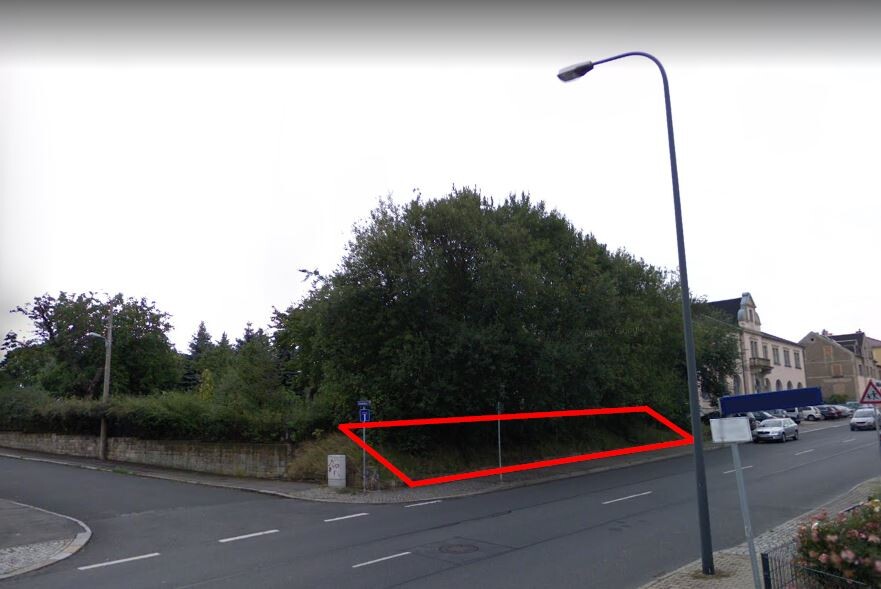
Changeling7 Nov 2017 09:31We are building along a medium-sized road. In the photo taken from the northwest, I have marked the slope leading from the property down to the road in red:
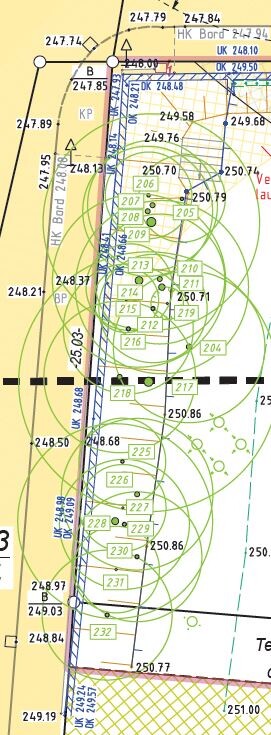
The site plan (oriented to the north) shows the various trees (all poplars) and also the slope with elevation levels indicated:
Unfortunately, the foliage is not as dense as it appears in the photo, especially in autumn and winter it is quite bare and you can easily see through it. As a result, noise from the road is quite noticeable.
Our idea was to prune or break the poplars at about 4-5m (13-16 feet) height and lay them horizontally so they would continue to grow, gradually creating a natural “hedge.” To reinforce this, we considered planting fir trees at the bottom of the slope, as they provide good screening from views and noise and also look nice during winter. These firs would also be pruned to a maximum height of 4-5m (13-16 feet) above our property to keep maintenance manageable and to avoid blocking too much of the western sun.
Is this feasible, or is there a better solution?
A retaining wall is unfortunately too expensive.
The site plan (oriented to the north) shows the various trees (all poplars) and also the slope with elevation levels indicated:
Unfortunately, the foliage is not as dense as it appears in the photo, especially in autumn and winter it is quite bare and you can easily see through it. As a result, noise from the road is quite noticeable.
Our idea was to prune or break the poplars at about 4-5m (13-16 feet) height and lay them horizontally so they would continue to grow, gradually creating a natural “hedge.” To reinforce this, we considered planting fir trees at the bottom of the slope, as they provide good screening from views and noise and also look nice during winter. These firs would also be pruned to a maximum height of 4-5m (13-16 feet) above our property to keep maintenance manageable and to avoid blocking too much of the western sun.
Is this feasible, or is there a better solution?
A retaining wall is unfortunately too expensive.
Hmm, you can prune poplars as long as enough green foliage remains at the top to allow the tree to continue growing upwards and prevent extensive root suckers.
As far as I know, firs/spruces are not suitable for regular topping—firstly, the shape will no longer look good, and secondly, they can become unstable due to their natural growth form and weight distribution not being designed for cutting like that.
I would start by shaping the poplars, observe how they grow and where there are gaps, and then consult with a gardener or preferably an arborist to consider the best way to complement this.
As far as I know, firs/spruces are not suitable for regular topping—firstly, the shape will no longer look good, and secondly, they can become unstable due to their natural growth form and weight distribution not being designed for cutting like that.
I would start by shaping the poplars, observe how they grow and where there are gaps, and then consult with a gardener or preferably an arborist to consider the best way to complement this.
C
Changeling7 Nov 2017 11:57Great to hear that the poplars might work out!
I have read about the unwanted side effects of pruning fir trees, but somehow hoped that regular trimming at this relatively low height could prevent those issues. A neighbor has a similar "fir hedge" at about 3-4 meters (10-13 feet) tall, which he trims regularly, so that’s where the idea comes from.
It would be nice to have something evergreen as well, so you don’t have to rely solely on the poplars. Maybe cherry laurel?
I have read about the unwanted side effects of pruning fir trees, but somehow hoped that regular trimming at this relatively low height could prevent those issues. A neighbor has a similar "fir hedge" at about 3-4 meters (10-13 feet) tall, which he trims regularly, so that’s where the idea comes from.
It would be nice to have something evergreen as well, so you don’t have to rely solely on the poplars. Maybe cherry laurel?
Laurel is totally out of the question for me; I really dislike that plant.
How about holly instead?
Actually, I need to reconsider – those plants don’t thrive in the same conditions. Poplars prefer moist soil, whereas holly tolerates it less... I will keep thinking about it.
How about holly instead?
Actually, I need to reconsider – those plants don’t thrive in the same conditions. Poplars prefer moist soil, whereas holly tolerates it less... I will keep thinking about it.
N
nightdancer7 Nov 2017 12:19Plant growth provides absolutely no sound insulation. If you need soundproofing, it must be incorporated into the building design.
C
Changeling7 Nov 2017 12:58nightdancer schrieb:
Vegetation provides absolutely no sound insulation. If you need soundproofing, it must be incorporated into the building design.Darn, that’s true. I quickly looked it up:
Vegetation
The noise reduction effect of vegetation is often greatly overestimated by non-experts. As an urban planning measure for noise control, vegetation is hardly feasible, since only a 100 m (330 ft) wide dense forest strip with thick undergrowth can achieve a noise level reduction of 5 to 10 dB. Individual, sparsely planted trees or shrubs offer virtually no sound insulation.
Reductions in continuous noise levels along a road through uniform plantings of buffer zones are shown in Table 7/2.
Vegetation
additional noise reduction
through vegetation
Forest without undergrowth 0.05 dB(A)/m (0.015 dB(A)/ft)
Forest (average) 0.10 dB(A)/m (0.03 dB(A)/ft)
Dense deciduous forest 0.15 dB(A)/m (0.045 dB(A)/ft)
Coniferous forest stands 0.20 – 0.30 dB(A)/m (0.06 – 0.09 dB(A)/ft)
Very dense hedges 0.20 – 0.30 dB(A)/m (0.06 – 0.09 dB(A)/ft)
Table 7/2: Noise reduction through vegetation
What should not be underestimated, however, is the visual screening effect caused by vegetation and the resulting positive psychological impact on those affected. Figure 7/27:
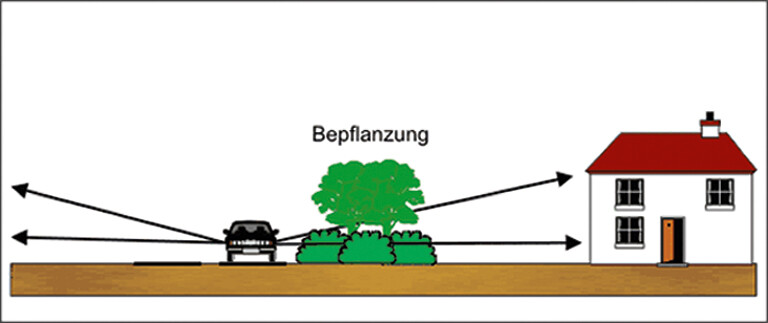
In this respect, the saying applies: What you don’t see, you don’t consciously hear! Trees along the roadside can also serve as a design element to enhance the streetscape, reducing the perceived nuisance of noise for residents and pedestrians.Annoying!
In this case, might it be more effective to raise the slope somewhat and create an earthen noise barrier or build a small retaining wall at the top?
The road is already about 1.5 to 3 meters (5 to 10 ft) lower than the property. Something like this direction:
Soundproofing will be applied to the building anyway, but our main concern is the garden that begins behind the trees.
Similar topics