
Development Plan / Restrictions
Plot size: 774 m² (8,330 ft²)
Slope: 13%, as shown on the site plan
Floor area ratio (FAR): 0.4
Building coverage ratio: 0.5
Building envelope, setback lines, and property boundary: 11 x 15 m (36 x 49 ft), as shown on the site plan
Number of floors: 2 full stories
Roof type: Gable roof, 30° pitch
Orientation: Ridge running NE-SW
Requirements of the Homeowners
Style, roof type, building type: Main residence with 2 accessory apartments (one in the attic, one smaller in the basement)
Basement, floors: Basement (UG), ground floor (EG), upper floor (OG), attic (DG)
Number of occupants, ages: 1975m, 1980f, 2007m (mostly lives with partner from previous marriage), 2009f, 2019m, (expected 2020m/f)
Space requirement on ground and upper floor: from 200 m² (2,150 ft²)
Office: Family use
Guests per year: Apart from resident born 2007 (male), about 6
Open or closed architecture: open plan
Traditional or contemporary design: modern
Open kitchen, kitchen island: yes
Number of dining seats: 6
Fireplace: no
Music/stereo wall: Home theater system in the living room
Balcony, roof terrace: Roof terrace in the attic for accessory apartment 1
Garage, carport: 3 garages, 2 parking spaces
Utility garden, greenhouse: A level garden is planned on top of the garages, with lawn and some bushes around.
Other wishes / special features / daily routine, including reasons for preferences:
House Design
Designer: Do-it-yourself
What do you especially like? Why? Plot with significant slope but still a level garden on top of the garages. Accessory apartment 1 with separate entrance from above.
Personal budget for the house, including outfitting: 1 million EUR in a major city in Bavaria
Preferred heating technology: Heat pump with photovoltaic system on the roof facing southwest
If you have to make compromises, which details/features can you do without: Gable window in the attic
Why is the design the way it is? We want to use the (expensive) plot as efficiently as possible.
What is the key/basic question about the floor plan in 130 characters? Where are the mistakes? Suggestions for improvement? Is the plumbing for bathrooms and kitchens sufficient or should I redesign it?
Unfortunately, I can’t accurately represent the terrain in the design software. If needed, I can scan a section drawing to make it clearer. The garden to the left of the house and above the external staircase will certainly be designed differently later. So far, there is no lawn area marked yet.
Many thanks in advance for lots of inspiring ideas

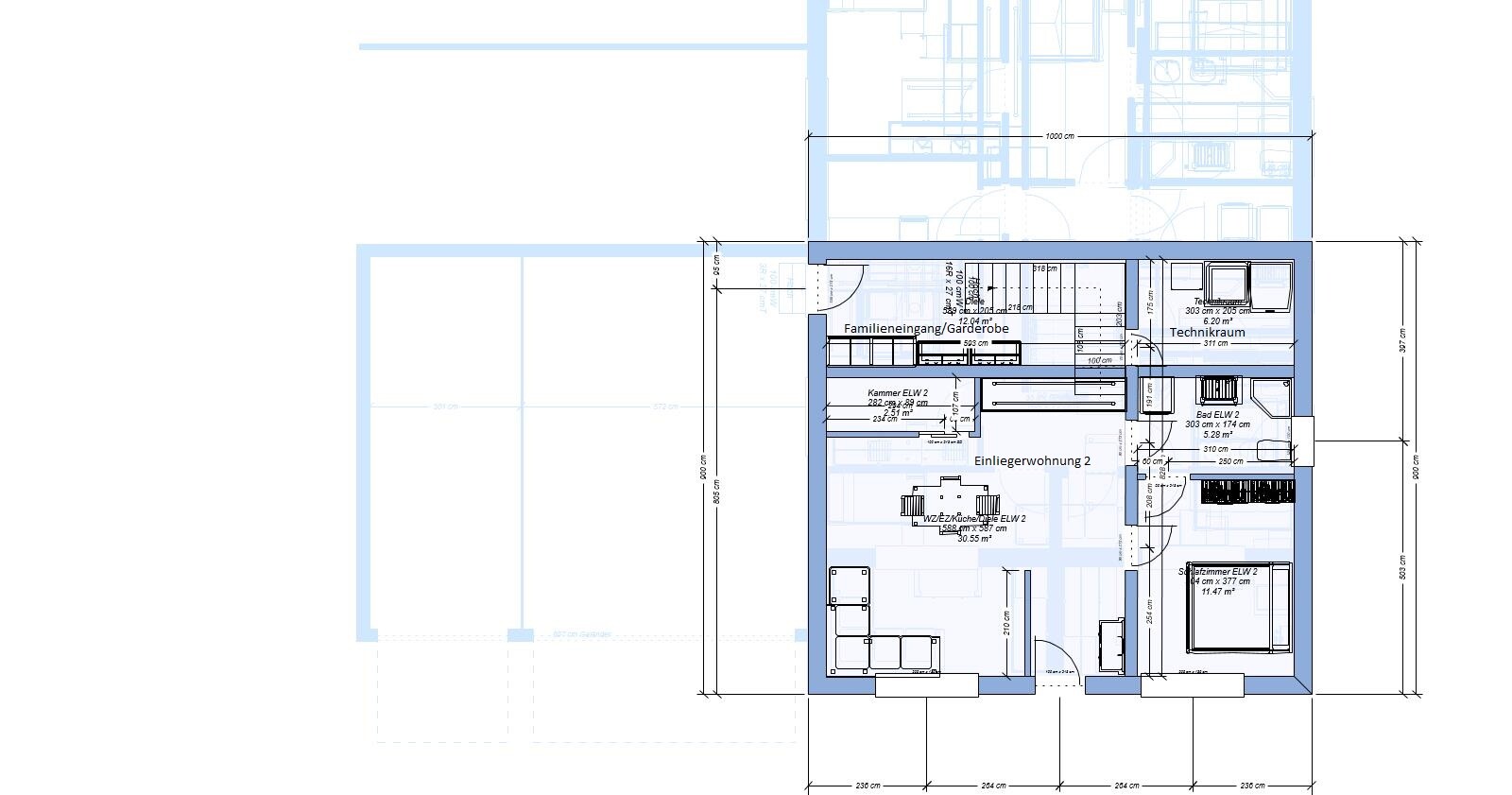
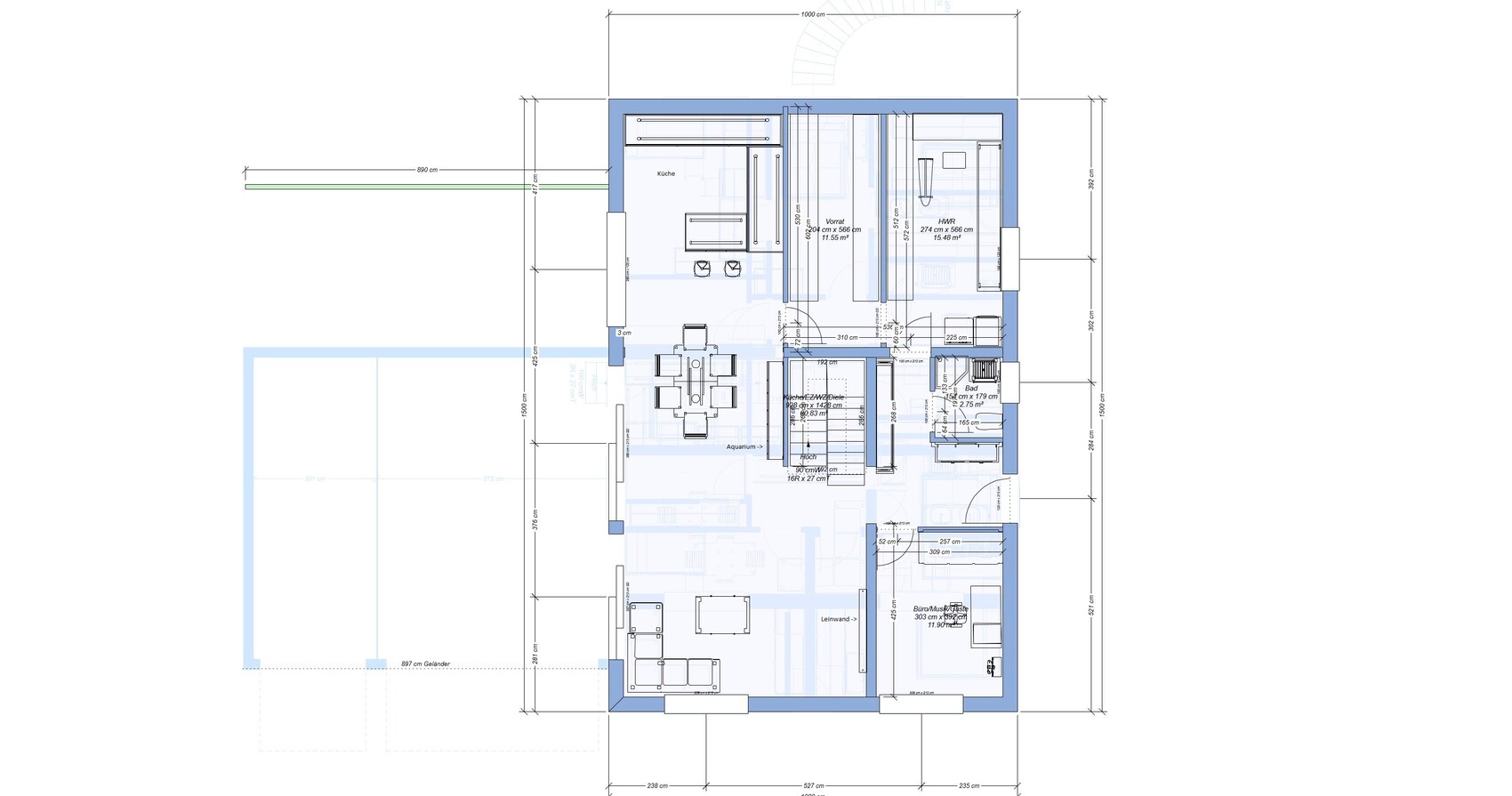
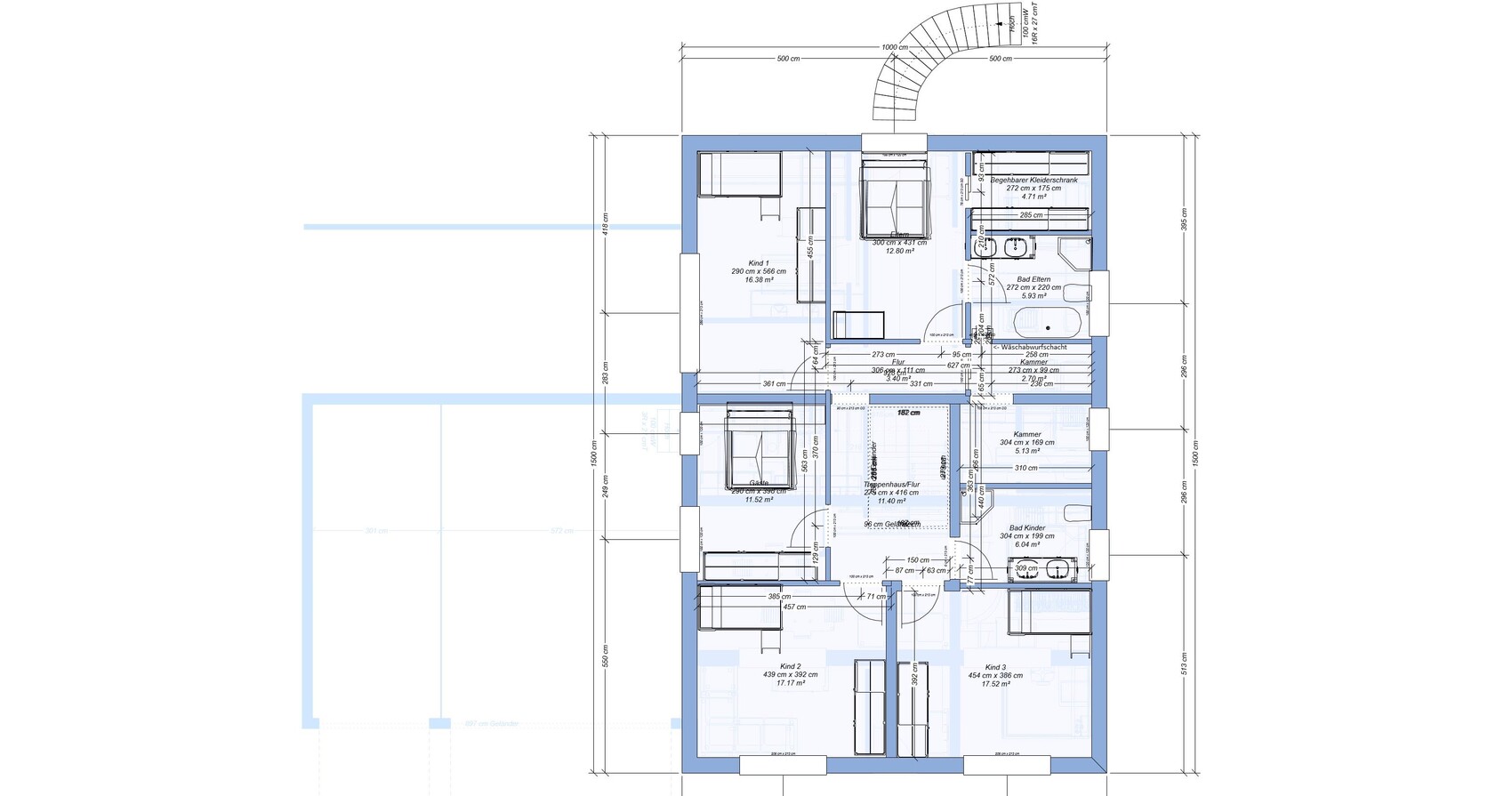
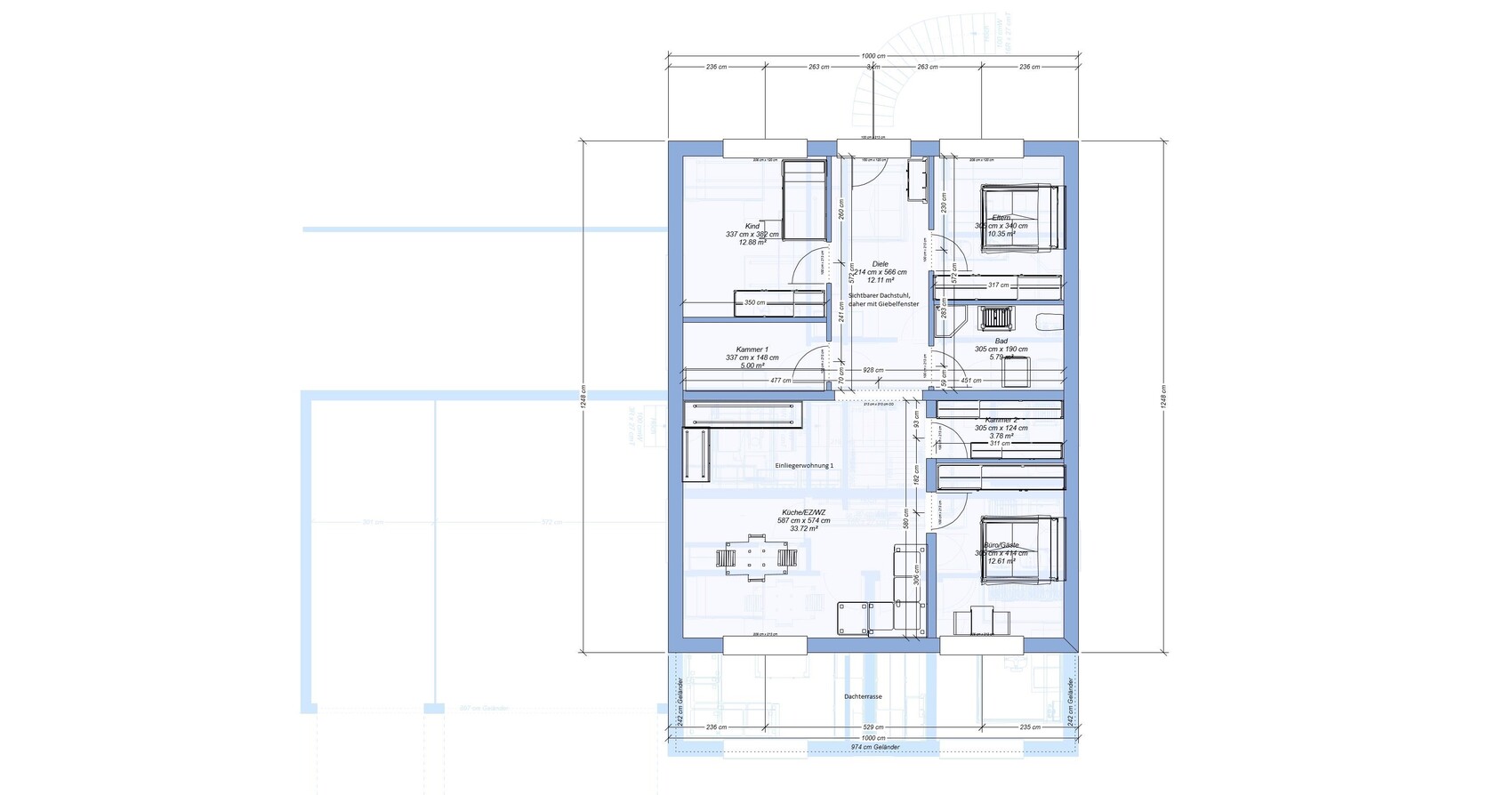
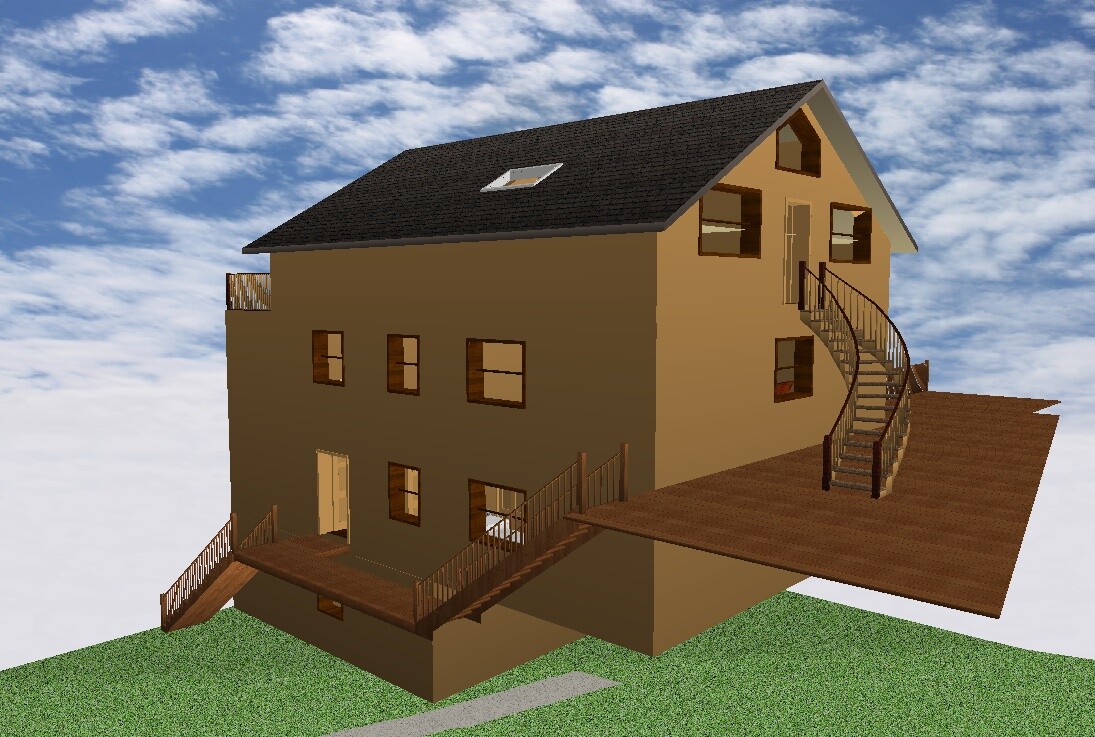
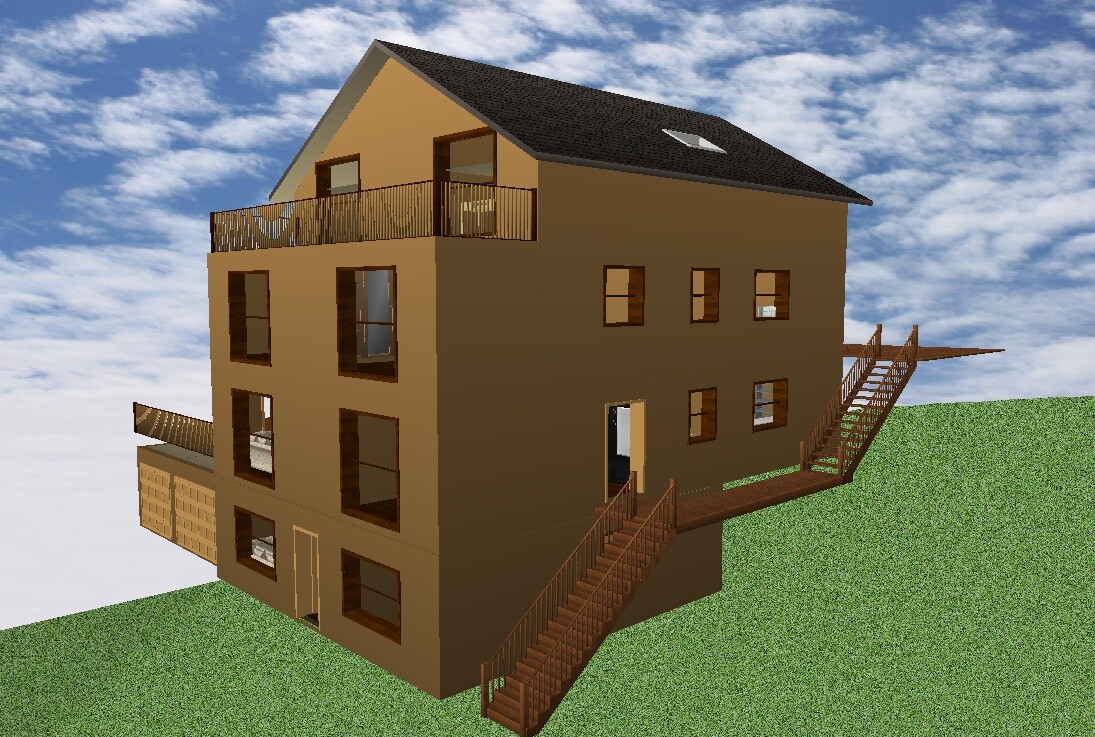

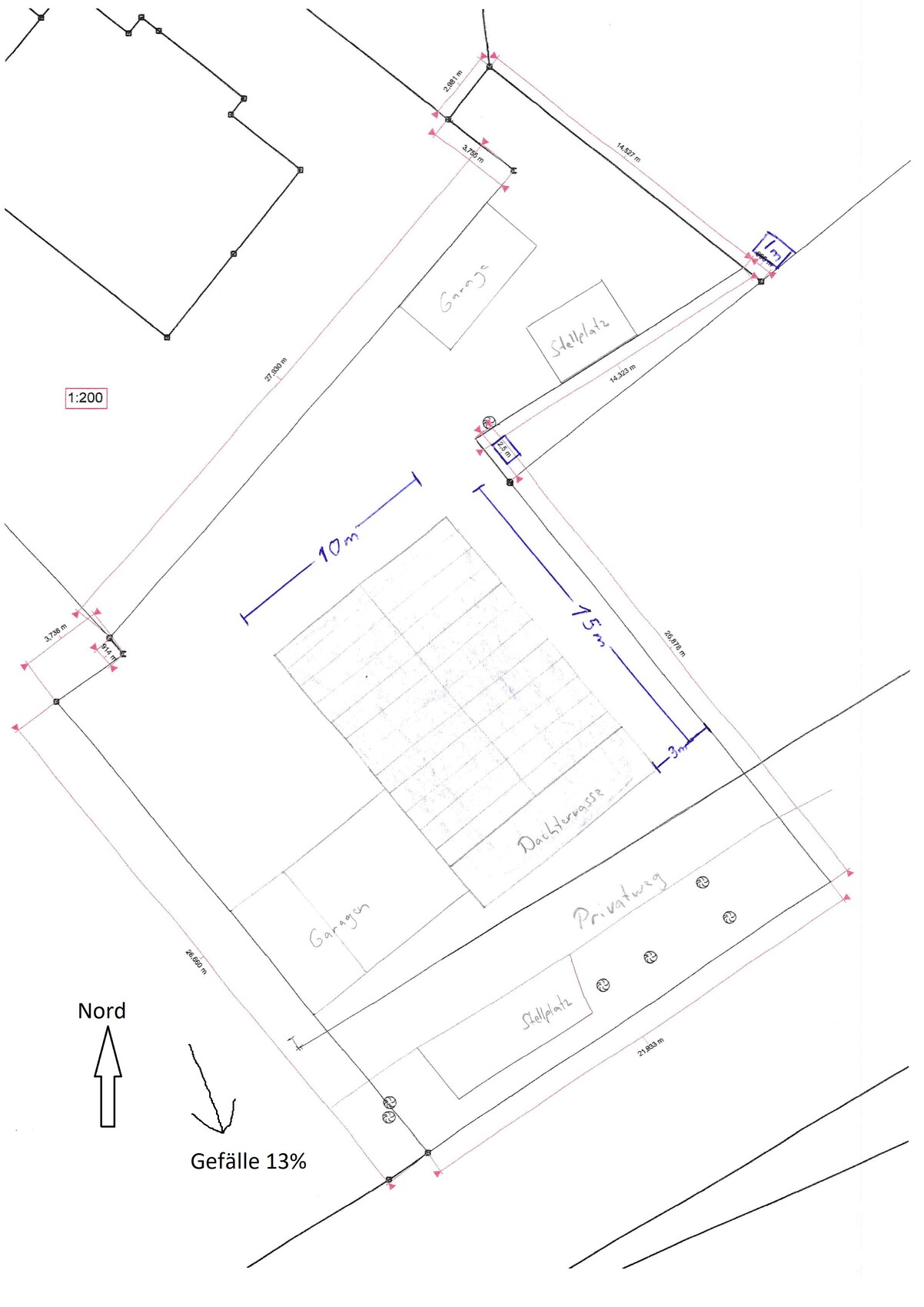
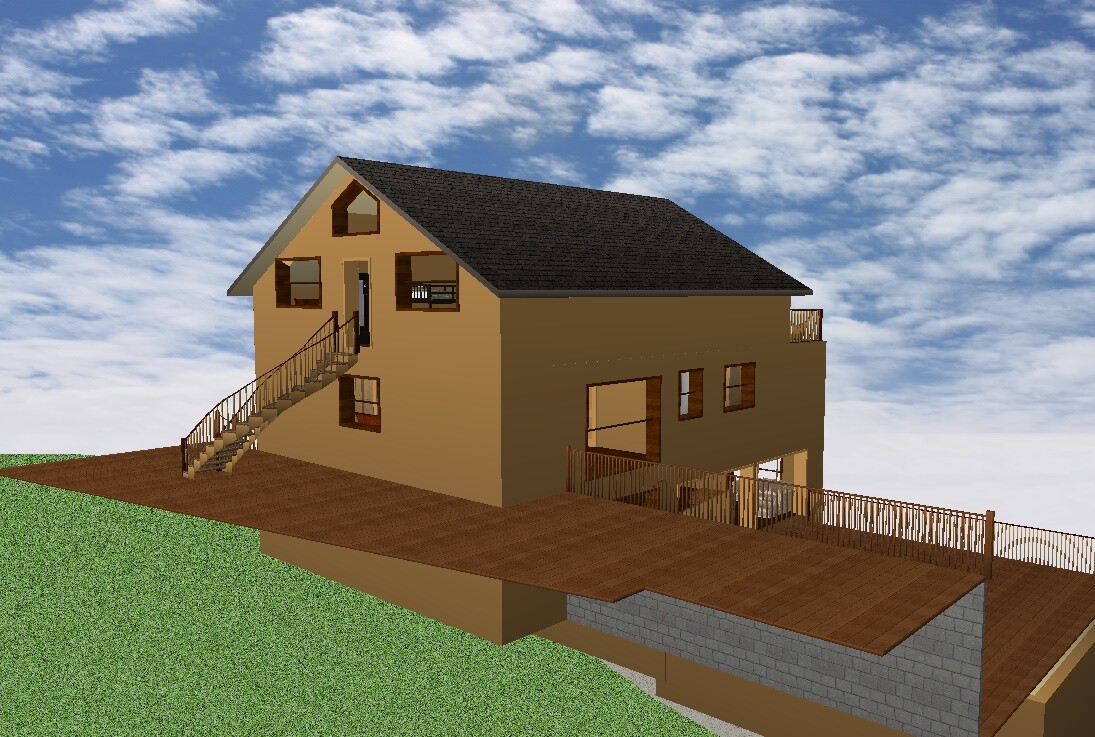
Plot size: 774 m² (8,330 ft²)
Slope: 13%, as shown on the site plan
Floor area ratio (FAR): 0.4
Building coverage ratio: 0.5
Building envelope, setback lines, and property boundary: 11 x 15 m (36 x 49 ft), as shown on the site plan
Number of floors: 2 full stories
Roof type: Gable roof, 30° pitch
Orientation: Ridge running NE-SW
Requirements of the Homeowners
Style, roof type, building type: Main residence with 2 accessory apartments (one in the attic, one smaller in the basement)
Basement, floors: Basement (UG), ground floor (EG), upper floor (OG), attic (DG)
Number of occupants, ages: 1975m, 1980f, 2007m (mostly lives with partner from previous marriage), 2009f, 2019m, (expected 2020m/f)
Space requirement on ground and upper floor: from 200 m² (2,150 ft²)
Office: Family use
Guests per year: Apart from resident born 2007 (male), about 6
Open or closed architecture: open plan
Traditional or contemporary design: modern
Open kitchen, kitchen island: yes
Number of dining seats: 6
Fireplace: no
Music/stereo wall: Home theater system in the living room
Balcony, roof terrace: Roof terrace in the attic for accessory apartment 1
Garage, carport: 3 garages, 2 parking spaces
Utility garden, greenhouse: A level garden is planned on top of the garages, with lawn and some bushes around.
Other wishes / special features / daily routine, including reasons for preferences:
- Ground-level family access via garage and ramp into the basement. Guest entrance on the right side into the ground floor.
- Separate external staircase leads directly to accessory apartment 1 in the attic. This unit also has a private entrance from above (north side) with garage and parking space (see site plan).
- Accessory apartment 2 has direct access from the private driveway to the basement and the garage at the left property boundary.
- Since we are a large family, laundry is often left in the living room. This should change, so we want a generous utility room (with marked ironing board) on the ground floor and possibly an additional ventilation system.
- The private driveway is used only by us and one other neighboring property behind us. The surroundings have many trees, so there is no real view.
- Large sliding glass doors from the dining room to the terrace/garden.
- Good soundproofing between attic / upper floor and ground floor / basement.
House Design
Designer: Do-it-yourself
What do you especially like? Why? Plot with significant slope but still a level garden on top of the garages. Accessory apartment 1 with separate entrance from above.
Personal budget for the house, including outfitting: 1 million EUR in a major city in Bavaria
Preferred heating technology: Heat pump with photovoltaic system on the roof facing southwest
If you have to make compromises, which details/features can you do without: Gable window in the attic
Why is the design the way it is? We want to use the (expensive) plot as efficiently as possible.
What is the key/basic question about the floor plan in 130 characters? Where are the mistakes? Suggestions for improvement? Is the plumbing for bathrooms and kitchens sufficient or should I redesign it?
Unfortunately, I can’t accurately represent the terrain in the design software. If needed, I can scan a section drawing to make it clearer. The garden to the left of the house and above the external staircase will certainly be designed differently later. So far, there is no lawn area marked yet.
Many thanks in advance for lots of inspiring ideas
haydee schrieb:
I would build the house without a granny flat.
Basement: entrance, cloakroom, office, utility room, storage
Ground floor: kitchen, dining, living, 1 children's bedroom
Direct garden access opening up the summer living and dining area with a small play corner for toddlers.
Upper floor: remaining bedrooms with access to the garden from the hallway
There, the slope would be developed with a shaded play area
Next garden level with a south-facing terrace for the transitional seasons (too hot in summer). It should be tall enough and not shaded by the house anymore.
Garage and house locations can be swapped.
If possible, I would plan 2 children's bedrooms in the basement and accommodate the two larger ones there.Thank you very much for the interesting suggestion. So you would build the house on the southwest side of the plot with only a small play corner for the toddlers facing southwest, and the main garden up north on the property? That seems a bit reversed to me since normally you would orient towards the south. But we will definitely think it over carefully.
750,000 euros for such a large house, double garage, and landscaping on a slope is very tight.
Just the structural engineer caused a five-figure cost.
What are your ground conditions?
Water
Soil classification
Contaminants
From where do you access the upper parking spaces that will be lost?
Yes, people say to place the garden on the south side.
It is almost unbearable there in summer.
Children should be protected from the sun.
Your plot is so elevated that you won’t cast shadows on yourselves.
You can position windows on the south side to bring light and warmth into the house during the darker months.
1. Loss of the granny flat
The rent will hardly cover the costs or improve the financing service.
2. Position the house so that as little earth as possible needs to be moved. Every shovel costs a lot of money.
3. The slope requires terraces.
Therefore, I would assign an outdoor area to each floor.
4. Minimize walls that are in contact with the ground.
We have a thick wall made of waterproof concrete with a lot of steel, insulated on both sides. Between the concrete wall and the soil there is a layer of gravel.
Costs about twice as much as an exterior wall without ground contact.
An au pair does not need a separate apartment.
Just the structural engineer caused a five-figure cost.
What are your ground conditions?
Water
Soil classification
Contaminants
From where do you access the upper parking spaces that will be lost?
Yes, people say to place the garden on the south side.
It is almost unbearable there in summer.
Children should be protected from the sun.
Your plot is so elevated that you won’t cast shadows on yourselves.
You can position windows on the south side to bring light and warmth into the house during the darker months.
1. Loss of the granny flat
The rent will hardly cover the costs or improve the financing service.
2. Position the house so that as little earth as possible needs to be moved. Every shovel costs a lot of money.
3. The slope requires terraces.
Therefore, I would assign an outdoor area to each floor.
4. Minimize walls that are in contact with the ground.
We have a thick wall made of waterproof concrete with a lot of steel, insulated on both sides. Between the concrete wall and the soil there is a layer of gravel.
Costs about twice as much as an exterior wall without ground contact.
An au pair does not need a separate apartment.
Here, in the middle of your upper floor according to the label, the staircase and hallway area towards the master bedroom is 275 cm (9 feet) wide. The staircase itself is usually at least 200 cm (6.5 feet) wide, leaving only 75 cm (2.5 feet) for the hallway and railing around the stairwell.
Also, your master bedroom dimensions seem inaccurate... 293 cm (9.6 feet) wide, and supposedly only 105 cm (41 inches) between the bed and the wall leading to the bathroom. That means the bed including the frame is only 188 cm (6.2 feet) wide. I usually plan with about 215 cm (7 feet) for this — 200 cm (6.5 feet) mattress plus bed frame, plus the fact that in reality the bed is usually placed 2 to 5 cm (about 1 to 2 inches) away from the wall. While 293 cm (9.6 feet) width is still possible, the clearances should be shown accurately.
Apart from that, the main walkway from your stairs still passes right in front of the sofa. Teenagers, family members, etc., everyone will be walking right past the seating area.
haydee schrieb:
750,000 euros for such a large house, a double garage, and landscaping on a slope is very tight Oof. That’s definitely sobering. Especially since we’re also dreaming of quite a bit of building technology: a low-energy house, photovoltaic system, heat pump, underfloor heating, rainwater cistern, garden irrigation system, etc. We’ll probably have to cut quite a bit.
haydee schrieb:
What are the ground conditions like on your site?
Water
Soil classification
Contaminants According to my father (a civil engineer), very favorable. The soil survey report is still pending, though.
haydee schrieb:
From where do you access the upper parking spaces that will be removed? There is also a small dead-end road at the top that ends at our property.
haydee schrieb:
They say gardens should face south.
It can be unbearable in summer there.
Children should be protected from the sun. We discussed your suggestion from page 6 at length yesterday, but we concluded that the floor layout as currently planned suits our needs better: we want to concentrate family life on one level with a garden, and the garden should be directly adjacent to the kitchen. The garden, as currently planned, is mostly shaded in the rear section anyway because we need to build a sloping wall to the southwest side bordering the neighbor to prevent their garden from overlooking ours. The front part of the garden is also quite shaded, as the entire plot is surrounded by trees.
haydee schrieb:
2. Position the house to minimize earthworks. Every shovel costs serious money.
3. The slope needs terraces.
That’s why I would allocate an outdoor area to each floor.
4. Minimize walls in contact with soil.
We have a thick wall of waterproof concrete with a lot of steel, insulated on both sides. Between the concrete wall and soil there is gravel fill.
Costs about twice as much as an exterior wall without soil contact.
An au pair girl doesn’t need her own apartment. Thanks for the advice, you’re absolutely right. We have an appointment with the architect on Monday. I will ask whether it’s better to build the house as currently planned or to have a smaller footprint without a separate apartment. We’ll see what he says — he seems competent and knows the location well.
kbt09 schrieb:
Here, right in the middle of your upper floor, the area marked as staircase and hallway leading to the master bedroom is 275 cm (108 inches) wide. You usually allow at least 200 cm (79 inches) width for the stairs, which leaves only 75 cm (30 inches) for the hallway and railing around the stairwell.
Also, the master bedroom measurements seem off... 293 cm (115 inches) wide, with supposedly only 105 cm (41 inches) between the bed and the wall next to the bathroom. This means the bed including the frame is only 188 cm (74 inches) wide. I usually plan for about 215 cm (85 inches) — a 200 cm (79 inches) mattress plus frame, plus the fact that in reality you typically leave 2 to 5 cm (1 to 2 inches) of space between the bed and the wall. While 293 cm (115 inches) width is still workable, you should reflect those distances more accurately. Thank you very much for the advice; you are absolutely right. I moved the wall next to the staircase to the left. This makes the hallway and the master bedroom wider, while child 1’s room and the guest room become a bit narrower (see attached image OG-71). That should work now, right?
kbt09 schrieb:
Besides that, the main path of your staircase still runs right in front of the sofa. Teenagers, guests, everyone passes right by the sofa. That's true. Do you think it would be better to add a short wall to separate the living room? Of course, that would affect the currently planned open-concept layout a bit. I tried that in image EG-71. However, my wife and I discussed it last night and agreed that such a room divider could also be installed later if needed.
I have now reduced the knee wall height on the upper floor to 150 cm (59 inches) and equipped the guest room and both bathrooms upstairs with roof windows. This allowed us to meet the required clearance area, although I’m still not entirely happy with it. I would have preferred full ceiling height upstairs (also because I am 1.93 m (6 ft 4 in) tall and my son, born in 2007, is already 1.87 m (6 ft 2 in)).
I also had to make the double garage and the garden slightly narrower.

You keep moving walls around and tweaking small details.
I find the entire box basically very ugly and unsuitable. Hillside houses can be amazing, but unfortunately, this is not one of them. Overall, it lacks a clear concept.
So far, you also haven’t explained why the granny flat is so absolutely necessary. As I said, it’s not useful for financing the project. For an au pair, a guest suite works just as well—that is, a room with a bathroom, and if you want to get fancy, you can also add a small kitchenette, which the oldest child could use later—so why waste the space and constantly have to arrange living next to strangers on the property?
750,000€? Keep dreaming... that will never be enough! Not for a hillside house of this size, and in Bavaria, no less—even with just one granny flat. As the design stands now, you’ll easily surpass a million. 750,000€—that’s a joke! Do you know how much prices for labor and materials related to construction have risen in recent years, especially in Bavaria?
In my opinion, you are starting off the wrong way. I would first get a solid understanding of the building lines. How much footprint do you have, what is allowed, and what isn’t? Then make a list without planning yet: must-haves, nice-to-haves, and things you definitely don’t want.
After that, find a good architect whose style you like.
Meanwhile, you can keep playing around with your designs—it’s fun, after all.
Get some input. Unfortunately, show homes aren’t very helpful where you are because there’s no show village for hillside locations, but I always like to recommend the “Dream Houses” series on BR, which is still available in the media library—you can get lots of inspiration there.
Buy architectural magazines. Even if the houses featured are probably beyond your budget, you can always get good ideas from them.
When the architect’s first draft comes back, you can still move walls and incorporate your ideas.
But this draft here, sorry, it’s just a box without any concept pushed into the hillside. It could actually turn out nice, though.
I find the entire box basically very ugly and unsuitable. Hillside houses can be amazing, but unfortunately, this is not one of them. Overall, it lacks a clear concept.
So far, you also haven’t explained why the granny flat is so absolutely necessary. As I said, it’s not useful for financing the project. For an au pair, a guest suite works just as well—that is, a room with a bathroom, and if you want to get fancy, you can also add a small kitchenette, which the oldest child could use later—so why waste the space and constantly have to arrange living next to strangers on the property?
750,000€? Keep dreaming... that will never be enough! Not for a hillside house of this size, and in Bavaria, no less—even with just one granny flat. As the design stands now, you’ll easily surpass a million. 750,000€—that’s a joke! Do you know how much prices for labor and materials related to construction have risen in recent years, especially in Bavaria?
In my opinion, you are starting off the wrong way. I would first get a solid understanding of the building lines. How much footprint do you have, what is allowed, and what isn’t? Then make a list without planning yet: must-haves, nice-to-haves, and things you definitely don’t want.
After that, find a good architect whose style you like.
Meanwhile, you can keep playing around with your designs—it’s fun, after all.
Get some input. Unfortunately, show homes aren’t very helpful where you are because there’s no show village for hillside locations, but I always like to recommend the “Dream Houses” series on BR, which is still available in the media library—you can get lots of inspiration there.
Buy architectural magazines. Even if the houses featured are probably beyond your budget, you can always get good ideas from them.
When the architect’s first draft comes back, you can still move walls and incorporate your ideas.
But this draft here, sorry, it’s just a box without any concept pushed into the hillside. It could actually turn out nice, though.
Similar topics