
ᐅ Privacy and Noise Protection on Sloped Sites Using Poplar or Fir Trees?
Created on: 7 Nov 2017 09:31
C
Changeling
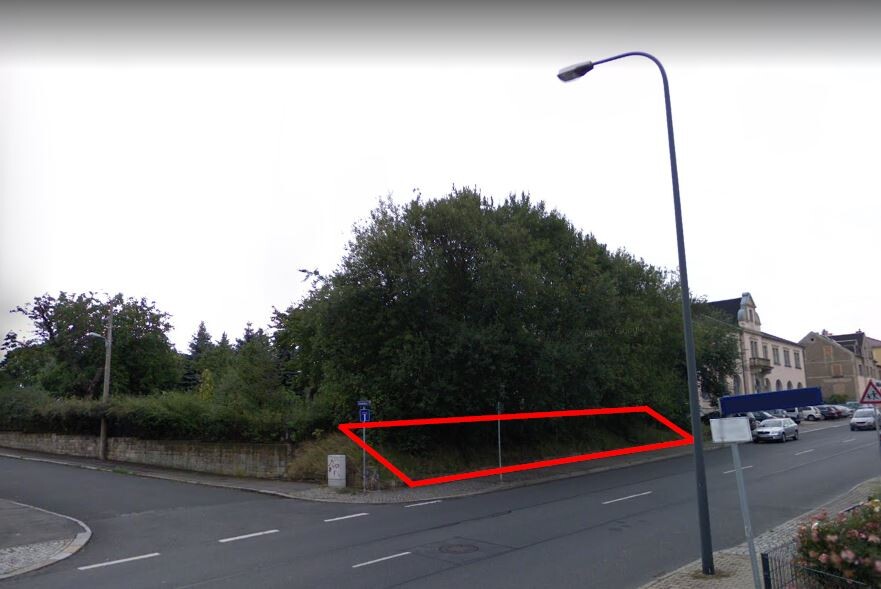
We are building along a medium-sized road. In the photo taken from the northwest, I have marked the slope leading from the property down to the road in red:
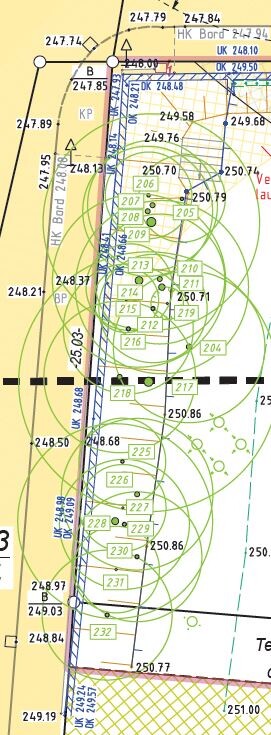
The site plan (oriented to the north) shows the various trees (all poplars) and also the slope with elevation levels indicated:
Unfortunately, the foliage is not as dense as it appears in the photo, especially in autumn and winter it is quite bare and you can easily see through it. As a result, noise from the road is quite noticeable.
Our idea was to prune or break the poplars at about 4-5m (13-16 feet) height and lay them horizontally so they would continue to grow, gradually creating a natural “hedge.” To reinforce this, we considered planting fir trees at the bottom of the slope, as they provide good screening from views and noise and also look nice during winter. These firs would also be pruned to a maximum height of 4-5m (13-16 feet) above our property to keep maintenance manageable and to avoid blocking too much of the western sun.
Is this feasible, or is there a better solution?
A retaining wall is unfortunately too expensive.
The site plan (oriented to the north) shows the various trees (all poplars) and also the slope with elevation levels indicated:
Unfortunately, the foliage is not as dense as it appears in the photo, especially in autumn and winter it is quite bare and you can easily see through it. As a result, noise from the road is quite noticeable.
Our idea was to prune or break the poplars at about 4-5m (13-16 feet) height and lay them horizontally so they would continue to grow, gradually creating a natural “hedge.” To reinforce this, we considered planting fir trees at the bottom of the slope, as they provide good screening from views and noise and also look nice during winter. These firs would also be pruned to a maximum height of 4-5m (13-16 feet) above our property to keep maintenance manageable and to avoid blocking too much of the western sun.
Is this feasible, or is there a better solution?
A retaining wall is unfortunately too expensive.
C
Changeling13 Nov 2017 12:55My current plan is to use the leftover soil from excavation work to raise the ground level by about 10–20cm (4–8 inches) and to even out any uneven areas. After that, I will lay a layer of stones on top, which I will secure in position toward the slope using metal rods. Above this, I intend to build a wooden soundproof fence: thick, overlapping vertical boards should effectively reduce noise. On top, a horizontal board will act as a "roof." Something like this, but probably a height of 1.0m to 1.5m (3.3 to 5 feet) will be sufficient:
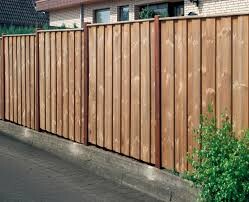
The stones at the bottom will protect against moisture, while the horizontal board on top serves as a "roof." The whole structure will be supported by individual posts, but where possible, I want the tree trunks to hold the fence. However, I am not sure if the trees will continue to grow after being cut. I’m concerned the fence might be lifted as the trees grow.
In that case, I would cut the trees completely about 3 to 4 meters (10 to 13 feet) above the ground level, not just break them off. The fence will provide sufficient privacy as well.
I welcome any comments or better suggestions.
The stones at the bottom will protect against moisture, while the horizontal board on top serves as a "roof." The whole structure will be supported by individual posts, but where possible, I want the tree trunks to hold the fence. However, I am not sure if the trees will continue to grow after being cut. I’m concerned the fence might be lifted as the trees grow.
In that case, I would cut the trees completely about 3 to 4 meters (10 to 13 feet) above the ground level, not just break them off. The fence will provide sufficient privacy as well.
I welcome any comments or better suggestions.
B
Bieber081513 Nov 2017 13:33The fence will be exposed to significant wind loads. Therefore, the fence posts need to be properly anchored. Usually, it is sufficient to dig a frost-resistant foundation hole 60 to 80 cm deep (24 to 31 inches), into which the posts are then set in concrete. It’s hard to say how this applies to your specific location from a distance. When in doubt, you will need a structural engineer. Yes, really—after all, the fence shouldn’t come loose and pose a danger to anyone.
It is also possible that a building permit / planning permission, neighborhood regulations, or other local rules regarding fencing and building law must be observed. I’m sure you’re aware of that.
I wouldn’t nail the fence to the trees; I would install the fence independently from the trees. It looks great like it does in your photo!
What is the issue with the trees that they should be cut back?
It is also possible that a building permit / planning permission, neighborhood regulations, or other local rules regarding fencing and building law must be observed. I’m sure you’re aware of that.
I wouldn’t nail the fence to the trees; I would install the fence independently from the trees. It looks great like it does in your photo!
What is the issue with the trees that they should be cut back?
C
Changeling13 Nov 2017 13:44The posts will be set in concrete, yes. I wouldn’t hire a structural engineer since the fence won’t be as tall as shown in the picture, and there is planting and shrubs all around, so there’s not much surface exposed. The goal is mainly a cost-effective solution.
The zoning plan and all necessary approvals are settled.
The trees will be pruned, ...
Since we are already shaded to the south by an apartment building, at least some sunlight should come in from the west. As you can also see in the pictures in the first post, the trees extend quite far over the sidewalk, and poplars are not exactly known for their stability. Therefore, I plan to cut them back 1-2m (3-6 feet) above the top edge of the fence, which means at about 4-5m (13-16 feet) growth height.
The zoning plan and all necessary approvals are settled.
The trees will be pruned, ...
Changeling schrieb:
on the one hand to keep maintenance manageable, and on the other hand to avoid blocking the afternoon sun too much.
Since we are already shaded to the south by an apartment building, at least some sunlight should come in from the west. As you can also see in the pictures in the first post, the trees extend quite far over the sidewalk, and poplars are not exactly known for their stability. Therefore, I plan to cut them back 1-2m (3-6 feet) above the top edge of the fence, which means at about 4-5m (13-16 feet) growth height.
Similar topics