
ᐅ Do photovoltaic systems and heat pumps share similar performance characteristics or operational experiences?
Created on: 9 Mar 2016 22:27
T
toxicmolotof
Hello dear forum members,
Since Monday afternoon, my photovoltaic system has been up and running, and I have to say... I can’t stop smiling.
Here are the details:
Today’s performance:
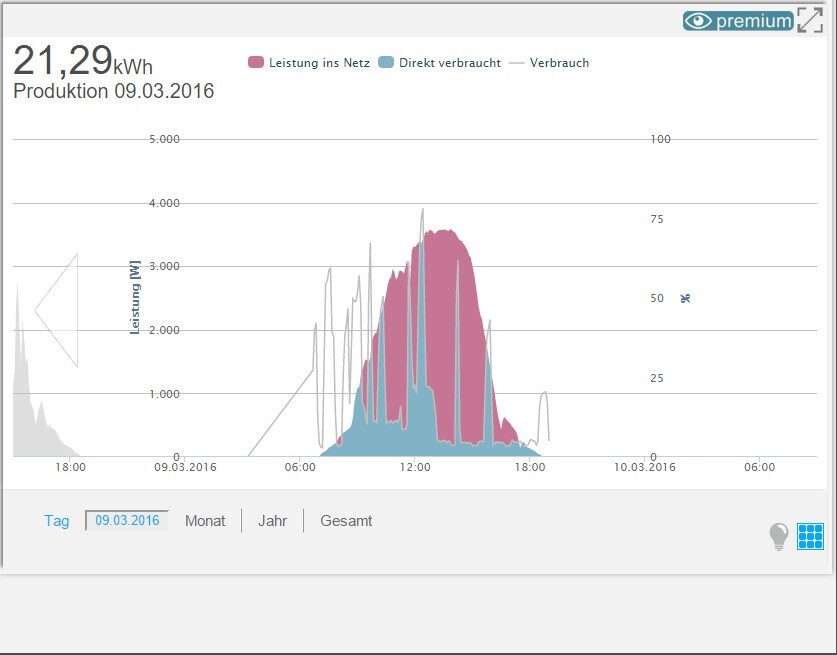
The gray line represents household consumption, the blue and red areas show production, where the blue part was self-consumed and the red part was sold.
You can clearly see the washing machine running in the morning, the regular starts of the heat pump, midday consumption, and even the not-so-optimally started dishwasher after 6 p.m.
For a (very good) day in March, I’m more than satisfied. The only thing is that the heat pump in the early morning isn’t yet running as efficiently as I’d like. But I guess only a battery would help with that, and that still seems uneconomical to me.
Since Monday afternoon, my photovoltaic system has been up and running, and I have to say... I can’t stop smiling.
Here are the details:
- 5.4 kWp (18 modules at 300 W each)
- Peak power limitation 70% soft
- Flat roof, mounting angle 10°
- Orientation southwest, about 45° off south
- Feed-in to household electricity including heat pump
- Surplus energy sale
- no battery storage
Today’s performance:
The gray line represents household consumption, the blue and red areas show production, where the blue part was self-consumed and the red part was sold.
You can clearly see the washing machine running in the morning, the regular starts of the heat pump, midday consumption, and even the not-so-optimally started dishwasher after 6 p.m.
For a (very good) day in March, I’m more than satisfied. The only thing is that the heat pump in the early morning isn’t yet running as efficiently as I’d like. But I guess only a battery would help with that, and that still seems uneconomical to me.
toxicmolotow schrieb:
Basically just a great technical gadget.Well – it is a gadget. We men need these kinds of toys. With an app. With graphics. The more details, the better.
But my wife doesn’t really understand my idea of washing laundry and running the dishwasher mostly when the sun is shining… the topic of self-consumption rate hasn’t reached level 10 excitement with her yet and only causes head shaking and doubts about my sanity. . It will come. . For sure. The enthusiasm.
Until then, I will connect smart plugs to the energy management system. Then the washing machine, dryer, and dishwasher simply won’t start unless there is enough sunshine. Probably the recipe to increase acceptance. I’ll report back. It’s going to be great.
T
toxicmolotof1 Sep 2016 23:41It’s time for an interim review...
A few technical details:
18x 300W Winaico panels (5.4 kWp) connected to a Fronius Symo 5.0.3.M
Installed on February 7, 2016, so about 6 months and 3 weeks in operation.
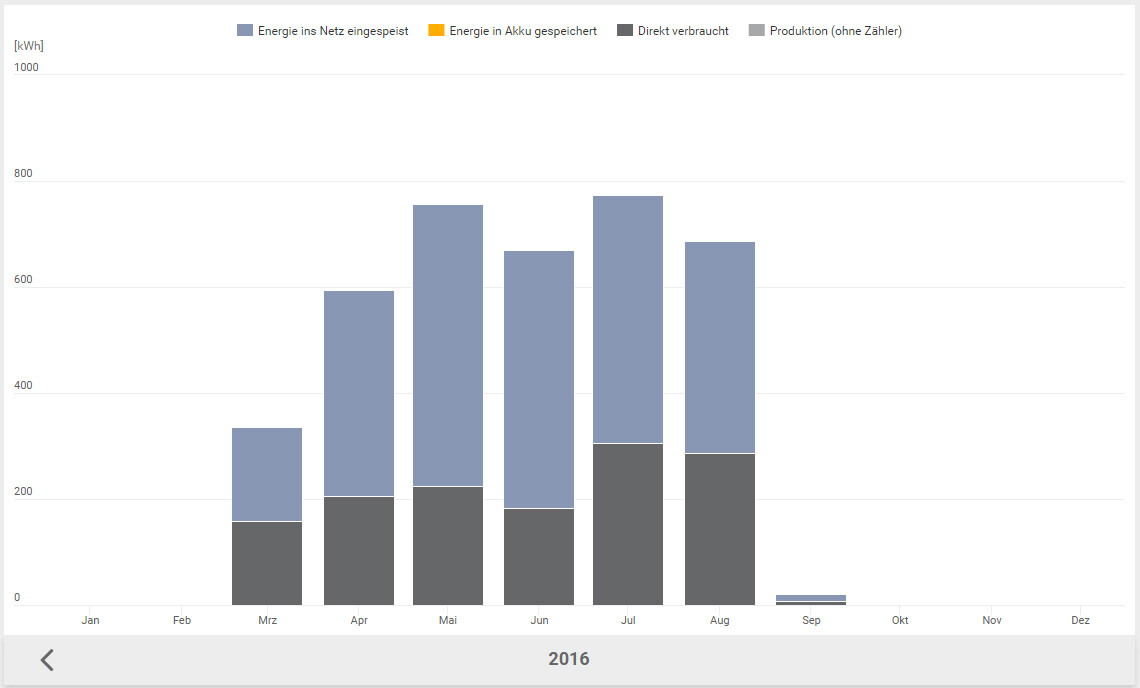
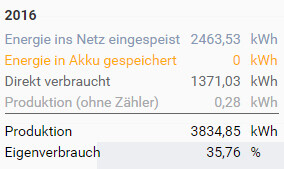
Out of 3,835 kWh produced, we were able to use 36% ourselves; unfortunately, the rest had to be fed into the grid at 12.31 cents per kWh.
That means: 303 euros feed-in tariff, minus 60 euros VAT on self-consumption and 120 euros insurance. I am deliberately excluding taxes here. After depreciation of the system and expenses, I consider this a neutral position.
However, I actually saved 375 euros that the supplier didn’t have to deliver to me.
So: 303 - 60 - 120 + 375 = 498 euros saved. On the other hand, the system costs me 864 euros per year. Overall, I pay about 30 euros per month for the first 10 years, which I consider worthwhile.
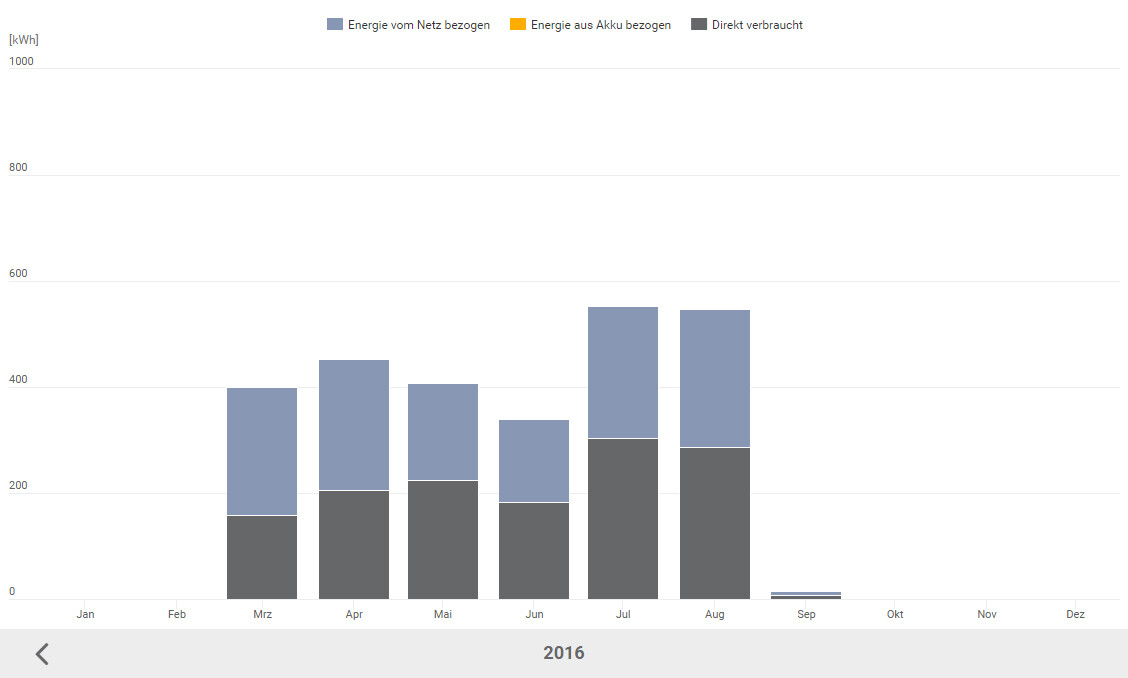
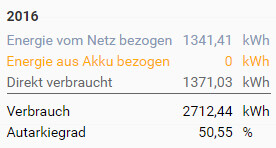
I find the self-consumption rate of 36% and the autonomy rate of 50% without storage quite respectable. It’s hard to beat that, especially since I’ve had a 25m³ (6600 gallon) pool for 2 months now, which helps with this, as can also be seen in the consumption.
A few technical details:
18x 300W Winaico panels (5.4 kWp) connected to a Fronius Symo 5.0.3.M
Installed on February 7, 2016, so about 6 months and 3 weeks in operation.
Out of 3,835 kWh produced, we were able to use 36% ourselves; unfortunately, the rest had to be fed into the grid at 12.31 cents per kWh.
That means: 303 euros feed-in tariff, minus 60 euros VAT on self-consumption and 120 euros insurance. I am deliberately excluding taxes here. After depreciation of the system and expenses, I consider this a neutral position.
However, I actually saved 375 euros that the supplier didn’t have to deliver to me.
So: 303 - 60 - 120 + 375 = 498 euros saved. On the other hand, the system costs me 864 euros per year. Overall, I pay about 30 euros per month for the first 10 years, which I consider worthwhile.
I find the self-consumption rate of 36% and the autonomy rate of 50% without storage quite respectable. It’s hard to beat that, especially since I’ve had a 25m³ (6600 gallon) pool for 2 months now, which helps with this, as can also be seen in the consumption.


First of all, congratulations on your results. It should be noted that the summer this year was quite poor during the first months. In a month-to-month comparison from March to August this year, we fed less electricity into the grid each month than last year. However, our self-consumption likely did not increase since we already achieved an exceptionally good result in the first year.
You are running your heat pump (heating + water) through the photovoltaic system as well—of course, that will help you achieve even greater autonomy.
However, I have to agree with @Musketier.
You will only get a meaningful overview after completing the entire year. The challenging periods are still ahead. Your self-consumption rate (consumption from total production) will increase—your feed-in to the grid will decrease—and your external electricity consumption will rise.
But this is nothing new to you—you’ve been dealing with this long enough.
You are running your heat pump (heating + water) through the photovoltaic system as well—of course, that will help you achieve even greater autonomy.
However, I have to agree with @Musketier.
You will only get a meaningful overview after completing the entire year. The challenging periods are still ahead. Your self-consumption rate (consumption from total production) will increase—your feed-in to the grid will decrease—and your external electricity consumption will rise.
But this is nothing new to you—you’ve been dealing with this long enough.
S
Sebastian792 Sep 2016 09:14Above all, the pool is quite a factor – a small power consumer that still improves the overall result. Without such an appliance, the situation looks different again.
I will find a way to implement it anyway... regardless of whether it is economical or not...
I will find a way to implement it anyway... regardless of whether it is economical or not...
Similar topics