
Hello everyone,
I need to decide whether to plaster, paint, or leave the basement walls as they are.
The basement has exterior walls made of waterproof concrete and interior walls made of sand-lime brick. Since the gas boiler in the utility room is scheduled to be installed at the end of next week, I have to decide fairly quickly how to treat the basement walls (at least in the utility room).
Unfortunately, the bottom row of bricks is damp because the basement was about 10cm (4 inches) underwater and was only pumped out today.
At the moment, I am leaning towards simply painting the basement for cost reasons. From what I have read so far, silicate paint with an appropriate silicate primer works very well.
My question is whether I can already paint the utility room even if the walls are still somewhat damp. What do you think?
If I go for plastering, is that less critical with "wet" walls?
P.S.:
Looking at the description of the silicate primer, it says, "All substrates must be clean, dry, load-bearing, absorbent, and free of release agents."
That would suggest it’s not possible. Or is it actually not that bad, and could I at least paint this one room already?
I need to decide whether to plaster, paint, or leave the basement walls as they are.
The basement has exterior walls made of waterproof concrete and interior walls made of sand-lime brick. Since the gas boiler in the utility room is scheduled to be installed at the end of next week, I have to decide fairly quickly how to treat the basement walls (at least in the utility room).
Unfortunately, the bottom row of bricks is damp because the basement was about 10cm (4 inches) underwater and was only pumped out today.
At the moment, I am leaning towards simply painting the basement for cost reasons. From what I have read so far, silicate paint with an appropriate silicate primer works very well.
My question is whether I can already paint the utility room even if the walls are still somewhat damp. What do you think?
If I go for plastering, is that less critical with "wet" walls?
P.S.:
Looking at the description of the silicate primer, it says, "All substrates must be clean, dry, load-bearing, absorbent, and free of release agents."
That would suggest it’s not possible. Or is it actually not that bad, and could I at least paint this one room already?
In my utility room, the interior walls (brick) were plastered with lime-cement plaster. For the concrete walls, I sanded down the rough spots (joints between the formwork panels), then applied and sanded Knauf Multifinish joint compound. The same process was done on the precast ceiling. Depending on the quality level desired, you might need to be more precise. Afterwards, the surfaces were painted with silicate paint from Keim (pretreated beforehand with the appropriate primer). For the utility room, this finish is completely sufficient for me. However, I’m not sure whether this should be done on damp areas or what might happen if it is. I would just recommend contacting a paint manufacturer to ask. This is the utility room; it’s a different situation in the living room.
Skip the Stosil and leave the bottom row of bricks exposed. Once they’re dry, apply the garage floor paint a little way up the wall. Use Sto Sil white 9010 or 9016. This is an exterior base coat for special decorative plasters and similar finishes. It also works well indoors and has a sandy texture, so it contains granules. Your wall will look rough, but it effectively masks unevenness. Sure, it’s a raw and practical method, but it’s not the living room.
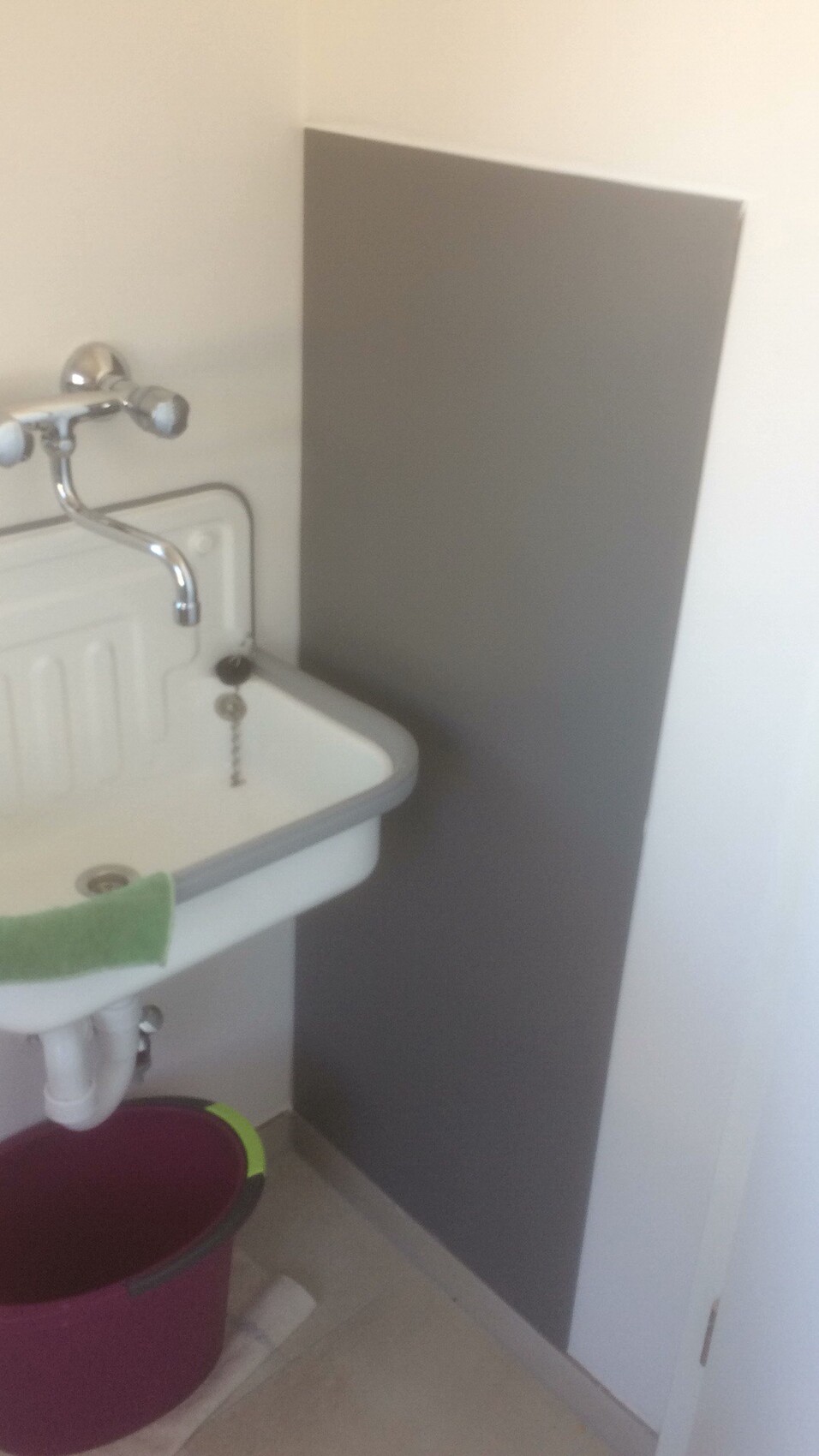
The StoSil wall in our utility room. The gray splashback on the wall is a PVC panel I stuck on later because of the washbasin.
The StoSil wall in our utility room. The gray splashback on the wall is a PVC panel I stuck on later because of the washbasin.
Similar topics