
Hello!
On the Ikea website, I found separate base cabinets for sinks, where the metal piece supporting the countertop on top is different. Is this only relevant because the cabinet could also be used for ovens, or is it actually important for sinks as well?
If not, I would like to use this one for the built-in sink since, due to our pipe situation, the back panel will have to be completely removed anyway. However, I need an intact 80cm x 80cm (31.5 inches x 31.5 inches) back panel elsewhere, similar to a Pax back panel.
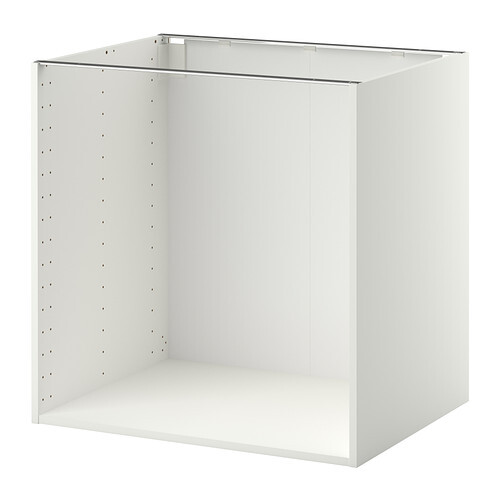
On the Ikea website, I found separate base cabinets for sinks, where the metal piece supporting the countertop on top is different. Is this only relevant because the cabinet could also be used for ovens, or is it actually important for sinks as well?
If not, I would like to use this one for the built-in sink since, due to our pipe situation, the back panel will have to be completely removed anyway. However, I need an intact 80cm x 80cm (31.5 inches x 31.5 inches) back panel elsewhere, similar to a Pax back panel.
T
tobi77_876724 Apr 2016 15:16I have the same question. Also, it saves 4 euros.
That too. Well, I am 99% sure that you can use standard cabinets with inset sinks (I’m not sure about fully drop-in sinks). In the instructions, I don’t see anything that contradicts this, since the sinks are only connected to the countertop.
The cut-out in the back panel of the sink cabinet doesn’t fit in my case anyway, so I’m leaving the panel out completely. I will probably even install a bottom panel only 37 cm (15 inches) deep because I would have to cut it down anyway.
The cut-out in the back panel of the sink cabinet doesn’t fit in my case anyway, so I’m leaving the panel out completely. I will probably even install a bottom panel only 37 cm (15 inches) deep because I would have to cut it down anyway.
There is another reason that, although not documented anywhere, is certainly important. When the openings for the sink and cooktop are cut out, even a 40mm (1.6 inch) solid wood countertop loses much of its stiffness and load-bearing capacity. This is where the corner profile comes into play, as it is significantly stiffer vertically than a standard flat crossbar.
A sink itself will hold up, but without the corner profile, the countertop could flex enough that the silicone seal around the sink might tear if you lean on the sink or stand on the countertop near it (the latter theoretically, but I have stood there with one foot while working on the upper part of the kitchen).
A sink itself will hold up, but without the corner profile, the countertop could flex enough that the silicone seal around the sink might tear if you lean on the sink or stand on the countertop near it (the latter theoretically, but I have stood there with one foot while working on the upper part of the kitchen).
Similar topics