
ᐅ Installing hardwood flooring: Which direction should it be laid?
Created on: 6 Mar 2016 22:13
W
werschtl
Dear forum,
I want to install ship deck parquet flooring in the living room of a penthouse apartment and have attached two pictures. The living room measures 6x5m (20x16 ft). The windows on the longer 6m (20 ft) side face southwest.
How should the parquet boards run—option 1 or along the long side option 2?
How would you recommend finishing the parquet at the window frame? Should I install a baseboard along the walls as well? Or rather create a silicone joint between the frame and the parquet, or glue in a cork strip?
I was considering Haro FP4000 3-strip oak, 13.5 mm (0.53 inch) thick. Is the quality good?
Thanks in advance, best regards
Frank
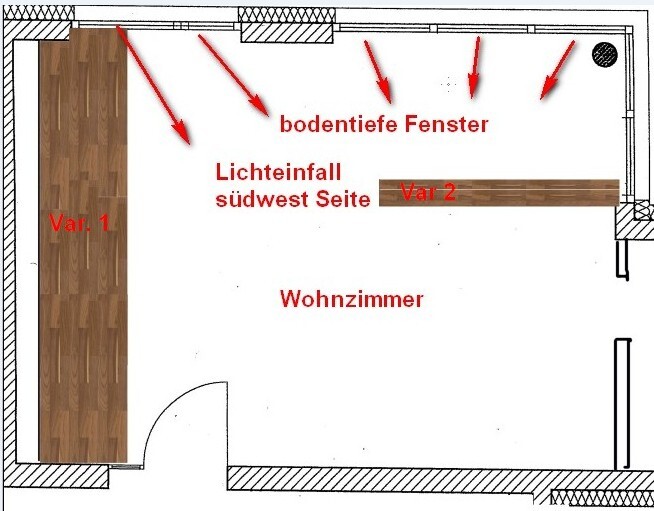
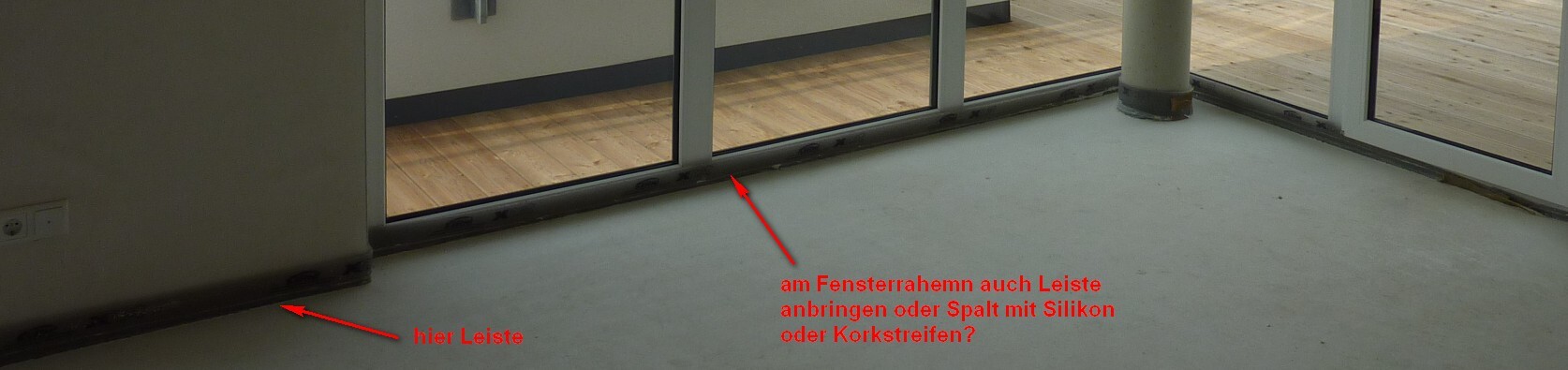
I want to install ship deck parquet flooring in the living room of a penthouse apartment and have attached two pictures. The living room measures 6x5m (20x16 ft). The windows on the longer 6m (20 ft) side face southwest.
How should the parquet boards run—option 1 or along the long side option 2?
How would you recommend finishing the parquet at the window frame? Should I install a baseboard along the walls as well? Or rather create a silicone joint between the frame and the parquet, or glue in a cork strip?
I was considering Haro FP4000 3-strip oak, 13.5 mm (0.53 inch) thick. Is the quality good?
Thanks in advance, best regards
Frank
@ KlaRa,
the builder argues that the standard flooring for your unit is laminate. When installing laminate, the screed layer does not need to be removed. If you had booked tile or parquet work, the layer would have been removed. Since I chose to do the flooring myself, I don’t benefit from that. A lawyer would need to get involved again, but this has already caused enough delays and frustration for me.
No matter how they sort it out, in my opinion the screed work has not been done properly.
Good luck, Frank
the builder argues that the standard flooring for your unit is laminate. When installing laminate, the screed layer does not need to be removed. If you had booked tile or parquet work, the layer would have been removed. Since I chose to do the flooring myself, I don’t benefit from that. A lawyer would need to get involved again, but this has already caused enough delays and frustration for me.
No matter how they sort it out, in my opinion the screed work has not been done properly.
Good luck, Frank

@ "werschtl":
You might assume that I also have technical expertise in the situation you described.
The developer’s comment is simply nonsense!
The builder or eventual buyer obviously has the right to a defect-free screed (or defect-free screed surface). It doesn’t matter at all which type of floor covering installation is used, whether floating or fully glued!
You could even decide years later to replace the currently planned laminate flooring with glued carpet, ceramic tiles, or glued parquet.
And who would then cover the additional costs? Exactly: YOU.
However, in my opinion it is not yet clear whether the screed surface actually has defects. This cannot be determined definitively from the photos and needs to be inspected on site!
My suggestion: find a specialist near you to have it checked.
This could be, for example, a master parquet installer, which is personally what I would recommend.
Although they will charge a small fee for their services, these costs will be far lower than those of a legal dispute (which carries uncertain outcomes).
A note to remember here: A lawyer rarely contributes to solving a technical problem. In many cases, they actually create additional problems.
------------------------
Best regards, KlaRa
You might assume that I also have technical expertise in the situation you described.
The developer’s comment is simply nonsense!
The builder or eventual buyer obviously has the right to a defect-free screed (or defect-free screed surface). It doesn’t matter at all which type of floor covering installation is used, whether floating or fully glued!
You could even decide years later to replace the currently planned laminate flooring with glued carpet, ceramic tiles, or glued parquet.
And who would then cover the additional costs? Exactly: YOU.
However, in my opinion it is not yet clear whether the screed surface actually has defects. This cannot be determined definitively from the photos and needs to be inspected on site!
My suggestion: find a specialist near you to have it checked.
This could be, for example, a master parquet installer, which is personally what I would recommend.
Although they will charge a small fee for their services, these costs will be far lower than those of a legal dispute (which carries uncertain outcomes).
A note to remember here: A lawyer rarely contributes to solving a technical problem. In many cases, they actually create additional problems.
------------------------
Best regards, KlaRa
Thank you very much, yes, that’s exactly how I see it as well. I’m in a good position; the developer also formally rejected my complaint about defects in writing. Therefore, I will proceed with a substitute performance (defect repair carried out by a third party). I will deduct the invoice from the final payment. The lawyer, that’s probably true…
Good luck, Frank
Good luck, Frank
Hello "werschtl".
Beware of traps, as was said in the past. This still applies in your case.
Because later on, if you want to claim costs legally, you will have the burden of proof for a situation whose evidence you logically destroyed by arranging a replacement action.
Right now, it is only about documenting the actual situation in a legally secure way.
Also for your own protection, because I will say it for the third time now:
The defect must first be proven.
But this can only be done by a professional. I have already recommended the master parquet installer. Ideally, you would use the assistance of a publicly appointed expert in "flooring technology" or "screeds." The costs incurred for such an inspection and evaluation with a short report will certainly be reasonable in relation to the legal certainty that such a statement would give you. Even if the expert does not assume there is a defect, the proportionality would still be maintained because it would save you from unnecessary costs of a dispute with the developer.
Because currently – I just want to remind you – there is only a statement from a tiler whose expertise I cannot verify.
With these hints, I just want to protect you from steps that could later possibly turn out to be a "self-goal."
Experts in the mentioned fields can be found through the "expert services" department at the local Chamber of Commerce and Industry or Chamber of Crafts. It’s just a phone call, nothing more.
-------------------------------------
Best regards, KlaRa
Beware of traps, as was said in the past. This still applies in your case.
Because later on, if you want to claim costs legally, you will have the burden of proof for a situation whose evidence you logically destroyed by arranging a replacement action.
Right now, it is only about documenting the actual situation in a legally secure way.
Also for your own protection, because I will say it for the third time now:
The defect must first be proven.
But this can only be done by a professional. I have already recommended the master parquet installer. Ideally, you would use the assistance of a publicly appointed expert in "flooring technology" or "screeds." The costs incurred for such an inspection and evaluation with a short report will certainly be reasonable in relation to the legal certainty that such a statement would give you. Even if the expert does not assume there is a defect, the proportionality would still be maintained because it would save you from unnecessary costs of a dispute with the developer.
Because currently – I just want to remind you – there is only a statement from a tiler whose expertise I cannot verify.
With these hints, I just want to protect you from steps that could later possibly turn out to be a "self-goal."
Experts in the mentioned fields can be found through the "expert services" department at the local Chamber of Commerce and Industry or Chamber of Crafts. It’s just a phone call, nothing more.
-------------------------------------
Best regards, KlaRa
Similar topics