
ᐅ Installing hardwood flooring: Which direction should it be laid?
Created on: 6 Mar 2016 22:13
W
werschtl
Dear forum,
I want to install ship deck parquet flooring in the living room of a penthouse apartment and have attached two pictures. The living room measures 6x5m (20x16 ft). The windows on the longer 6m (20 ft) side face southwest.
How should the parquet boards run—option 1 or along the long side option 2?
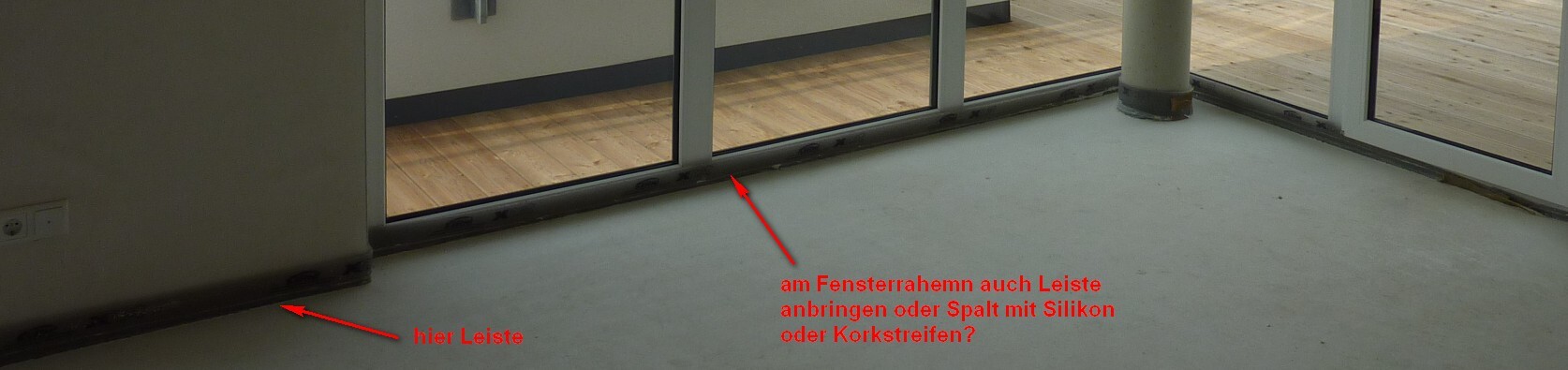
How would you recommend finishing the parquet at the window frame? Should I install a baseboard along the walls as well? Or rather create a silicone joint between the frame and the parquet, or glue in a cork strip?
I was considering Haro FP4000 3-strip oak, 13.5 mm (0.53 inch) thick. Is the quality good?
Thanks in advance, best regards
Frank
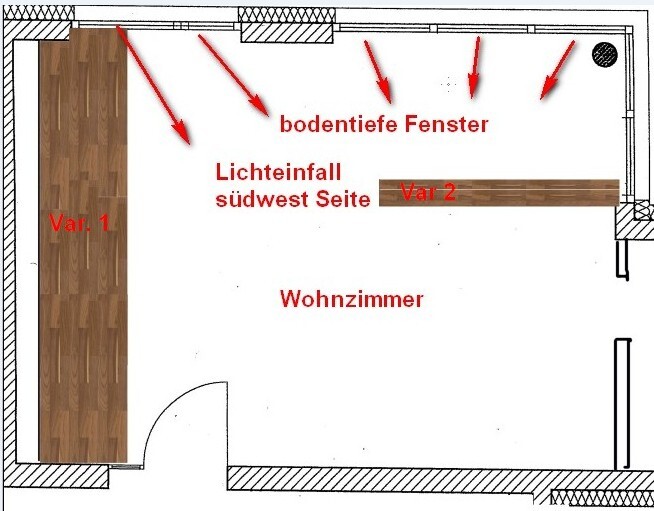
I want to install ship deck parquet flooring in the living room of a penthouse apartment and have attached two pictures. The living room measures 6x5m (20x16 ft). The windows on the longer 6m (20 ft) side face southwest.
How should the parquet boards run—option 1 or along the long side option 2?
How would you recommend finishing the parquet at the window frame? Should I install a baseboard along the walls as well? Or rather create a silicone joint between the frame and the parquet, or glue in a cork strip?
I was considering Haro FP4000 3-strip oak, 13.5 mm (0.53 inch) thick. Is the quality good?
Thanks in advance, best regards
Frank
Thank you all for the helpful answers. I am now leaning towards option 1, as it follows the same direction as the terrace flooring, even though that is the shorter edge (5m (16 feet)). The two adjacent rooms are the kitchen and the hallway. Both have glass doors, but there will be 30 x 60cm (12 x 24 inch) tiles laid in exactly the same direction.
Now I just thought of something else. How would you start laying, from left to right? Problem:
You can see in the picture that there is a column at the far right corner near the window, which unfortunately I cannot cut away, so precise cutting will be necessary there.
I will definitely glue the flooring, not lay it as a floating floor. It feels better that way.
Thanks again for your help.
Best regards,
Frank
Now I just thought of something else. How would you start laying, from left to right? Problem:
You can see in the picture that there is a column at the far right corner near the window, which unfortunately I cannot cut away, so precise cutting will be necessary there.
I will definitely glue the flooring, not lay it as a floating floor. It feels better that way.
Thanks again for your help.
Best regards,
Frank

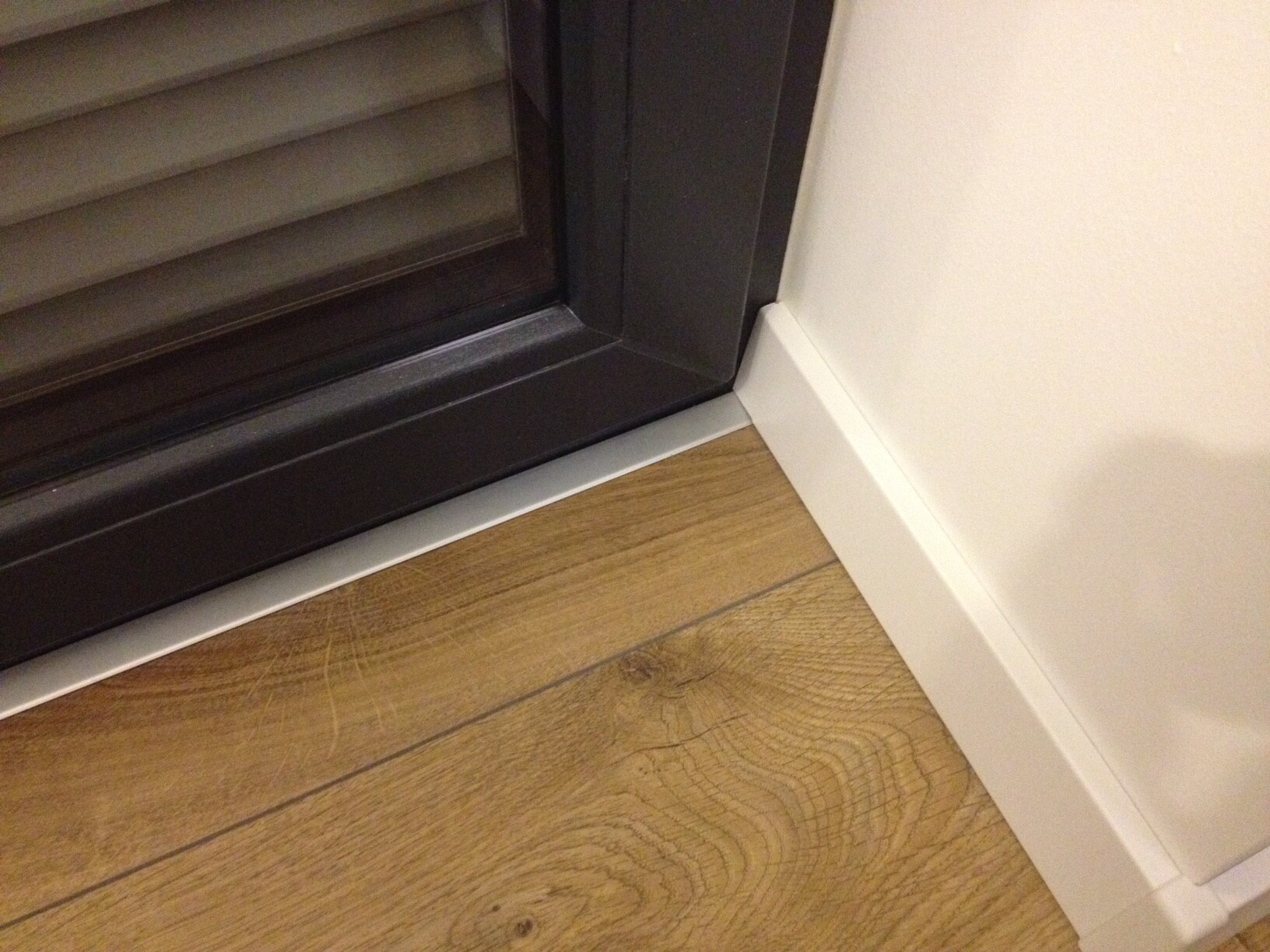
We installed a small L-shaped aluminum strip below the floor-to-ceiling windows. It is glued to the window frame on the back side with silicone, allowing the laminate flooring underneath to float freely. We bought the strips as affordable linear material at the home improvement store.
@KlaRa,
I need to ask again, what exactly do you mean? I thought deformation couldn’t occur with bonding?
Good luck, Frank
I need to ask again, what exactly do you mean? I thought deformation couldn’t occur with bonding?
KlaRa schrieb:
Multilayer parquet elements installed floating (or on an underlay) have the characteristic that unavoidable deformation caused by moisture absorption from the air, which is positively limited by the adhesive bonding on the underside in floating installation, can now take effect without restriction.
Good luck, Frank

Hello Frank,
that is not entirely correct.
In my posts, I have always pointed out that bonding limits (but does not completely prevent) moisture- or temperature-related deformation of parquet elements, as well as parquet strips.
However, we must also consider the material thickness when dealing with deformations. For example, a thin slice of bread left on a kitchen cabinet will develop complete warping over time due to drying.
In thicker parquet or wood-based panels bonded on the backside, the adhesive layer remains bonded, but the material above it still moves.
As a result, joint formation is not uncommon (even though the parquet backing is still firmly adhered to the screed through the adhesive layer) or edge cupping occurs when the wood swells from moisture.
-----------------------
Best regards, KlaRa
that is not entirely correct.
In my posts, I have always pointed out that bonding limits (but does not completely prevent) moisture- or temperature-related deformation of parquet elements, as well as parquet strips.
However, we must also consider the material thickness when dealing with deformations. For example, a thin slice of bread left on a kitchen cabinet will develop complete warping over time due to drying.
In thicker parquet or wood-based panels bonded on the backside, the adhesive layer remains bonded, but the material above it still moves.
As a result, joint formation is not uncommon (even though the parquet backing is still firmly adhered to the screed through the adhesive layer) or edge cupping occurs when the wood swells from moisture.
-----------------------
Best regards, KlaRa