
ᐅ Installing hardwood flooring: Which direction should it be laid?
Created on: 6 Mar 2016 22:13
W
werschtl
Dear forum,
I want to install ship deck parquet flooring in the living room of a penthouse apartment and have attached two pictures. The living room measures 6x5m (20x16 ft). The windows on the longer 6m (20 ft) side face southwest.
How should the parquet boards run—option 1 or along the long side option 2?
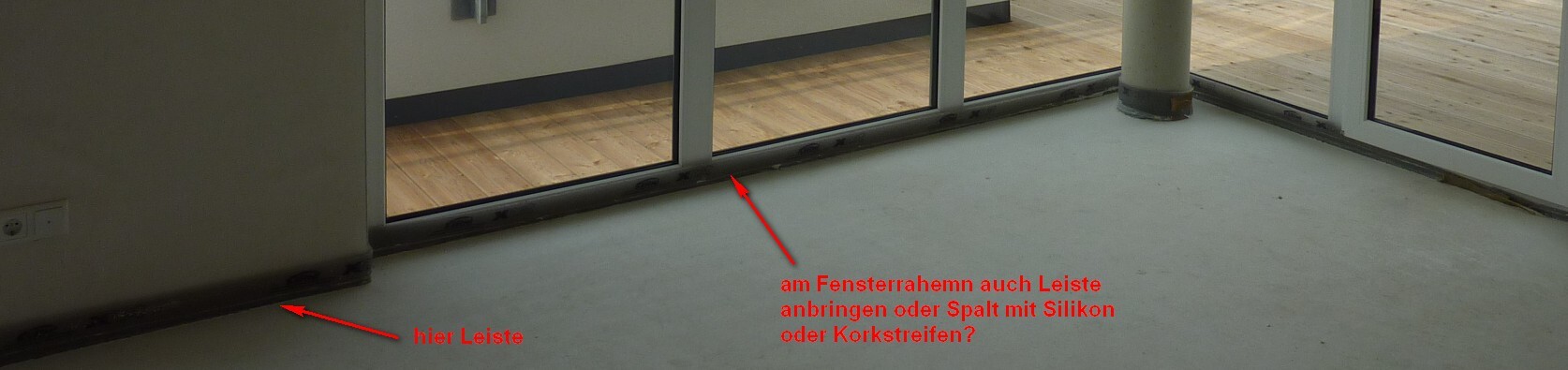
How would you recommend finishing the parquet at the window frame? Should I install a baseboard along the walls as well? Or rather create a silicone joint between the frame and the parquet, or glue in a cork strip?
I was considering Haro FP4000 3-strip oak, 13.5 mm (0.53 inch) thick. Is the quality good?
Thanks in advance, best regards
Frank
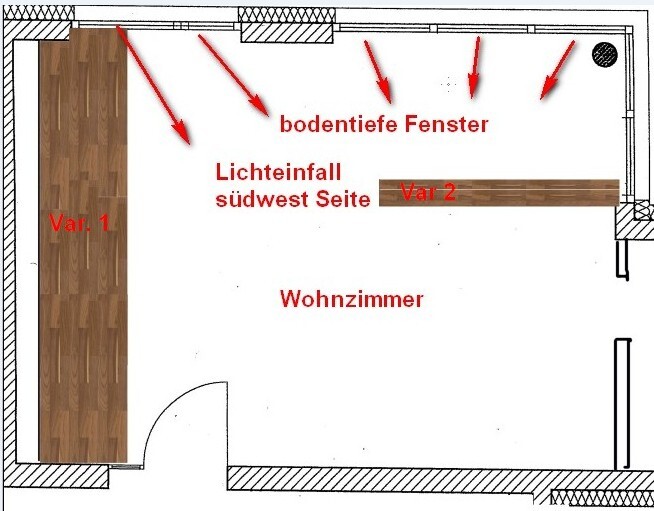
I want to install ship deck parquet flooring in the living room of a penthouse apartment and have attached two pictures. The living room measures 6x5m (20x16 ft). The windows on the longer 6m (20 ft) side face southwest.
How should the parquet boards run—option 1 or along the long side option 2?
How would you recommend finishing the parquet at the window frame? Should I install a baseboard along the walls as well? Or rather create a silicone joint between the frame and the parquet, or glue in a cork strip?
I was considering Haro FP4000 3-strip oak, 13.5 mm (0.53 inch) thick. Is the quality good?
Thanks in advance, best regards
Frank

Hello "werschtl",
a heated screed is certainly not considered a "defect"! However, this installation method as "screed on insulation layer" (which is also regulated in DIN 18560 Part 2) was not the main focus here. Rather, it was the—let’s say—“unusual” comments and terminology raised during the discussion on this topic.
If small flakes are detaching from a screed surface—as you now describe—the following installer will have to carefully decide whether to remove them himself or raise concerns. The latter option might be the right approach if (which I obviously cannot judge from a distance) the screed is actually defective.
In that case, a formal written notice of defects must be issued to the screed contractor. If your tiler takes matters into his own hands, the screed contractor immediately loses responsibility and warranty since the tiler has accepted the screed work as properly completed!
You may realize here that the situation might not be so simple after all.
If your remarks were accurately reported without any embellishment from the tiler’s statements, then my comments still apply! The tiler is only obliged—as are the floor and parquet installers—to perform a so-called cleaning grind. The informal term used on a construction site is: "He just runs the machine over it."
That’s all he needs to do, except to remove any dirt deposits accumulated on the screed surface in the meantime. Removing flake-like detachments from the screed surface is definitely not part of his responsibilities and, as I mentioned earlier, could have legal consequences.
For example, if the screed surface has significant defects (which your tiler fails to notice, though he should), and he accepts the screed in any way, then the follow-up costs for proper repair, which you as the client can insist on, remain solely with him.
Meanwhile, the screed contractor can sit back smiling and whistle a tune. Rightfully so!
------------------------
PS: I’m writing all this not because I am bored or seeking recognition, but rather to share my experience here in this forum and to warn homeowners like you against mistakes (including those of others).
Best regards, KlaRa
a heated screed is certainly not considered a "defect"! However, this installation method as "screed on insulation layer" (which is also regulated in DIN 18560 Part 2) was not the main focus here. Rather, it was the—let’s say—“unusual” comments and terminology raised during the discussion on this topic.
If small flakes are detaching from a screed surface—as you now describe—the following installer will have to carefully decide whether to remove them himself or raise concerns. The latter option might be the right approach if (which I obviously cannot judge from a distance) the screed is actually defective.
In that case, a formal written notice of defects must be issued to the screed contractor. If your tiler takes matters into his own hands, the screed contractor immediately loses responsibility and warranty since the tiler has accepted the screed work as properly completed!
You may realize here that the situation might not be so simple after all.
If your remarks were accurately reported without any embellishment from the tiler’s statements, then my comments still apply! The tiler is only obliged—as are the floor and parquet installers—to perform a so-called cleaning grind. The informal term used on a construction site is: "He just runs the machine over it."
That’s all he needs to do, except to remove any dirt deposits accumulated on the screed surface in the meantime. Removing flake-like detachments from the screed surface is definitely not part of his responsibilities and, as I mentioned earlier, could have legal consequences.
For example, if the screed surface has significant defects (which your tiler fails to notice, though he should), and he accepts the screed in any way, then the follow-up costs for proper repair, which you as the client can insist on, remain solely with him.
Meanwhile, the screed contractor can sit back smiling and whistle a tune. Rightfully so!
------------------------
PS: I’m writing all this not because I am bored or seeking recognition, but rather to share my experience here in this forum and to warn homeowners like you against mistakes (including those of others).
Best regards, KlaRa
Hello KlaRa,
Thank you very much for the detailed explanation; I really appreciate it and find it very helpful. Now I understand what it’s about.
Tomorrow, I will take a photo of it and upload it. Surely something is wrong; on the surface of the screed, you can see small bubbles exactly above the loops of the underfloor heating. Most likely, the screed installers need to perform the final grinding. I will then report this as a construction defect.
Thanks again for the expert help.
Good luck, Frank
Thank you very much for the detailed explanation; I really appreciate it and find it very helpful. Now I understand what it’s about.
Tomorrow, I will take a photo of it and upload it. Surely something is wrong; on the surface of the screed, you can see small bubbles exactly above the loops of the underfloor heating. Most likely, the screed installers need to perform the final grinding. I will then report this as a construction defect.
Thanks again for the expert help.
Good luck, Frank
Hello "werschtl",
The situation as shown in the photo does not seem as serious as initially feared.
It is quite possible that the cloud-like shading can be removed by a cleaning grind performed by the tile installer (this is a service that should be provided free of charge and is always factored into the tile layer’s pricing).
Only if, to put it very dramatically, the grinding machine “digs into” the screed (due to insufficient screed strength) should the screed installer be called in.
The same applies if, after the cleaning grind, the tile installer detects a lack of absorbency on the screed surface using a drop test, or if flaky pieces come off during the so-called “hammer test.”
Please keep in mind the mindset: “No need to panic!”
That means: Approach the matter calmly and, above all, with professional expertise.
Wild speculation will certainly not help.
Please describe how the situation was resolved at a later time!
----------------------------
Best regards, KlaRa
The situation as shown in the photo does not seem as serious as initially feared.
It is quite possible that the cloud-like shading can be removed by a cleaning grind performed by the tile installer (this is a service that should be provided free of charge and is always factored into the tile layer’s pricing).
Only if, to put it very dramatically, the grinding machine “digs into” the screed (due to insufficient screed strength) should the screed installer be called in.
The same applies if, after the cleaning grind, the tile installer detects a lack of absorbency on the screed surface using a drop test, or if flaky pieces come off during the so-called “hammer test.”
Please keep in mind the mindset: “No need to panic!”
That means: Approach the matter calmly and, above all, with professional expertise.
Wild speculation will certainly not help.
Please describe how the situation was resolved at a later time!
----------------------------
Best regards, KlaRa
Thank you very much,
yes, I will report back. It’s not entirely clear to me whether the removal of the sinter layer is the final step performed by the screed installer. In my case, this would be a construction defect. I took over the apartment with the option of “flooring work done by owner.” Therefore, I suspect the developer will respond that this is the responsibility of the floor installer.
Good luck, Frank
yes, I will report back. It’s not entirely clear to me whether the removal of the sinter layer is the final step performed by the screed installer. In my case, this would be a construction defect. I took over the apartment with the option of “flooring work done by owner.” Therefore, I suspect the developer will respond that this is the responsibility of the floor installer.
Good luck, Frank
Hello "werschtl".
At your current stage, a technical layperson really needs professional help. From my point of view, there are only two ways to assess the situation:
a) The screed surface can be brought to a condition suitable for covering with a light cleaning grind, or
b) The screed surface has defects.
However, checking this is practically impossible for a layperson.
If there is a defect in the screed surface (which cannot be completely ruled out), the screed installer has the right to carry out remedial work with an effort acceptable to them.
The defect must be reported to them in writing by their contractual partner.
Assuming you have a contract with a general contractor (GC), you would need to notify them of the defect (of course in writing), so they can pass it on to their subcontractor, the screed installer.
Doing floor work yourself does not invalidate your (own) right to a defect-free screed (or surface).
As for whether the developer passes this on as you fear, I would suggest waiting and seeing. The next step: have a qualified professional—someone rightfully bearing that title—assess the current condition of the screed, and only then respond further if a defect is actually confirmed.
The "underlying risk," of course, is delay, since the floor covering cannot be installed. But this should be considered secondary given the potential damage and costs that could arise in the worst-case scenario.
-----------------------------
Best regards, KlaRa
At your current stage, a technical layperson really needs professional help. From my point of view, there are only two ways to assess the situation:
a) The screed surface can be brought to a condition suitable for covering with a light cleaning grind, or
b) The screed surface has defects.
However, checking this is practically impossible for a layperson.
If there is a defect in the screed surface (which cannot be completely ruled out), the screed installer has the right to carry out remedial work with an effort acceptable to them.
The defect must be reported to them in writing by their contractual partner.
Assuming you have a contract with a general contractor (GC), you would need to notify them of the defect (of course in writing), so they can pass it on to their subcontractor, the screed installer.
Doing floor work yourself does not invalidate your (own) right to a defect-free screed (or surface).
As for whether the developer passes this on as you fear, I would suggest waiting and seeing. The next step: have a qualified professional—someone rightfully bearing that title—assess the current condition of the screed, and only then respond further if a defect is actually confirmed.
The "underlying risk," of course, is delay, since the floor covering cannot be installed. But this should be considered secondary given the potential damage and costs that could arise in the worst-case scenario.
-----------------------------
Best regards, KlaRa
Similar topics