
ᐅ Ikea corner bench in country style made from kitchen cabinets – my guide
Created on: 25 Sep 2017 12:00
K
Kaspatoo
Hello,
I would like to share some of my knowledge with you here.
Perhaps you have some suggestions for improvement.
We have been searching forever for a nice corner bench in a country style, which also has fixed cushions. I really don’t like it when the cushion slides back and forth.
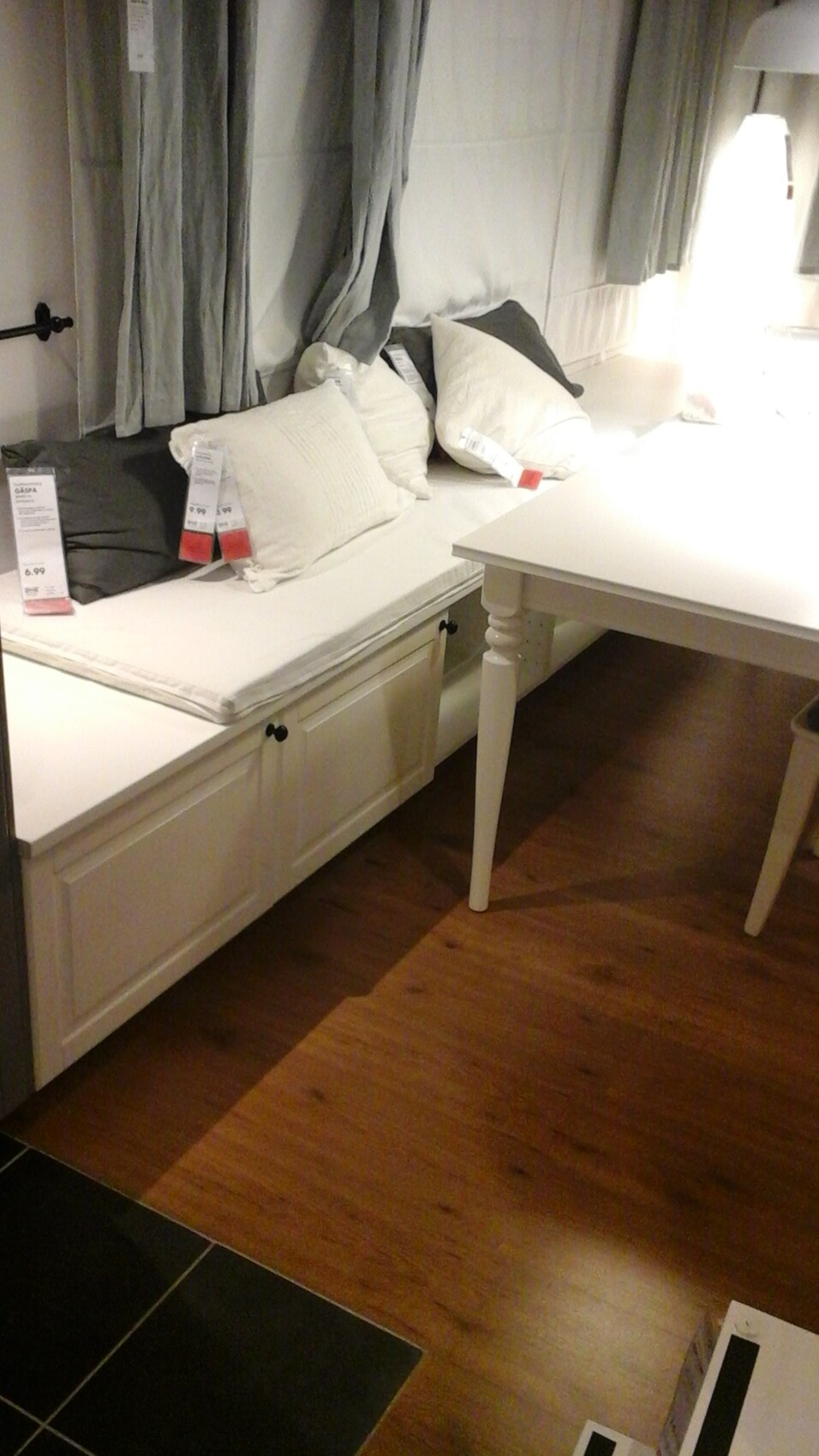
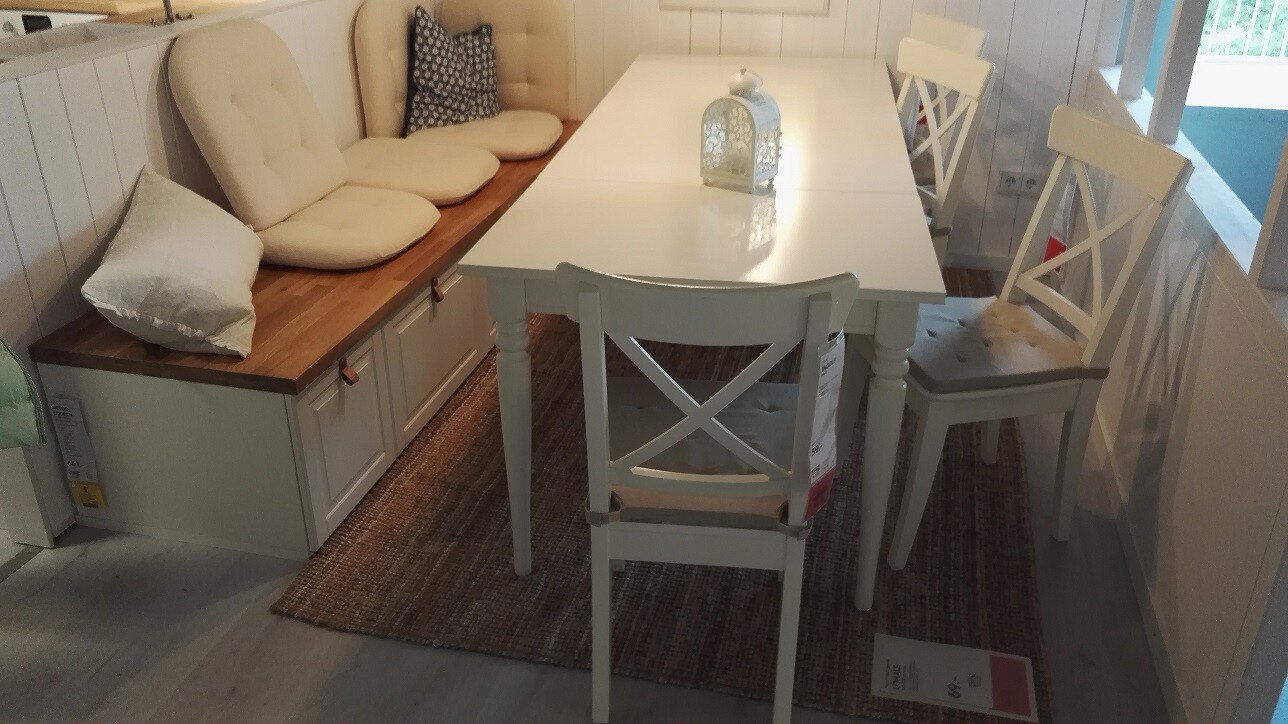
At IKEA, I saw a bench made from kitchen cabinets with a countertop as the seat surface.
There were loose cushions there as well, but a upholsterer could fix that.
I have already found similar ideas on Pinterest; just search for "corner bench country style."
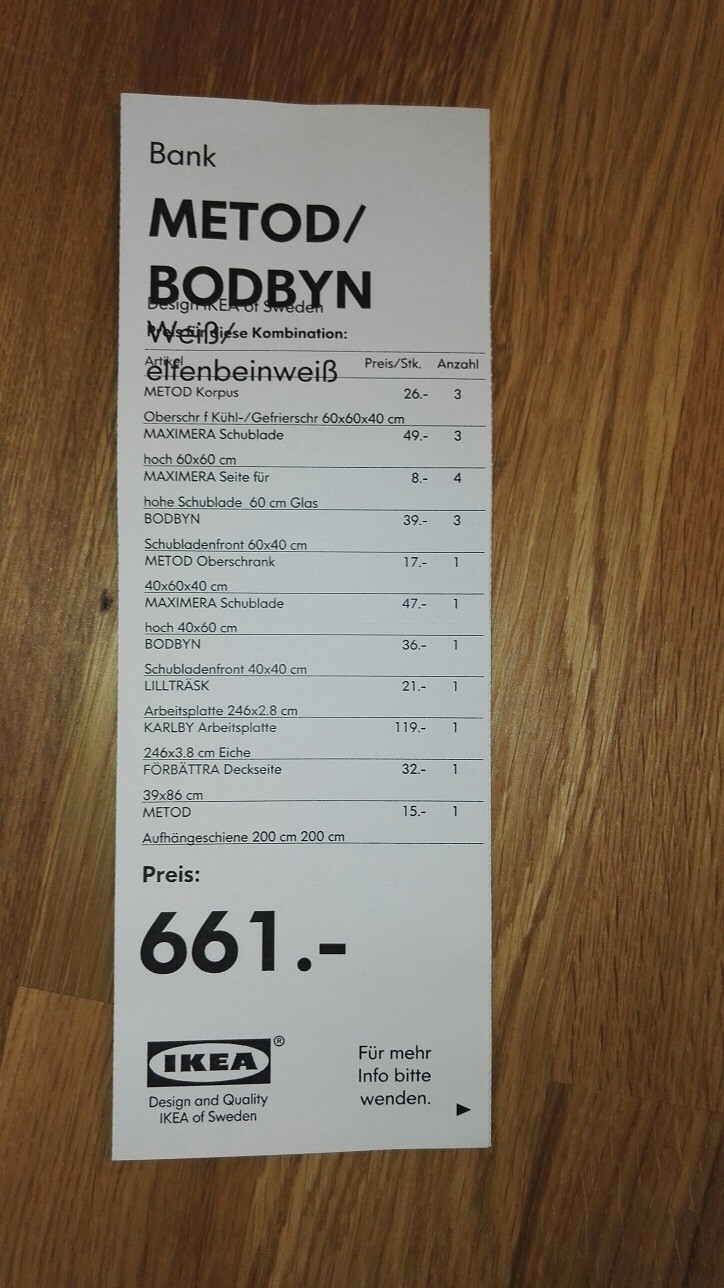
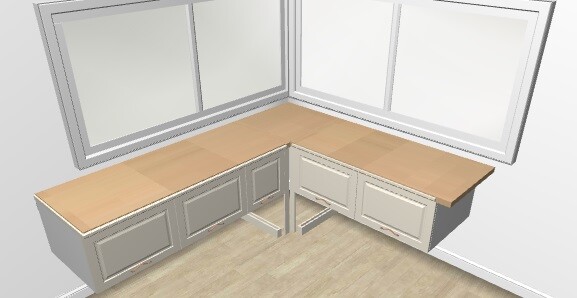
I have already put together the IKEA furniture parts on paper.
Material costs are about 900€ (advantage: storage space under the seat, disadvantage: feet cannot be placed “under” the bench).
An offer from the kitchen studio for the kitchen modules alone was about 1800€.
Offers from two upholsterers: about 1000€ (very high-quality fabric; material costs almost 500€ alone; seat cushions reversible/double-sided for twice the service life; non-slip underlay; back cushions fixed with Velcro; custom-cut cushions; all covers removable and washable).
I have already sketched my plan on paper.
Basically, everything is almost clear and ready to be ordered.
Chairs and benches including cushions usually have a seat height of 50cm (20 inches).
The seat depth is usually 47cm (18.5 inches).
Small variations can be made as desired.
For aesthetic reasons, we leave 2.5cm (1 inch) of space between the cushions on the side and at the top edge of the back cushion to let the real wood panel show through.
Unlike one of the drawings, but exactly like the side view, the seat and back cushions touch directly without any gap.
Under the seat cushions there will be a non-slip mat. I have already tested this myself at the upholsterer’s; nothing slips, and the mat costs only a few cents.
Because the seat cushions are symmetrical and not fixed, we can also turn them over, so the cushions effectively have double the seating life.
The back cushions are attached with Velcro and therefore cannot be flipped. However, the back cushions are not as heavily used as the seat cushions.
The Velcro is sewn into the cushion; the counterpart is self-adhesive. The finished cushion is pressed against the back wall at the right spot, the self-adhesive piece sticks, then the cushion is removed again (the self-adhesive Velcro remains on the back wall in the desired position).
The rule is: “Only what is glued can come unstuck.” The self-adhesive Velcro is additionally fixed to the back wall with a staple gun.
My planning files are attached here.
I would like to share some of my knowledge with you here.
Perhaps you have some suggestions for improvement.
We have been searching forever for a nice corner bench in a country style, which also has fixed cushions. I really don’t like it when the cushion slides back and forth.
At IKEA, I saw a bench made from kitchen cabinets with a countertop as the seat surface.
There were loose cushions there as well, but a upholsterer could fix that.
I have already found similar ideas on Pinterest; just search for "corner bench country style."
I have already put together the IKEA furniture parts on paper.
Material costs are about 900€ (advantage: storage space under the seat, disadvantage: feet cannot be placed “under” the bench).
An offer from the kitchen studio for the kitchen modules alone was about 1800€.
Offers from two upholsterers: about 1000€ (very high-quality fabric; material costs almost 500€ alone; seat cushions reversible/double-sided for twice the service life; non-slip underlay; back cushions fixed with Velcro; custom-cut cushions; all covers removable and washable).
I have already sketched my plan on paper.
Basically, everything is almost clear and ready to be ordered.
Chairs and benches including cushions usually have a seat height of 50cm (20 inches).
The seat depth is usually 47cm (18.5 inches).
Small variations can be made as desired.
For aesthetic reasons, we leave 2.5cm (1 inch) of space between the cushions on the side and at the top edge of the back cushion to let the real wood panel show through.
Unlike one of the drawings, but exactly like the side view, the seat and back cushions touch directly without any gap.
Under the seat cushions there will be a non-slip mat. I have already tested this myself at the upholsterer’s; nothing slips, and the mat costs only a few cents.
Because the seat cushions are symmetrical and not fixed, we can also turn them over, so the cushions effectively have double the seating life.
The back cushions are attached with Velcro and therefore cannot be flipped. However, the back cushions are not as heavily used as the seat cushions.
The Velcro is sewn into the cushion; the counterpart is self-adhesive. The finished cushion is pressed against the back wall at the right spot, the self-adhesive piece sticks, then the cushion is removed again (the self-adhesive Velcro remains on the back wall in the desired position).
The rule is: “Only what is glued can come unstuck.” The self-adhesive Velcro is additionally fixed to the back wall with a staple gun.
My planning files are attached here.
I have now completed the corner bench.
We decided not to use upholstery from a professional upholsterer.
Instead of spending 1000€ for upholstery, we are using seat cushions for just a few marks.
The panels come from Hornbach, the only DIY store near us that offers the IKEA depth of 63.5cm (25 inches).
Other stores would have required cutting from 90cm (35 inches).
I did not check with the chipboard supplier in the neighboring district; it didn’t work out.
The solid beech wood panels cost 97€ for 4 meters (13 feet). They can also be bought by the meter (foot).
The seat panels are about 4cm (1.6 inches) thick, the backrests 2-3cm (0.8-1.2 inches).
Unfortunately, the cutting in the store (specifically ours) is not precise to the millimeter.
We had a few rough errors corrected at the store during pickup.
Some panels had minor defects, for which we received two discounts of 15€ each.
The panels are also not 100% consistent in thickness. The supplier from the hardware store delivers varying quality; one panel was 38mm (1.5 inches), the other 40mm (1.6 inches) thick. Since they were supposed to match, this was a problem.
So, this is something to watch out for.
When assembling, we also had to reduce the height of the back panels in one spot with a handheld circular saw and a guide because I had planned them a bit too high.
The panels are untreated and not sanded or oiled. I finished this myself at home, which caused additional cost, work, and a lot of dust and dirt. Definitely do this outside.
Solid wood (the beech hardwood we used) will delaminate if it gets wet.
Wiping it down is no problem, but exposure to rain will damage it.
Alternatively, IKEA panels are available in approximately 180cm (6 feet) and 280cm (9 feet) lengths. Cutting must be done yourself. Prices vary there as well.
We joined the panels together and to the carcasses with thick screws, as well as with metal plates and small screws.
The bench rests against the window sills, cushioned with felt pads, making it very stable. Without leaning on the window sill, it could be a bit less stable with long-term use because the backrest has some flex, as it is only fastened with screws from underneath.
Here are a few photos.
We decided not to use upholstery from a professional upholsterer.
Instead of spending 1000€ for upholstery, we are using seat cushions for just a few marks.
The panels come from Hornbach, the only DIY store near us that offers the IKEA depth of 63.5cm (25 inches).
Other stores would have required cutting from 90cm (35 inches).
I did not check with the chipboard supplier in the neighboring district; it didn’t work out.
The solid beech wood panels cost 97€ for 4 meters (13 feet). They can also be bought by the meter (foot).
The seat panels are about 4cm (1.6 inches) thick, the backrests 2-3cm (0.8-1.2 inches).
Unfortunately, the cutting in the store (specifically ours) is not precise to the millimeter.
We had a few rough errors corrected at the store during pickup.
Some panels had minor defects, for which we received two discounts of 15€ each.
The panels are also not 100% consistent in thickness. The supplier from the hardware store delivers varying quality; one panel was 38mm (1.5 inches), the other 40mm (1.6 inches) thick. Since they were supposed to match, this was a problem.
So, this is something to watch out for.
When assembling, we also had to reduce the height of the back panels in one spot with a handheld circular saw and a guide because I had planned them a bit too high.
The panels are untreated and not sanded or oiled. I finished this myself at home, which caused additional cost, work, and a lot of dust and dirt. Definitely do this outside.
Solid wood (the beech hardwood we used) will delaminate if it gets wet.
Wiping it down is no problem, but exposure to rain will damage it.
Alternatively, IKEA panels are available in approximately 180cm (6 feet) and 280cm (9 feet) lengths. Cutting must be done yourself. Prices vary there as well.
We joined the panels together and to the carcasses with thick screws, as well as with metal plates and small screws.
The bench rests against the window sills, cushioned with felt pads, making it very stable. Without leaning on the window sill, it could be a bit less stable with long-term use because the backrest has some flex, as it is only fastened with screws from underneath.
Here are a few photos.
Yes, the feet cannot be positioned backward.
I also enjoy doing that sometimes.
With a seat cushion, it’s much more comfortable on the buttocks; for the back, it’s fine as is, or adding another cushion behind the back also works.
The first big gathering already took place, and everyone was happy.
The only thing is that the table has to be moved to get in and out.
However, it was difficult to find a table that doesn’t have legs on the outside on both sides, looks good to us, and fits within our budget.
I also enjoy doing that sometimes.
With a seat cushion, it’s much more comfortable on the buttocks; for the back, it’s fine as is, or adding another cushion behind the back also works.
The first big gathering already took place, and everyone was happy.
The only thing is that the table has to be moved to get in and out.
However, it was difficult to find a table that doesn’t have legs on the outside on both sides, looks good to us, and fits within our budget.
Craftsmanship is very well executed, and it’s also a very nice idea. Unfortunately, I have a preference for country-style homes and can’t relate much to this style. Overall, considering the amount of work involved, it’s certainly not a cheap project, but it should serve very reliably for many years. Personally, at first glance, I might be a bit bothered by the corner cladding in a "different" color that isn’t flush. Objectively, though, that’s a spot you will hardly ever see, so it’s really just nitpicking at a very high level.
What I find quite uncomfortable to imagine is the backrest at a 90° angle. I’m also planning to build something for the garden this year and have been "testing" various benches for months to find the ideal back angle. Even though it’s a much more demanding task from a craftsmanship perspective, I probably wouldn’t get used to it because it only partially fulfills the main purpose—comfortable seating. But I’m open to being convinced otherwise.
I would probably have sawed wedge-shaped MDF supports at the back and screwed the backrest to those. At the front, I would have added a cover panel to hide the rear structure and visually enhance the bench. Of course, that makes the build significantly more complex because the bottom edge of the backrest would need a miter cut (does a DIY store do that?), and the corner joint would also need to be mitered at an angle. The cover panels would have to be custom-made and painted yourself as well. So if you can’t do that on your own, it would drive the cost way up.
What do you store in the drawers? I find the idea great but am wondering if I would find it easier to move the table aside to access the drawer contents or just grab the items from the next room (if that’s an option).
What I find quite uncomfortable to imagine is the backrest at a 90° angle. I’m also planning to build something for the garden this year and have been "testing" various benches for months to find the ideal back angle. Even though it’s a much more demanding task from a craftsmanship perspective, I probably wouldn’t get used to it because it only partially fulfills the main purpose—comfortable seating. But I’m open to being convinced otherwise.
I would probably have sawed wedge-shaped MDF supports at the back and screwed the backrest to those. At the front, I would have added a cover panel to hide the rear structure and visually enhance the bench. Of course, that makes the build significantly more complex because the bottom edge of the backrest would need a miter cut (does a DIY store do that?), and the corner joint would also need to be mitered at an angle. The cover panels would have to be custom-made and painted yourself as well. So if you can’t do that on your own, it would drive the cost way up.
What do you store in the drawers? I find the idea great but am wondering if I would find it easier to move the table aside to access the drawer contents or just grab the items from the next room (if that’s an option).
The sides of the two legs have a different color than the two panels at the front inside corner.
This is noticeable only upon close inspection or in photos. It hardly stands out in the overall appearance.
The backrest even has a slight backward tilt by chance, which is noticeably different from a true 90° angle (we tested this before final assembly by sitting on it).
A steeper tilt can be achieved, for example, with a proper miter cut—almost impossible to do with a handheld circular saw.
It would then need to be supported with, for instance, angle brackets.
Because of the backrest’s tilt, I studied various chairs and my parents-in-law’s corner bench and discussed this with the upholsterer. In my original plans, the tilt seems close to optimal for my preference.
Some drawers open from under the table, while others only open when the table is moved. A table with a single central leg would be practical here.
That’s why we store items that are not used frequently.
Additional placemats (for when we have many guests for coffee), tablecloths, table runners, some decorations, a few board games (though they are rarely played here).
All things that usually end up in the lowest kitchen drawer and are used only about three times a year.
This is noticeable only upon close inspection or in photos. It hardly stands out in the overall appearance.
The backrest even has a slight backward tilt by chance, which is noticeably different from a true 90° angle (we tested this before final assembly by sitting on it).
A steeper tilt can be achieved, for example, with a proper miter cut—almost impossible to do with a handheld circular saw.
It would then need to be supported with, for instance, angle brackets.
Because of the backrest’s tilt, I studied various chairs and my parents-in-law’s corner bench and discussed this with the upholsterer. In my original plans, the tilt seems close to optimal for my preference.
Some drawers open from under the table, while others only open when the table is moved. A table with a single central leg would be practical here.
That’s why we store items that are not used frequently.
Additional placemats (for when we have many guests for coffee), tablecloths, table runners, some decorations, a few board games (though they are rarely played here).
All things that usually end up in the lowest kitchen drawer and are used only about three times a year.
Similar topics