
The walls and brickwork of our extension are finished.
It is 7.5m wide and 5m long (24.6 ft by 16.4 ft).
Now we are looking for a roofer (much too late).
We have already had a few here... and everyone tells a different story about the vapor retarder and insulation.
At first, I thought about using tapered insulation, but every roofer told me it would be too expensive.
The roofing company I liked best wants to carry it out as shown in the picture.
This way, I can install the insulation myself.
Due to regulations at home, the rafters must remain visible.
With tapered insulation, the beams would be fully visible.
With the roofer’s idea, 10cm (4 inches) would remain visible. (I actually like this idea quite a lot.)
Would such a construction be acceptable? The vapor retarder worries me a little since I can only install it between the rafters and then have to stick the membrane onto the rafters.
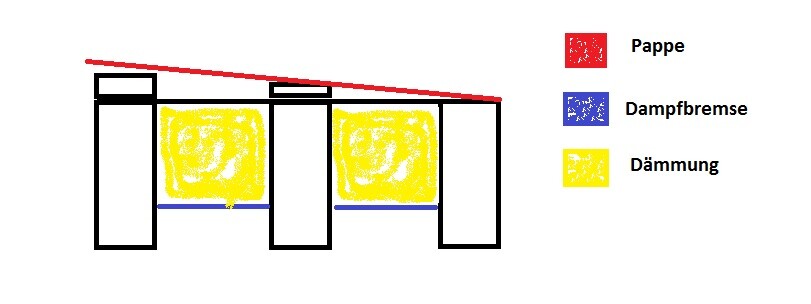
It is 7.5m wide and 5m long (24.6 ft by 16.4 ft).
Now we are looking for a roofer (much too late).
We have already had a few here... and everyone tells a different story about the vapor retarder and insulation.
At first, I thought about using tapered insulation, but every roofer told me it would be too expensive.
The roofing company I liked best wants to carry it out as shown in the picture.
This way, I can install the insulation myself.
Due to regulations at home, the rafters must remain visible.
With tapered insulation, the beams would be fully visible.
With the roofer’s idea, 10cm (4 inches) would remain visible. (I actually like this idea quite a lot.)
Would such a construction be acceptable? The vapor retarder worries me a little since I can only install it between the rafters and then have to stick the membrane onto the rafters.

The outcome of my research so far has consistently been mineral wool, whether for the external thermal insulation composite system (ETICS) or for roof insulation.
We plan to fully sheath the (pitched) roof and apply sound insulation continuously on the rafters—probably using mineral wool boards. Thermal insulation will then be installed between the rafters. However, the final decision has not yet been made.
Achieving a sound reduction index of 50 dB in rooms under the sloped roof is quite a real challenge.
We plan to fully sheath the (pitched) roof and apply sound insulation continuously on the rafters—probably using mineral wool boards. Thermal insulation will then be installed between the rafters. However, the final decision has not yet been made.
Achieving a sound reduction index of 50 dB in rooms under the sloped roof is quite a real challenge.
G
garfunkel20 Jul 2016 22:35Sound insulation works on the spring principle: hard-soft-hard. Rigid foam boards, whether open-cell or not, do not provide any "soft" behavior. Sometimes you even find people online claiming that these boards actually act as reinforcements. Personally, I cannot confirm this.
I only learned too late what rigid foam insulation really entails, but fortunately, it wasn’t a problem. However, I attribute that to my specific local conditions!
For example, I hear rain when it’s pouring heavily, with a gentle background pattering or rustling. I don’t mind this because I actually enjoy it, and it’s part of what I appreciate about living in a top-floor apartment.
Traffic noise is barely transmitted in my case. The house stands about 3 meters (10 feet) from the street, and the eave is about 6 meters (20 feet) away. Traffic noise reaches the roof too faintly to be clearly audible.
But anyone who wants to be absolutely sure about soundproofing should avoid rigid foam, which I concluded after extensive internet research and discussions with a professional.
My rigid foam boards have an additional 4 or 5 cm (1.5 or 2 inches) layer of mineral wool applied for soundproofing. But honestly, that small amount doesn’t make a significant difference in the right circumstances. When you have such a panel in front of you, you understand why.
If soundproofing is important, you should definitely choose something else to be safe. I can’t say for sure what’s better, like wood wool, rock wool, or other materials.
Based on everything I’ve read since then, as a layperson, I would probably go for wood wool because of its insulation and sound-absorbing properties. Although I believe there’s not much difference between rock wool, wood wool, or any other type of wool.
After reading some of the horror stories about rigid foam online, I quickly scheduled an appointment with the roofer to express my concerns. He reassured me and explained that the residential area/street does not exceed 60 dB of traffic noise (during daytime). The rigid foam boards, or rather the roof structure, reduce it by about 40-48 dB. So there are still 20-12 dB of traffic noise left, which I hear. I have to be very quiet, almost as if I were sleeping, to hear a bus (which is very quiet and only passes during the day), and that only happens in the rooms facing the street. My bedroom is on the other side. Of course, other factors such as the masonry and/or windows also come into play.
But as mentioned before, if you value sound reduction and really want peace under the roof, you should thoroughly research what materials and construction methods will be used beforehand. My roofer provided me with detailed sound calculations and clearly showed how it works in my case, which is an older building. For a new build, this definitely needs to be considered and documented. If it’s not, I would have it addressed.
By the way, my rigid foam boards also reduce summer heat quite well. The last few days have been very warm, and inside the apartment the temperature never rose above 23°C (73°F) during the day. Thinking back to older insulation from the 1970s, it would already be 28°C (82°F) now.
As far as I understand, wood wool is supposed to be the better option for this. Of course, it always depends on the thickness of the insulation layer and other factors.
In conclusion, consult a professional and, if possible, get the expected values in writing. It may also be worthwhile to contact an independent expert with your documents and situation.
@ Sirhc: I consider it an absolute myth to call a sound insulation rating of 50 dB or an external noise exposure of under 50 dB in the apartment difficult to achieve. I truly can’t imagine it being that hard.
I only learned too late what rigid foam insulation really entails, but fortunately, it wasn’t a problem. However, I attribute that to my specific local conditions!
For example, I hear rain when it’s pouring heavily, with a gentle background pattering or rustling. I don’t mind this because I actually enjoy it, and it’s part of what I appreciate about living in a top-floor apartment.
Traffic noise is barely transmitted in my case. The house stands about 3 meters (10 feet) from the street, and the eave is about 6 meters (20 feet) away. Traffic noise reaches the roof too faintly to be clearly audible.
But anyone who wants to be absolutely sure about soundproofing should avoid rigid foam, which I concluded after extensive internet research and discussions with a professional.
My rigid foam boards have an additional 4 or 5 cm (1.5 or 2 inches) layer of mineral wool applied for soundproofing. But honestly, that small amount doesn’t make a significant difference in the right circumstances. When you have such a panel in front of you, you understand why.
If soundproofing is important, you should definitely choose something else to be safe. I can’t say for sure what’s better, like wood wool, rock wool, or other materials.
Based on everything I’ve read since then, as a layperson, I would probably go for wood wool because of its insulation and sound-absorbing properties. Although I believe there’s not much difference between rock wool, wood wool, or any other type of wool.
After reading some of the horror stories about rigid foam online, I quickly scheduled an appointment with the roofer to express my concerns. He reassured me and explained that the residential area/street does not exceed 60 dB of traffic noise (during daytime). The rigid foam boards, or rather the roof structure, reduce it by about 40-48 dB. So there are still 20-12 dB of traffic noise left, which I hear. I have to be very quiet, almost as if I were sleeping, to hear a bus (which is very quiet and only passes during the day), and that only happens in the rooms facing the street. My bedroom is on the other side. Of course, other factors such as the masonry and/or windows also come into play.
But as mentioned before, if you value sound reduction and really want peace under the roof, you should thoroughly research what materials and construction methods will be used beforehand. My roofer provided me with detailed sound calculations and clearly showed how it works in my case, which is an older building. For a new build, this definitely needs to be considered and documented. If it’s not, I would have it addressed.
By the way, my rigid foam boards also reduce summer heat quite well. The last few days have been very warm, and inside the apartment the temperature never rose above 23°C (73°F) during the day. Thinking back to older insulation from the 1970s, it would already be 28°C (82°F) now.
As far as I understand, wood wool is supposed to be the better option for this. Of course, it always depends on the thickness of the insulation layer and other factors.
In conclusion, consult a professional and, if possible, get the expected values in writing. It may also be worthwhile to contact an independent expert with your documents and situation.
@ Sirhc: I consider it an absolute myth to call a sound insulation rating of 50 dB or an external noise exposure of under 50 dB in the apartment difficult to achieve. I truly can’t imagine it being that hard.
I don’t understand the part after "or rather."
Outdoor noise is 71–75 dB, which corresponds to noise level category 5 and a sound insulation requirement of 50 dB for bedrooms. The bedrooms are located under the roof, with knee walls about 1.30 meters (4 feet 3 inches) high or so, meaning there are many sloped surfaces. Meeting these requirements will definitely require significant effort, since a large area is not vertical wall. You can, of course, replace heavy materials to achieve this, but it will involve high financial costs.
Outdoor noise is 71–75 dB, which corresponds to noise level category 5 and a sound insulation requirement of 50 dB for bedrooms. The bedrooms are located under the roof, with knee walls about 1.30 meters (4 feet 3 inches) high or so, meaning there are many sloped surfaces. Meeting these requirements will definitely require significant effort, since a large area is not vertical wall. You can, of course, replace heavy materials to achieve this, but it will involve high financial costs.
G
garfunkel21 Jul 2016 01:22Not necessarily. For example, if you use 160mm (6.3 inches) of mineral wool or stone wool insulation, you already have a decent sound barrier assembled.
Roof tiles, insulation, battens.
I assume you want an exposed rafter roof structure? Otherwise, rigid foam insulation would be unusual.
Another factor that plays a role is probably the rafters. They can absorb sound and transmit it further into the living area.
However, I think it would be sensible to consult a building physicist or a similar expert. I am just an amateur who has read a lot.
For noise level category 5, I wouldn’t want to take too much risk.
Roof tiles, insulation, battens.
I assume you want an exposed rafter roof structure? Otherwise, rigid foam insulation would be unusual.
Another factor that plays a role is probably the rafters. They can absorb sound and transmit it further into the living area.
However, I think it would be sensible to consult a building physicist or a similar expert. I am just an amateur who has read a lot.
For noise level category 5, I wouldn’t want to take too much risk.
Similar topics