
The walls and brickwork of our extension are finished.
It is 7.5m wide and 5m long (24.6 ft by 16.4 ft).
Now we are looking for a roofer (much too late).
We have already had a few here... and everyone tells a different story about the vapor retarder and insulation.
At first, I thought about using tapered insulation, but every roofer told me it would be too expensive.
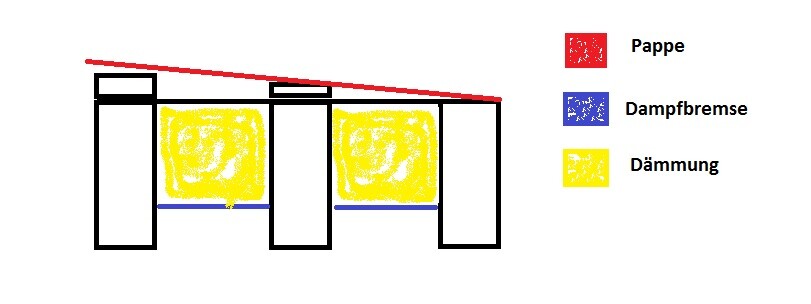
The roofing company I liked best wants to carry it out as shown in the picture.
This way, I can install the insulation myself.
Due to regulations at home, the rafters must remain visible.
With tapered insulation, the beams would be fully visible.
With the roofer’s idea, 10cm (4 inches) would remain visible. (I actually like this idea quite a lot.)
Would such a construction be acceptable? The vapor retarder worries me a little since I can only install it between the rafters and then have to stick the membrane onto the rafters.
It is 7.5m wide and 5m long (24.6 ft by 16.4 ft).
Now we are looking for a roofer (much too late).
We have already had a few here... and everyone tells a different story about the vapor retarder and insulation.
At first, I thought about using tapered insulation, but every roofer told me it would be too expensive.
The roofing company I liked best wants to carry it out as shown in the picture.
This way, I can install the insulation myself.
Due to regulations at home, the rafters must remain visible.
With tapered insulation, the beams would be fully visible.
With the roofer’s idea, 10cm (4 inches) would remain visible. (I actually like this idea quite a lot.)
Would such a construction be acceptable? The vapor retarder worries me a little since I can only install it between the rafters and then have to stick the membrane onto the rafters.
And what goes underneath the insulation? Or do you always want to look at the vapor barrier?
Proper insulation looks different to me, but everyone has to decide for themselves. This way, the insulation remains weak, and not much of the rafters is visible either. What is the argument against using insulating sheathing above the rafters?
Proper insulation looks different to me, but everyone has to decide for themselves. This way, the insulation remains weak, and not much of the rafters is visible either. What is the argument against using insulating sheathing above the rafters?
According to all the roofers, this would be way too expensive. As a roofing layman, I have to take their word for it…
Attached is our drawing. The engineer said he sized the beams generously.
20x8cm (8x3 inches)
The 5-meter (16.4 feet) sides are 40cm (16 inches) higher than the brick wall and 28cm (11 inches) at the front.
The 20x8cm (8x3 inches) rafters should rest on the wall.
Then, starting from the front with a 2% slope insulation, 8cm (3 inches) thick, extending to the old building.
The gutter should run along the entire front side.
If the beams are generously sized according to the engineer, couldn’t 15x8cm (6x3 inches) rafters also be used?
On top of these, a regular insulation above the rafters of 10cm (4 inches) PIR, and then a battens system to create the 2% slope.
Since our house is very old, built in 1938, the entire insulation (cavity wall insulation) is not as thick as in modern houses. That is why I believe/ed starting with 8cm (3 inches) slope insulation is completely sufficient.
Attached is our drawing. The engineer said he sized the beams generously.
20x8cm (8x3 inches)
The 5-meter (16.4 feet) sides are 40cm (16 inches) higher than the brick wall and 28cm (11 inches) at the front.
The 20x8cm (8x3 inches) rafters should rest on the wall.
Then, starting from the front with a 2% slope insulation, 8cm (3 inches) thick, extending to the old building.
The gutter should run along the entire front side.
If the beams are generously sized according to the engineer, couldn’t 15x8cm (6x3 inches) rafters also be used?
On top of these, a regular insulation above the rafters of 10cm (4 inches) PIR, and then a battens system to create the 2% slope.
Since our house is very old, built in 1938, the entire insulation (cavity wall insulation) is not as thick as in modern houses. That is why I believe/ed starting with 8cm (3 inches) slope insulation is completely sufficient.
Schmello schrieb:
Since our house is very old—built in 1938—the cavity wall insulation is not as thick as in modern houses. That’s why I thought starting with 8cm (3 inches) of tapered insulation would be completely sufficient.Well, just because the rest of the house has poor insulation doesn’t mean you have to accept that here as well. However, I would also say that insulation above the rafters is a simple, effective, and cost-efficient option. I don’t really understand where the huge cost factor is supposed to be.
The company is coming by again today...
Does anyone have experience with structural engineering and can confirm that 15x8 rafters would be sufficient...
10cm (4 inches) PIR insulation...
And is the slope created using battens?
The company said the first time that sloped insulation costs almost 2000 euros more because it has to be custom-made for the roof.
Does anyone have experience with structural engineering and can confirm that 15x8 rafters would be sufficient...
10cm (4 inches) PIR insulation...
And is the slope created using battens?
The company said the first time that sloped insulation costs almost 2000 euros more because it has to be custom-made for the roof.
G
garfunkel20 Jul 2016 00:01External roof insulation and rigid foam require careful consideration regarding sound insulation! Don’t forget the local conditions. PUR or PIR insulation hardly reduces noise at all.
I’m not referring to rain or similar sounds, but more to traffic noise or other sources.
This might not apply to your case, but it could. Therefore, it is advisable to find out in advance what to expect. You don’t want to run into problems later.
I also can’t imagine that external roof insulation will be much more expensive. Since the rafters are visible and planed anyway, only the boarding would need to be planed, resulting in a slightly different roof assembly. However, the cost difference shouldn’t be that significant.
Regarding insulation with a vapor retarder: I’ve practically stopped dealing with that topic myself. It’s possible to do, but please have a professional guide you briefly on how and what needs to be done. Otherwise, it can become quite frustrating. 🙂
For that reason alone, I would recommend insulating from the outside as much as possible. It’s simply less stressful.
I’m not referring to rain or similar sounds, but more to traffic noise or other sources.
This might not apply to your case, but it could. Therefore, it is advisable to find out in advance what to expect. You don’t want to run into problems later.
I also can’t imagine that external roof insulation will be much more expensive. Since the rafters are visible and planed anyway, only the boarding would need to be planed, resulting in a slightly different roof assembly. However, the cost difference shouldn’t be that significant.
Regarding insulation with a vapor retarder: I’ve practically stopped dealing with that topic myself. It’s possible to do, but please have a professional guide you briefly on how and what needs to be done. Otherwise, it can become quite frustrating. 🙂
For that reason alone, I would recommend insulating from the outside as much as possible. It’s simply less stressful.
Similar topics