
ᐅ Fencing in Rhineland-Palatinate: Is a small fence allowed on private property?
Created on: 28 Jun 2023 15:05
K
kati1337
Hello,
I have reviewed our development plan, and there is no mention of fencing. I have now contacted the local authority again and am waiting for a response regarding any special regulations, but as far as I can tell, the general law of Rhineland-Palatinate applies. So far, I haven’t found much except: If a neighbor has a justified reason, you must fence; otherwise, you may fence but only on your own property, unless you agree to place it on the boundary.
I personally don’t insist on a fence directly on the boundary. I would like to fence at my own expense and not too high—1.2 meters (4 feet) would be fine if necessary. My main concern is simply to know where our property ends and how far we can plant things.
Now, in the building regulations of Rhineland-Palatinate, I found only this:
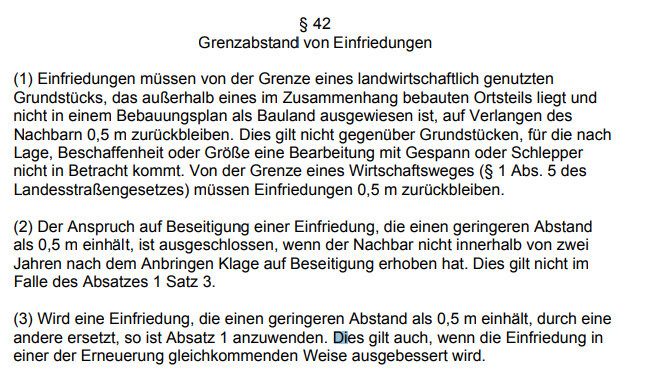
Am I right in understanding that this applies only if we border agricultural land? What distance do we need to keep from the boundary with our 1.20-meter (4 feet) fence? Could we also build a 1.80-meter (6 feet) fence? The text says this:

I don’t think anything special is considered “customary” here. Some neighbors have welded mesh panel fences; others have chain-link fences.
Last but not least: What would be an affordable way to build a permanent fence? I find welded mesh panels (without those terrible plastic parts) quite acceptable visually. Chain-link fences are a bit old-fashioned, but I could also live with that. I would plant vegetation in front anyway, so the look is not very important to me. It just shouldn’t cost an arm and a leg.
I have reviewed our development plan, and there is no mention of fencing. I have now contacted the local authority again and am waiting for a response regarding any special regulations, but as far as I can tell, the general law of Rhineland-Palatinate applies. So far, I haven’t found much except: If a neighbor has a justified reason, you must fence; otherwise, you may fence but only on your own property, unless you agree to place it on the boundary.
I personally don’t insist on a fence directly on the boundary. I would like to fence at my own expense and not too high—1.2 meters (4 feet) would be fine if necessary. My main concern is simply to know where our property ends and how far we can plant things.
Now, in the building regulations of Rhineland-Palatinate, I found only this:
Am I right in understanding that this applies only if we border agricultural land? What distance do we need to keep from the boundary with our 1.20-meter (4 feet) fence? Could we also build a 1.80-meter (6 feet) fence? The text says this:
I don’t think anything special is considered “customary” here. Some neighbors have welded mesh panel fences; others have chain-link fences.
Last but not least: What would be an affordable way to build a permanent fence? I find welded mesh panels (without those terrible plastic parts) quite acceptable visually. Chain-link fences are a bit old-fashioned, but I could also live with that. I would plant vegetation in front anyway, so the look is not very important to me. It just shouldn’t cost an arm and a leg.
W
WilderSueden1 Jul 2023 18:14By “ready-mix concrete,” I meant the pre-mixed variety. Ready-mixed concrete is more suitable for larger projects. There are various calculators available where you can estimate the savings from mixing your own concrete. Of course, if you need to rent a machine, at some point it’s no longer cost-effective. But there’s likely a neighbor in the new development who has one. On the other hand, you don’t really want to mix mortar for 20 fence post holes without a mortar mixer.
I don’t understand why that would be discouraging. It’s a great opportunity to learn something new. And when it comes to concrete for a fence post, you really can’t go wrong—any mix will hold up. Over the past few months, I’ve done many things I had never tried before: operating an excavator, building a 5m (16 feet) swing, constructing a dry-stone wall, bonding XPS foam with PU foam, and installing window sills. There are instructions for everything. Of course, I made mistakes along the way, but that’s not a problem. You can choose projects that are forgiving of errors.
I don’t understand why that would be discouraging. It’s a great opportunity to learn something new. And when it comes to concrete for a fence post, you really can’t go wrong—any mix will hold up. Over the past few months, I’ve done many things I had never tried before: operating an excavator, building a 5m (16 feet) swing, constructing a dry-stone wall, bonding XPS foam with PU foam, and installing window sills. There are instructions for everything. Of course, I made mistakes along the way, but that’s not a problem. You can choose projects that are forgiving of errors.

WilderSueden schrieb:
I don’t understand what’s demotivating about it? It’s a great opportunity to learn something new. Actually, mostly the fear of not being able to manage it. Having a proper fence is quite important to me.
But I think I will also start some DIY projects in the new garden. I’ve decided to build a sandbox and a raised bed =)
M
motorradsilke1 Jul 2023 19:11WilderSueden schrieb:
A 25kg (55lb) bag yields about 12 liters (0.4 cubic feet) of concrete. That means with a 30cm (12 inch) diameter and 30cm (12 inch) depth, you’ve already used 2 bags. Then it’s better if only a small dog runs into it, especially with your sandy soil 😉
That’s why I wrote to include old stones. There’s plenty of leftover material from house construction that you can set aside for this. Fieldstones also work.
Then 2 bags are enough 😉
@kati1337: Just trust yourself for once. We’ve all started somewhere. And here you can ask specific questions, or look online—today there are instructions for everything—or ask your neighbor.

For the driven sleeves, it’s best to use a driving aid. Then hit it with a heavy hammer (rubber mallet or club hammer) and check the plumb every two strikes. You don’t have to overdo it, since the post can still be adjusted slightly afterward.
We have somewhat sandy soil. Even so, we concreted every other sleeve. Here, you need to be more careful with the plumb. It’s best to screw the post into the sleeve beforehand, so you have a longer reference for the plumb. There are practical post levels that you can attach to the post with a rubber strap; they have a bubble level on two edges.
There is also concrete that basically comes ready to use—you just pour it. It’s the most expensive option, but it really simplifies the process.
At the road, I unintentionally made things hardest for myself because I planned to use screw-on sleeves there. That is a lot of work and allows for more errors. So for the shed, terrace, and carport, I will embed H-shaped anchors in concrete from the start. It’s easier, and you don’t have to get the foundation perfectly plumb and level yourself.
We have somewhat sandy soil. Even so, we concreted every other sleeve. Here, you need to be more careful with the plumb. It’s best to screw the post into the sleeve beforehand, so you have a longer reference for the plumb. There are practical post levels that you can attach to the post with a rubber strap; they have a bubble level on two edges.
There is also concrete that basically comes ready to use—you just pour it. It’s the most expensive option, but it really simplifies the process.
At the road, I unintentionally made things hardest for myself because I planned to use screw-on sleeves there. That is a lot of work and allows for more errors. So for the shed, terrace, and carport, I will embed H-shaped anchors in concrete from the start. It’s easier, and you don’t have to get the foundation perfectly plumb and level yourself.
W
WilderSueden1 Jul 2023 19:35kati1337 schrieb:
Actually, what I fear most is not being able to manage it.
The enclosure is quite important to me; I want it to be done properly. If in doubt, out of 20 posts, 10 might be slightly off. It’s not the end of the world 😉
Maybe you have someone in your family or circle of friends who has done something like this and can help a bit. Once the first post is set together, and the next two are installed under supervision, the rest probably won’t be that difficult.
 ateliersiegel1 Jul 2023 19:44
Were "screw foundations" already discussed?
I have only installed one myself as a test, and it went quite well.
Others complained that it doesn’t work at all – a single stone and everything becomes uneven, if it even goes in.
So, test first...
I have only installed one myself as a test, and it went quite well.
Others complained that it doesn’t work at all – a single stone and everything becomes uneven, if it even goes in.
So, test first...
Similar topics