
ᐅ Fencing in Rhineland-Palatinate: Is a small fence allowed on private property?
Created on: 28 Jun 2023 15:05
K
kati1337
Hello,
I have reviewed our development plan, and there is no mention of fencing. I have now contacted the local authority again and am waiting for a response regarding any special regulations, but as far as I can tell, the general law of Rhineland-Palatinate applies. So far, I haven’t found much except: If a neighbor has a justified reason, you must fence; otherwise, you may fence but only on your own property, unless you agree to place it on the boundary.
I personally don’t insist on a fence directly on the boundary. I would like to fence at my own expense and not too high—1.2 meters (4 feet) would be fine if necessary. My main concern is simply to know where our property ends and how far we can plant things.
Now, in the building regulations of Rhineland-Palatinate, I found only this:
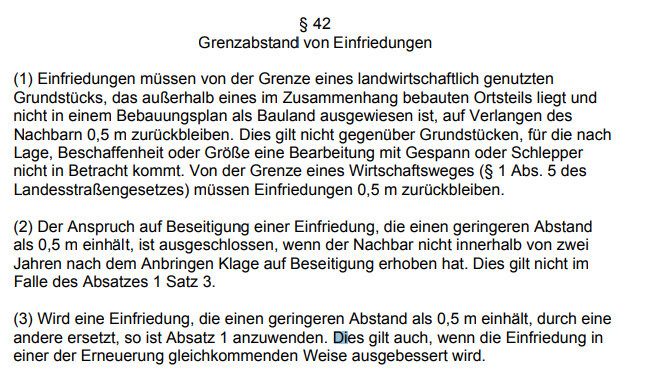
Am I right in understanding that this applies only if we border agricultural land? What distance do we need to keep from the boundary with our 1.20-meter (4 feet) fence? Could we also build a 1.80-meter (6 feet) fence? The text says this:

I don’t think anything special is considered “customary” here. Some neighbors have welded mesh panel fences; others have chain-link fences.
Last but not least: What would be an affordable way to build a permanent fence? I find welded mesh panels (without those terrible plastic parts) quite acceptable visually. Chain-link fences are a bit old-fashioned, but I could also live with that. I would plant vegetation in front anyway, so the look is not very important to me. It just shouldn’t cost an arm and a leg.
I have reviewed our development plan, and there is no mention of fencing. I have now contacted the local authority again and am waiting for a response regarding any special regulations, but as far as I can tell, the general law of Rhineland-Palatinate applies. So far, I haven’t found much except: If a neighbor has a justified reason, you must fence; otherwise, you may fence but only on your own property, unless you agree to place it on the boundary.
I personally don’t insist on a fence directly on the boundary. I would like to fence at my own expense and not too high—1.2 meters (4 feet) would be fine if necessary. My main concern is simply to know where our property ends and how far we can plant things.
Now, in the building regulations of Rhineland-Palatinate, I found only this:
Am I right in understanding that this applies only if we border agricultural land? What distance do we need to keep from the boundary with our 1.20-meter (4 feet) fence? Could we also build a 1.80-meter (6 feet) fence? The text says this:
I don’t think anything special is considered “customary” here. Some neighbors have welded mesh panel fences; others have chain-link fences.
Last but not least: What would be an affordable way to build a permanent fence? I find welded mesh panels (without those terrible plastic parts) quite acceptable visually. Chain-link fences are a bit old-fashioned, but I could also live with that. I would plant vegetation in front anyway, so the look is not very important to me. It just shouldn’t cost an arm and a leg.
M
motorradsilke30 Jun 2023 22:17kati1337 schrieb:
How much does something like this cost?
Setting wooden posts yourself also means you have to make concrete and set the posts straight, right?Ready-mix concrete is available at hardware stores; you just need to add water. Alternatively, you can have gravel delivered and buy some bags of cement to mix it yourself. Almost anyone can get the posts straight using a few strings and a spirit level.W
WilderSueden30 Jun 2023 22:33I would definitely mix the concrete myself. Ready-mix bags are extremely expensive if you want to concrete more than just a small hole. Alternatively, use post anchors driven into the ground—chain link fences don’t experience much wind load anyway. Plus, you won’t end up with a lot of concrete in your garden that requires complex removal later.
M
motorradsilke1 Jul 2023 08:29WilderSueden schrieb:
I would definitely mix the concrete yourself. Ready-mixed bags are really expensive if you want to pour more than just a small hole. Alternatively, you can use driven ground sleeves, since a chain-link fence doesn’t have much wind load. Plus, you end up with less concrete in the garden afterward, which can be difficult to remove. I mix it myself too. But I also have a trailer and get the gravel from a company 3 meters (10 feet) away.
If you have to get gravel delivered, it’s not worth it if you only want to pour a few holes. At Hornbach, a sack of ready-mixed concrete costs €5.75, and you’d need one or two per fence post hole if you add some old stones as filler. You have to calculate it yourself.
Driven ground sleeves don’t work in every type of soil either. Here, on our sandy soil, you can lever them out by hand if you’re unlucky. And a fence doesn’t just have to withstand wind load – occasionally a child or a dog might run into it as well.
W
WilderSueden1 Jul 2023 13:10In the new development area, there is probably someone who rents out their trailer cheaply. Depending on other projects (or together with a neighbor), it might also make sense to have a full 3-axle load delivered. Maybe there’s also a swing set for embedding, curbstones, etc.
A 25kg (55 lb) bag yields about 12 liters (3 gallons) of concrete. This means that with a diameter of 30cm (12 inches) and a depth of 30cm (12 inches), you’ve already used 2 bags. Better for only a small dog to bump into it on your sandy soil 😉
I would rather use 3 bags per hole. That adds up to approximately 1.5 to 2 pallets of ready-mix concrete for 20 to 30 holes.
A 25kg (55 lb) bag yields about 12 liters (3 gallons) of concrete. This means that with a diameter of 30cm (12 inches) and a depth of 30cm (12 inches), you’ve already used 2 bags. Better for only a small dog to bump into it on your sandy soil 😉
I would rather use 3 bags per hole. That adds up to approximately 1.5 to 2 pallets of ready-mix concrete for 20 to 30 holes.

The problem with ready-mix concrete is that you can’t work with it that quickly, even with two people. With bags, you can fill one hole after another.
Of course, if you have six or more people, you could do something like a fence line on a Saturday – oh wait, the concrete plant isn’t open on Saturdays.
No, for DIY work the bags are definitely more practical.
You can also mix it yourself with cement and sand. I’m doing that right now because I still have a lot of sand left over. But it is definitely more work. You would have to calculate how much you save. Roughly, one bag of cement can make four to five times as much ready-mix concrete. It costs about two thirds as much. So for the same money, you still get three times more material. But then you also need gravel. No idea what that costs right now – maybe 20 EUR per cubic meter (about 27 US gallons) with delivery? So that’s negligible. You have to consider whether you want to save around 150 EUR (about 160 USD) per cubic meter but have 30% more work.
There is one advantage to mixing it yourself. You can adjust the mixture—more cement or less cement depending on the area of use.
Of course, if you have six or more people, you could do something like a fence line on a Saturday – oh wait, the concrete plant isn’t open on Saturdays.
No, for DIY work the bags are definitely more practical.
You can also mix it yourself with cement and sand. I’m doing that right now because I still have a lot of sand left over. But it is definitely more work. You would have to calculate how much you save. Roughly, one bag of cement can make four to five times as much ready-mix concrete. It costs about two thirds as much. So for the same money, you still get three times more material. But then you also need gravel. No idea what that costs right now – maybe 20 EUR per cubic meter (about 27 US gallons) with delivery? So that’s negligible. You have to consider whether you want to save around 150 EUR (about 160 USD) per cubic meter but have 30% more work.
There is one advantage to mixing it yourself. You can adjust the mixture—more cement or less cement depending on the area of use.

After reading the 5-6 posts about concrete and cement, I’m already feeling too discouraged to do anything myself. I didn’t even know that cement and concrete are different things, let alone that one can be mixed from the other. ^^
I might consider the driven ground sleeves, although I’m not sure if I’d be able to install them properly. I’ll get some other quotes from fence installers.
Wire mesh panels aren’t really a visual highlight for me either, but as someone mentioned before: it’s a compromise between price and durability.
I might consider the driven ground sleeves, although I’m not sure if I’d be able to install them properly. I’ll get some other quotes from fence installers.
Wire mesh panels aren’t really a visual highlight for me either, but as someone mentioned before: it’s a compromise between price and durability.
Similar topics