
ᐅ Extend the drinking water service chamber by adding a support ring
Created on: 25 Mar 2024 15:50
V
vaderleHello everyone,
My driveway project also involves raising the existing potable water handover manhole. It is one of those concrete handover manholes with a fixed ladder. On top, there is a sturdy manhole cover. Inside the manhole, the house's drinking water connection is connected to the water utility’s supply line. The manhole is closed at the bottom. There are already two concrete support rings placed on top of the manhole.
The desired height increase is about 13 cm (5 inches) to match the level of the upcoming driveway.
My questions:
I noticed that the two existing support rings are simply placed on top of the manhole. It seems there is no cement mortar applied between the layers, nor are the joints plastered with cement mortar. Is this correct? After the winter, I found about 3 cm (1 inch) of water inside the manhole. It must have entered either at the cover or at the joints where ring meets ring. Since I have already exposed the manhole enough to remove the two existing rings, I plan to add cement mortar and lay the additional ring on top also in cement mortar. With an additional 10 cm (4 inches) ring plus mortar at the four connection points, I should reach the 13 cm (5 inches) height. Or would an 8 cm (3 inch) ring be better, since the mortar adds some height?
Should I prime the concrete parts beforehand to ensure the cement mortar bonds and holds well? Do you usually use ordinary cement mortar, or does it need to be a special type?
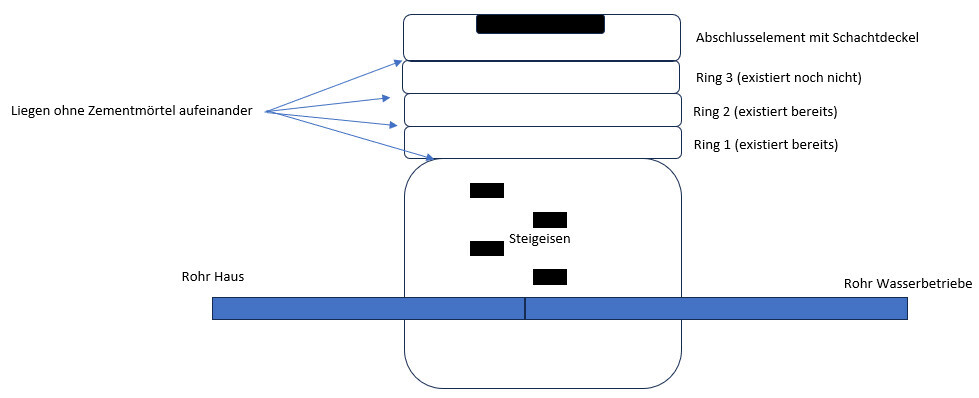
Before closing everything again with reinforced concrete material (I have exposed the manhole down to ring 1), I am considering wrapping a dimpled membrane around the outside to provide additional waterproofing. Does that make sense?
My driveway project also involves raising the existing potable water handover manhole. It is one of those concrete handover manholes with a fixed ladder. On top, there is a sturdy manhole cover. Inside the manhole, the house's drinking water connection is connected to the water utility’s supply line. The manhole is closed at the bottom. There are already two concrete support rings placed on top of the manhole.
The desired height increase is about 13 cm (5 inches) to match the level of the upcoming driveway.
My questions:
I noticed that the two existing support rings are simply placed on top of the manhole. It seems there is no cement mortar applied between the layers, nor are the joints plastered with cement mortar. Is this correct? After the winter, I found about 3 cm (1 inch) of water inside the manhole. It must have entered either at the cover or at the joints where ring meets ring. Since I have already exposed the manhole enough to remove the two existing rings, I plan to add cement mortar and lay the additional ring on top also in cement mortar. With an additional 10 cm (4 inches) ring plus mortar at the four connection points, I should reach the 13 cm (5 inches) height. Or would an 8 cm (3 inch) ring be better, since the mortar adds some height?
Should I prime the concrete parts beforehand to ensure the cement mortar bonds and holds well? Do you usually use ordinary cement mortar, or does it need to be a special type?
Before closing everything again with reinforced concrete material (I have exposed the manhole down to ring 1), I am considering wrapping a dimpled membrane around the outside to provide additional waterproofing. Does that make sense?
W
WilderSueden25 Mar 2024 20:34I would use well foam. Just spray it once, place the ring, and you’re done. It’s reasonably waterproof as well. If you have gravel around it, there shouldn’t be any standing water.
I would choose mortar if your driveway has a slope. Then mortar the ring so that it sits exactly level with the paving surface. Don’t set the shaft level and the driveway with a slope—that looks bad.
I would choose mortar if your driveway has a slope. Then mortar the ring so that it sits exactly level with the paving surface. Don’t set the shaft level and the driveway with a slope—that looks bad.

You can’t achieve a 100% seal because the lid just rests on top (and it’s only supposed to rest on top). The shaft should have a pump sump anyway. So, having water inside that you need to pump out regularly is normal.
So, just reduce the critical alert levels by two steps.
I think we currently have about 10cm (4 inches) of water at the bottom.
So, just reduce the critical alert levels by two steps.
I think we currently have about 10cm (4 inches) of water at the bottom.
N
nordanney25 Mar 2024 23:54And otherwise, just use a self-adhesive butyl/rubber/EPDM sealing tape around the outside. It won't get any more watertight than that (once you have already glued or mortared it).
Similar topics