
Hello,
I have a question for the group! It concerns a soil report that presents two options for securing the basement against moisture intrusion. I have attached the soil report.
My question relates to the alternative involving the “white tank” (watertight concrete structure), which was also installed in our case. Do I understand correctly from the soil report that if I build a white tank, the backfilling up to the planned ground level must be done either with granular soil (sands, gravel, etc.) or with drainage boards installed against the basement walls? And what is meant by the final remark that "a natural runoff for the retained water is provided"?
Some background: I insisted on installing a drainage system since we have a sloped plot, even though my construction manager and basement contractor said it was technically unnecessary. The basement was backfilled with a silty-clayey/sandy soil mixture. Drainage boards were not installed against the basement walls. Additionally, a coconut fiber-wrapped drainage pipe without inspection chambers was installed at the corners of the house. An expert criticized that the drainage was not installed according to DIN 4095 (German standard for drainage). As a result, I had the drainage removed, which caused additional costs of about €15,000 for disposing of the uncompacted soil and the new filling sand. Now the construction manager and basement contractor argue that the drainage was not necessary according to the report. But that would only be true if either the appropriate granular soil or drainage boards were installed exclusively. Or am I misunderstanding the passage in the soil report?
Since neither exclusively granular soil nor drainage boards were installed, doesn’t this represent a planning error on the part of the construction management or basement company? Also, the drainage was technically installed incorrectly. It would be great if you could help shed some light on this rather complicated situation.
Best regards
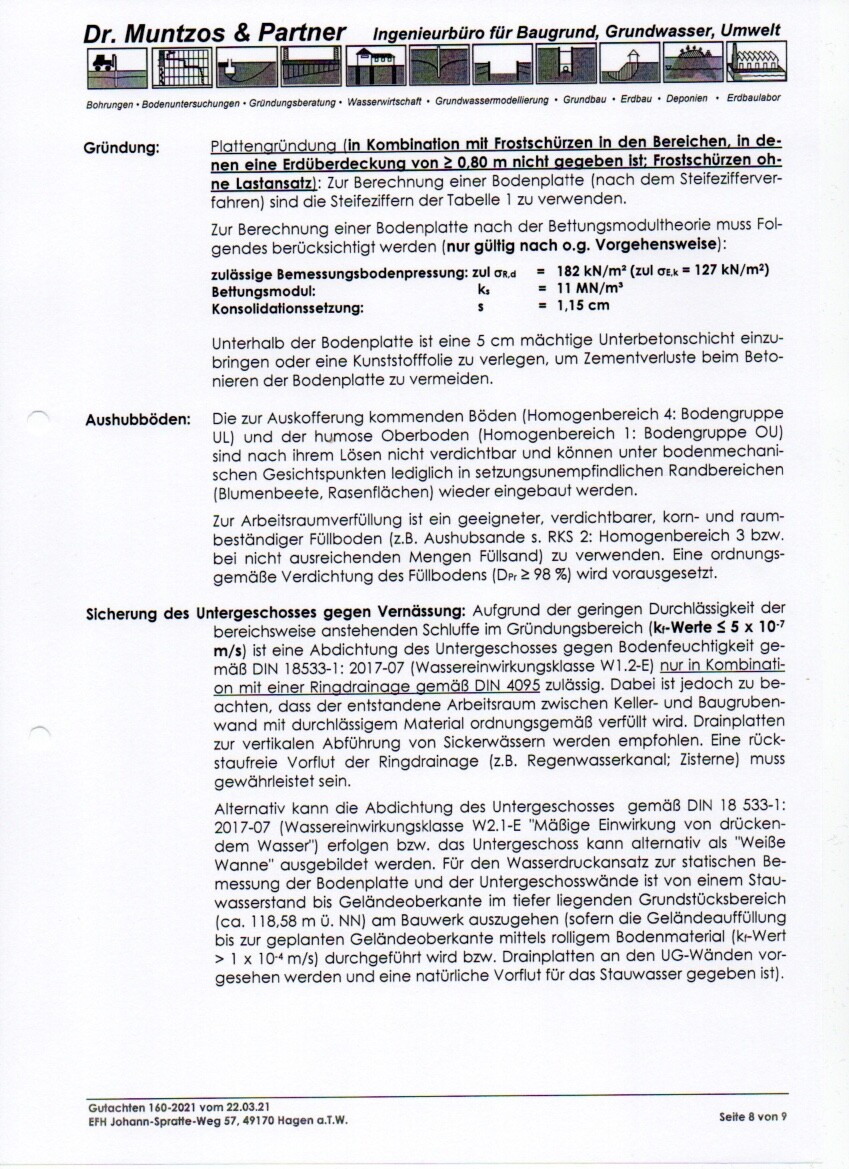
I have a question for the group! It concerns a soil report that presents two options for securing the basement against moisture intrusion. I have attached the soil report.
My question relates to the alternative involving the “white tank” (watertight concrete structure), which was also installed in our case. Do I understand correctly from the soil report that if I build a white tank, the backfilling up to the planned ground level must be done either with granular soil (sands, gravel, etc.) or with drainage boards installed against the basement walls? And what is meant by the final remark that "a natural runoff for the retained water is provided"?
Some background: I insisted on installing a drainage system since we have a sloped plot, even though my construction manager and basement contractor said it was technically unnecessary. The basement was backfilled with a silty-clayey/sandy soil mixture. Drainage boards were not installed against the basement walls. Additionally, a coconut fiber-wrapped drainage pipe without inspection chambers was installed at the corners of the house. An expert criticized that the drainage was not installed according to DIN 4095 (German standard for drainage). As a result, I had the drainage removed, which caused additional costs of about €15,000 for disposing of the uncompacted soil and the new filling sand. Now the construction manager and basement contractor argue that the drainage was not necessary according to the report. But that would only be true if either the appropriate granular soil or drainage boards were installed exclusively. Or am I misunderstanding the passage in the soil report?
Since neither exclusively granular soil nor drainage boards were installed, doesn’t this represent a planning error on the part of the construction management or basement company? Also, the drainage was technically installed incorrectly. It would be great if you could help shed some light on this rather complicated situation.
Best regards
B
Benutzer 100121 Oct 2022 20:37Isn't it already a defect that the cavity is not filled with compactible material?
D
DaniMartinez21 Oct 2022 21:26Cronos86 schrieb:
That’s right, you ordered a service and should be able to expect that performance. As far as I know, in such cases the defect must be reported to the contractor and they should be given the opportunity to rectify it.
At this point, I would recommend discussing the issue with the construction company and seeking legal advice.I informed the construction company of the defect, set a deadline, and requested repairs. The company responded that “they will only cover the excavation costs for the digging, but cannot understand why a drainage system, which is not officially approved but still works, should be removed. They will not contribute to the additional costs (soil disposal, new fill sand, etc.)!”
The good news is that an independent expert also identified and documented the defect. I presented the expert report and the defect to the company, but they insist on their previously mentioned position. The site manager and the basement contractor work together on many projects and both argue the same way.
The site manager stated that removing this well-functioning drainage system would not be proportional.
Honestly, I don’t know what else to say when even an expert report is being dismissed. Is taking the unpleasant step of involving a lawyer the last option?
W
WilderSueden21 Oct 2022 22:44How are you planning to build? Turnkey with a general contractor who also handles the basement and earthworks, or by contracting individually, possibly awarding the basement and earthworks separately yourself?
With turnkey contracts, you have relatively few options during the construction phase since the full service is due only upon handover. Retaining payment due to defects is therefore difficult. In this case, you can only document the defects, point them out again, and at handover either refuse acceptance of the defective parts or have the defects recorded in the acceptance report.
If you have contracted these works yourself, it’s easier because the service must already be delivered without defects. Then you should consult a lawyer to clarify how you can securely withhold payment.
With turnkey contracts, you have relatively few options during the construction phase since the full service is due only upon handover. Retaining payment due to defects is therefore difficult. In this case, you can only document the defects, point them out again, and at handover either refuse acceptance of the defective parts or have the defects recorded in the acceptance report.
If you have contracted these works yourself, it’s easier because the service must already be delivered without defects. Then you should consult a lawyer to clarify how you can securely withhold payment.
D
DaniMartinez22 Oct 2022 09:37Hi
Hi, we worked with separate contracts! I guess I’ll contact my lawyer then! Thanks ☺️
WilderSueden schrieb:
How are you building? Turnkey with a general contractor who also handles the basement and groundwork, or are you contracting those separately yourself?
With turnkey, you have relatively little control during the construction phase since the full scope of work is only due upon handover. Retaining payment due to defects is also difficult. You can only document the defects, notify the contractor again, and then refuse to accept the defective parts at handover or have them noted as defective in the acceptance report.
If you have contracted these works separately yourself, it’s easier because the work must be completed without defects at this point. Then you should consult a lawyer to determine how to securely withhold payment.
Hi, we worked with separate contracts! I guess I’ll contact my lawyer then! Thanks ☺️
You really wanted a drainage system that isn’t necessary, and the contractor is thinking: what nonsense – well, I’ll just throw in a pipe and that’ll keep him happy.
You could also just leave the pipe there (it doesn’t cause any problems) and not pay for the drainage. Wouldn’t that be an option?
You could also just leave the pipe there (it doesn’t cause any problems) and not pay for the drainage. Wouldn’t that be an option?
Similar topics