
D
DaniMartinez21 Oct 2022 09:50Hello,
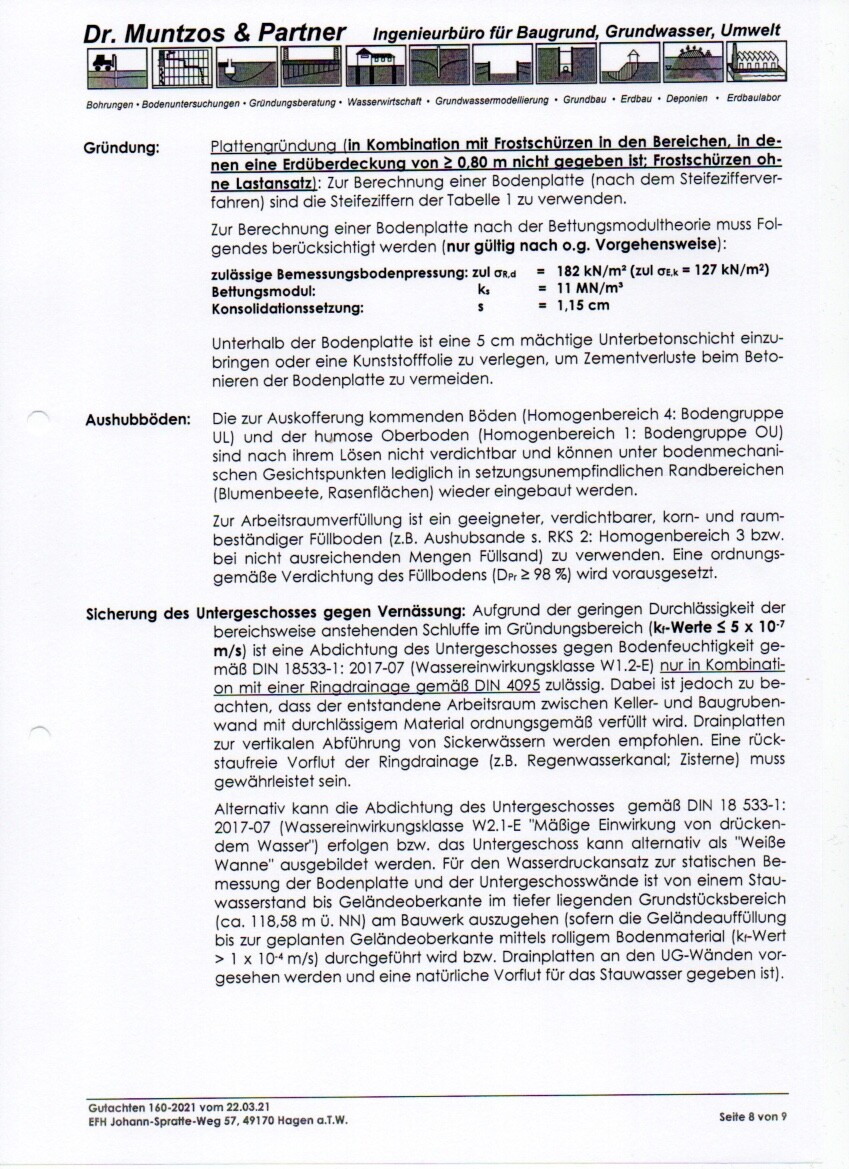
I have a question for the group! It concerns a soil report that presents two options for securing the basement against moisture intrusion. I have attached the soil report.
My question relates to the alternative involving the “white tank” (watertight concrete structure), which was also installed in our case. Do I understand correctly from the soil report that if I build a white tank, the backfilling up to the planned ground level must be done either with granular soil (sands, gravel, etc.) or with drainage boards installed against the basement walls? And what is meant by the final remark that "a natural runoff for the retained water is provided"?
Some background: I insisted on installing a drainage system since we have a sloped plot, even though my construction manager and basement contractor said it was technically unnecessary. The basement was backfilled with a silty-clayey/sandy soil mixture. Drainage boards were not installed against the basement walls. Additionally, a coconut fiber-wrapped drainage pipe without inspection chambers was installed at the corners of the house. An expert criticized that the drainage was not installed according to DIN 4095 (German standard for drainage). As a result, I had the drainage removed, which caused additional costs of about €15,000 for disposing of the uncompacted soil and the new filling sand. Now the construction manager and basement contractor argue that the drainage was not necessary according to the report. But that would only be true if either the appropriate granular soil or drainage boards were installed exclusively. Or am I misunderstanding the passage in the soil report?
Since neither exclusively granular soil nor drainage boards were installed, doesn’t this represent a planning error on the part of the construction management or basement company? Also, the drainage was technically installed incorrectly. It would be great if you could help shed some light on this rather complicated situation.
Best regards
I have a question for the group! It concerns a soil report that presents two options for securing the basement against moisture intrusion. I have attached the soil report.
My question relates to the alternative involving the “white tank” (watertight concrete structure), which was also installed in our case. Do I understand correctly from the soil report that if I build a white tank, the backfilling up to the planned ground level must be done either with granular soil (sands, gravel, etc.) or with drainage boards installed against the basement walls? And what is meant by the final remark that "a natural runoff for the retained water is provided"?
Some background: I insisted on installing a drainage system since we have a sloped plot, even though my construction manager and basement contractor said it was technically unnecessary. The basement was backfilled with a silty-clayey/sandy soil mixture. Drainage boards were not installed against the basement walls. Additionally, a coconut fiber-wrapped drainage pipe without inspection chambers was installed at the corners of the house. An expert criticized that the drainage was not installed according to DIN 4095 (German standard for drainage). As a result, I had the drainage removed, which caused additional costs of about €15,000 for disposing of the uncompacted soil and the new filling sand. Now the construction manager and basement contractor argue that the drainage was not necessary according to the report. But that would only be true if either the appropriate granular soil or drainage boards were installed exclusively. Or am I misunderstanding the passage in the soil report?
Since neither exclusively granular soil nor drainage boards were installed, doesn’t this represent a planning error on the part of the construction management or basement company? Also, the drainage was technically installed incorrectly. It would be great if you could help shed some light on this rather complicated situation.
Best regards
DaniMartinez schrieb:
Hello,
Some background. I insisted on installing drainage (we have a sloped lot), even though my site manager and basement contractor said that drainage was technically not necessary. The basement was backfilled with a silty-clayey/sandy soil mix. Drainage panels were not installed on the basement walls. Instead, a coconut-fiber wrapped drainage pipe was installed at the house corners, but without inspection chambers. An expert pointed out that the drainage was not executed according to DIN 4095.
I then had the drainage removed, which led to additional costs of about 15,000€ due to the disposal of uncompacted soil and the new backfill sand. The site manager and basement contractor now argue that according to the expert report, the drainage was not necessary. But that would only be true if either properly graded soil or drainage panels had been installed. Or am I misunderstanding that passage in the soil report?
Since neither properly graded soil nor drainage panels were installed, this seems to be a planning error on the part of the site management or the basement contractor. Additionally, the drainage was technically installed incorrectly.
Regards Hello,
According to the soil report, there are two options:
1. Option:
Waterproofing according to W 1.2-E (soil moisture) but only with a perimeter drainage system according to DIN 4095. Additionally, the working space must be backfilled with well-draining material. Drainage mats are recommended as extra protection but are not mandatory. However, drainage and gravel are required!
2. Option:
Waterproofing according to W2.1-E (pressurized water) or waterproof concrete (e.g., a watertight concrete shell). No additional measures are needed here.
A watertight concrete shell can permanently withstand groundwater. Therefore, drainage is not necessary as the site manager and basement contractor stated. Also, neither well-draining material nor drainage mats are required.
Best regards
Oh, by the way: The lower paragraph concerning trapped water is relevant for structural engineering. It relates to the water pressure acting on the components in contact with the ground. This pressure can be reduced through additional measures. However, this concerns structural engineering and not waterproofing against groundwater.
Therefore, the more important question is what water pressure/earth pressure was considered in the structural calculations for the basement wall.
Therefore, the more important question is what water pressure/earth pressure was considered in the structural calculations for the basement wall.
D
DaniMartinez21 Oct 2022 19:28Cronos86 schrieb:
Hello,
according to the geotechnical report, there are two options:
1. Option:
Waterproofing according to W 1.2-E (soil moisture), but only with a perimeter drainage system according to DIN 4095. Additionally, the working space must be filled with well-draining material. Drainage mats are recommended as an extra protective measure, but they are not mandatory. However, the drainage system and gravel are required!
2. Option:
Waterproofing according to W2.1-E (pressing water) or waterproof concrete. In this case, no additional measures are necessary.
The waterproof concrete shell can stand permanently in groundwater. Therefore, as the site supervisor and basement builder have said, drainage is not necessary. Also, neither permeable material nor drainage mats are needed.
Regards Hey, thanks for your reply. 😀
Despite everything, the drainage was incorrectly installed from a technical standpoint (according to DIN 4095 no standard piping, the geotextile was not fully wrapped around the gravel bed, I didn’t have inspection chambers at the building corners, and the yellow perforated pipes were already partly clogged with 5cm (2 inches) of sediment).
Who is responsible for covering the additional costs if the drainage system needs to be dismantled? In my opinion, the site manager and the basement builder performed poorly, even though a drainage system isn’t strictly necessary. When I order a service, I expect professional workmanship. If everything had been done properly, there wouldn’t be any follow-up costs caused by faulty drainage. Or am I wrong?
That’s right, you have ordered a certain level of performance and should be able to expect it. As far as I know, in this case the defect must be reported to the contractor and the opportunity for remediation must be given.
At this point, I would recommend discussing the issue with the construction company and seeking legal advice.
At this point, I would recommend discussing the issue with the construction company and seeking legal advice.
W
WilderSueden21 Oct 2022 20:21Definitely get an expert involved if you haven’t done so already.
Similar topics